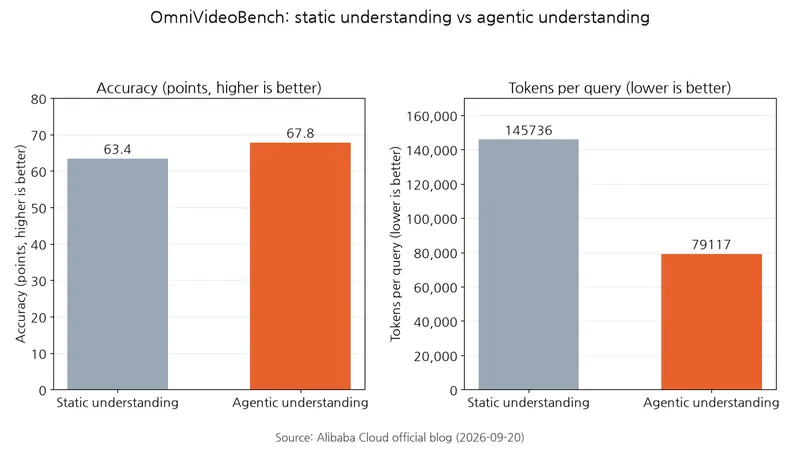
Alibaba Cloud unveiled Qwen3.8-Omni-Flash, an omnimodal model that handles multiple types of sensory information together. Alibaba Cloud compared static interpretation and agent mode on the same OmniVideoBench questions. Agent mode retains context, including prior conversation and task information, across turns. It raised accuracy from 63.4 to 67.8 and reduced token consumption per query from 145,736 to 79,117. The shift toward selecting segments instead of feeding in entire videos adds another option for video summarization pipelines, which link multiple processing stages.
Measurement method
Alibaba Cloud compared Qwen3.8-Omni-Flash and Gemini 3.8 Flash on OmniVideoBench and Video-MME-v2, standardized audio-video reasoning benchmarks, and LVOmniBench, a long-video reasoning benchmark.
Static is a mode in which the model interprets inputs directly. Agent mode uses the Qwen Code harness, a framework that coordinates execution, to plan questions and call tools. Gemini 3.8 Flash was tested in the same two configurations. Prices are based on the public price list for Model Studio's Singapore region. Hourly rates were calculated by multiplying the input cost of a 2-minute clip by 30. Video was calculated at 720p and 1 frame, an individual video image, per second.
Table: Static interpretation and agent-mode accuracy on three benchmarks
Conditions: Static interpretation and Qwen Code agent mode on all three benchmarks; identical conditions for Gemini 3.8 Flash; as reported by Alibaba Cloud
Unit: Points
| Benchmark (reasoning type) | Qwen3.8 static | Qwen3.8 agent | Gemini 3.8 static | Gemini 3.8 agent |
|---|---|---|---|---|
| OmniVideoBench (audio-video) | 63.4 | 67.8 | 65.2 | 70.1 |
| Video-MME-v2 (audio-video) | 65.0 | 71.3 | 71.0 | 72.7 |
| LVOmniBench (long video) | 63.3 | 73.6 | 70.7 | 70.7 |
Results
According to Alibaba Cloud's design description, agent mode selects which segments of long videos to watch and hear, spending its budget on relevant portions. The figures below are published benchmark results.
Table: OmniVideoBench static interpretation versus agentic understanding
Conditions: OmniVideoBench; Qwen3.8-Omni-Flash static interpretation versus agent mode; agent mode retains context across turns; as reported by Alibaba Cloud
| Metric | Static interpretation | Agentic understanding | Difference |
|---|---|---|---|
| Accuracy (↑) | 63.4 | 67.8 | +4.4 |
| Tokens per query (↓) | 145,736 | 79,117 | −45.7% |
Qwen3.8-Omni-Flash improved accuracy in agent mode on all three benchmarks. The gap varied by benchmark: the two models were nearly tied on Video-MME-v2, while only Qwen3.8-Omni-Flash improved notably on LVOmniBench. On OmniVideoBench, accuracy rose by 4.4 points and token consumption per query fell by about 45.7%.
Why the difference?
Alibaba Cloud attributes this difference to the agent design. Starting from a question, the agent chooses which segments to watch and hear, gathering evidence as it narrows from broad sections to finer details. The explanation is that it can spend its token budget on relevant segments without processing every frame.
Context supports this length. According to the documentation, the context length is 1M tokens, and text, images, audio, and video can be included in one request. Audio input is billed at 7 tokens per second.
Alibaba Cloud also disclosed an experiment to improve a smaller model. An agent was tasked with improving Sichuanese speech recognition in Qwen2.5-Omni-3B over 12 hours. It selected its own evaluation set, a collection of test problems, and generated 3,413 training samples across four experiments. On the same WenetSpeech-Chuan evaluation set, it reduced the character error rate, CER, from 25.79% to 15.30%. CER measures errors at the character level in recognized text.
According to Alibaba Cloud, the average score across 29 evaluations rose by more than 25% over Qwen3.5-Omni-Plus. In the same comparison, WildClawBench-MM rose by 36.5 points using the Claude Code harness. AgenticVBench rose by 22.3 points, LongAudioSpan by 8.3 points, and OmniCap-IF instruction compliance by 14.1 points. UniClawBench scored 69.6 using the OpenClaw harness. AliMeeting's diarization error rate, DER, which measures errors in distinguishing speakers, fell from 88.11 to 3.35.
Table: Model Studio Singapore region API price comparison
Conditions: Model Studio Singapore region public price list; Qwen3.8-Omni-Flash uses a single rate regardless of modality, the format in which input information is conveyed
Unit: USD / 1 million tokens
| Rate | Qwen3.8-Omni-Flash | Qwen3.5-Omni-Plus |
|---|---|---|
| Input text, images, video | 0.15 | 1.4 |
| Input audio | 0.15 | 11 |
| Output text | 0.47 | 8.3 |
According to Alibaba Cloud, the price per hour of audio input is more than 98% lower, and the price per hour of audio-video input is more than 93% lower.
Selection criteria
For long-video summarization and meeting analysis, use qwen3.8-omni-flash. It accepts audio in 113 languages and dialects and outputs text only. For speech output, use qwen3.5-omni-plus. It outputs speech in 29 languages and 7 dialects. For real-time voice and video conversation, use qwen3.8-omni-flash-realtime and Qwen-Live-Harness. Version v1.0.0 was released on September 21, 2026, and the desktop app requires macOS 12 or later and Node.js 22.13 or later. Alibaba Cloud measured text output at 83.00 tokens per second with 20 seconds of audio-video input. Time to the first text token was 981.01 milliseconds, and time to the first audio packet was 1350.49 milliseconds. The audio-generation real-time factor, RTF, the ratio of generation time to playback time, was 0.1528. Use Qwen-MM-Plugins' omni-video2note to turn local tutorial videos into illustrated PDF notes, or omni-skill-creator to turn demonstration videos into reusable Agent Skills. The installation script supports Claude Code, Codex, Qwen Code, Gemini CLI, and others. Use omni-chatcut for video production and omni-memory to build audiovisual memory for long videos.
If you run a long-video summarization pipeline, try the same question set with static interpretation and Qwen Code agent mode before switching models.