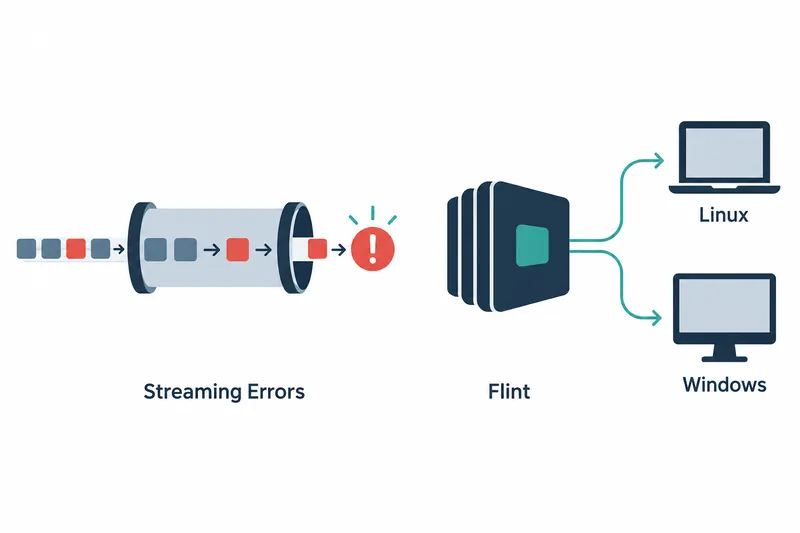
Ollama now reports generation failures that occur mid-response and lets Flint models run on Linux and Windows. Developers building live-response services can distinguish partial output from completed answers. Flint users gain more execution environment choices.
1. Responses now report failures after partial output
The release notes say streaming requests in OpenAI Responses and Anthropic Messages formats now report generation failures instead of ending silently after partial output. Previously, recipients could mistake the content already sent for a successful response. Failures can now be detected at the end of the stream.
In the Anthropic format, errors occurring after streaming begins are delivered as error events. Errors occurring before streaming begins are still handled as responses containing error details.
OpenAI Responses now emits the failure status event response.failed. The changed code also preserves previously generated partial output when generation ends in failure.
	response := anthropic.NewError(w.Status(), errData.Error)
	if w.stream && w.Written() {
		if err := w.writeEvent("error", anthropic.StreamErrorEvent{Type: response.Type, Error: response.Error}); err != nil {
			return 0, err
		}
		return len(data), nil
	}
This code is part of the Anthropic handling included in the full changelog. It checks whether response writing has already begun before sending an error event. Stream consumers must interpret the final failure event, not just display content fragments.
2. Passing cloud model information to coding tools
ollama launch now passes cloud models' context lengths and capabilities to coding tools. Context length is the amount of input a model can consider at once. The release notes say this corrects context and compaction settings. Compaction shortens long conversations so work can continue. Tools need to know the model's input limit to time it correctly.
The Claude Code integration applies the context length from model information to its settings and adjusts the automatic compaction threshold within a defined upper limit. Any threshold already set by the user is preserved. Users connecting cloud models to coding tools can check whether each model's input limit is reflected in the settings.
3. Flint execution expands to Linux and Windows
Ollama announced that Flint now runs on Linux and Windows as well as macOS. Users of these operating systems can therefore also choose to run the same model.
The full changelog also includes a fix that makes Flint generate responses directly when reasoning, the intermediate thinking process before answering, is disabled. The change description says prompts for the default settings and for reasoning-enabled use remain unchanged.
4. Follow-up search requests also use supported settings
Follow-up requests for Anthropic-compatible web search now reuse reasoning settings supported by the model. Settings adjusted for the initial request carry over to requests after a search. Ollama says this prevents avoidable failures.
While the streaming changes focus on notifying recipients of errors, this fix focuses on using appropriate settings for requests following a search. Both address errors, but one reports failures while the other aligns follow-up request settings.
5. Integration code handles partial output and final status together
Reporting streaming errors can reduce the risk of treating interrupted output as a completed answer. Integrations that previously consumed only successful output need to read failure events and notify users. Error handling becomes clearer, but managing state on the consuming side becomes more important.
0.40.9 improves integration accuracy and choice by clearly reporting streaming failures, passing cloud model information, and expanding Flint support.