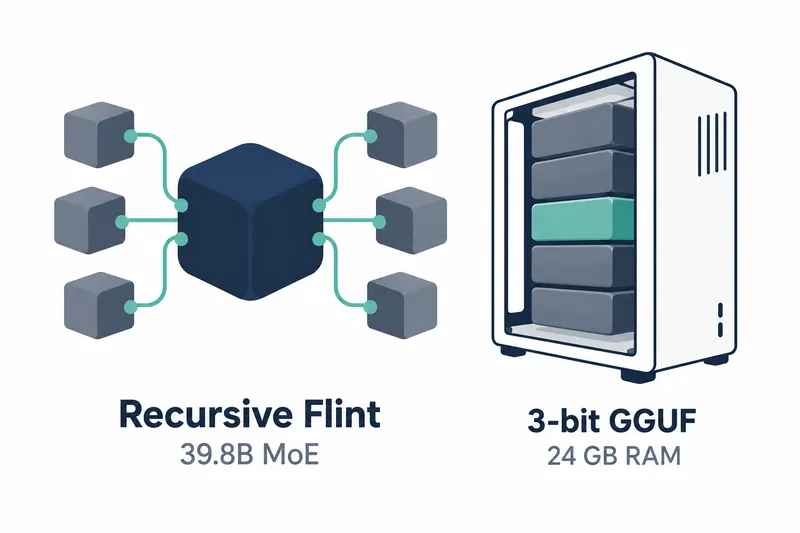
Unsloth released Recursive's coding agent model Flint, enabling developers to run a large model on their own computers instead of external servers. It says the 3-bit file runs with 24GB of memory at short contexts and provides instructions for connecting coding tools.
1. A model targeting code investigation through test writing
Unsloth introduced Flint support in its v0.1.910-beta release on October 23, 2026. Developed by Recursive, the model targets codebase investigation, bug fixes, feature implementation, and test writing. It supports reasoning through internal computation and repeated tool use. The documented context limit is 262,144 tokens, combining input and output.
The model has 39.8 billion parameters, the numerical values learned and stored during training, but activates about 2.5 billion per token. A mixture-of-experts architecture selects a subset of experts rather than computing the entire model each time. Flint uses 6 of 256 experts in each expert layer, plus an always-active shared expert.
2. A 3-bit file option for 24GB configurations
The 3-bit UD-Q3_K_XL file listed in Unsloth's documentation is 18.50GB. The company says it runs with 24GB of memory at short contexts. The same guide includes a memory recommendation table based on combined RAM and VRAM, or unified memory.
Table: Memory recommendations by quantization
Conditions: Flint hardware requirements table in Unsloth's documentation, based on RAM plus VRAM or unified memory
Unit: GB
| Quantization | Memory |
|---|---|
| 2-bit | 13–15 |
| 3-bit | 16–20 |
| 4-bit | 26 |
| 6-bit | 38 |
| 8-bit | 44 |
The table recommends 16–20GB for 3-bit, while the text describes running it in a 24GB configuration with a short context. Hardware selection should account for memory headroom to process conversations, not just space to hold the file.
3. Connecting a coding agent from the project folder
You can download and run the file through Unsloth Desktop's model hub or run it directly with llama.cpp. To connect a coding agent, install Unsloth and your chosen agent, then run the command from the project folder.
Below is the Claude Code integration example from the documentation. It uses a 25.05GB 4-bit file and allocates a larger context for coding, consuming more memory than the documented 8,000-token execution example.
unsloth start claude \
    --model unsloth/flint-GGUF:UD-Q4_K_XL \
    --temp 1.0 --top-p 0.95 --top-k 20 --min-p 0.0
4. Coding evaluation results for the original and compressed models
According to Recursive's announcement, the original BF16 model and the smaller NVFP4 model scored similarly on the three agent evaluations below. Agent scores average the single-attempt success rate across at least 5 attempts.
Table: Agent evaluations of the original and compressed Flint models
Conditions: Recursive's announcement; temperature 1.0, top-p 0.95, top-k 20. Terminal-Bench uses Terminus 2; SWE-bench uses mini-swe-agent. Mean pass@1 over at least 5 attempts; Terminal-Bench counts answers found via web search as failures.
Unit: %
| Model | Terminal-Bench 2.1 | SWE-bench Pro v2 | SWE-bench Verified |
|---|---|---|---|
| Flint BF16 | 54.9 | 89.7 | 74.2 |
| Flint NVFP4 | 53.7 | 88.5 | 74.1 |
The compressed model scored slightly below the original in all three evaluations. The compressed model in this table is NVFP4, while the 3-bit file for local execution is provided in GGUF format.
Unsloth's release also listed SWE-bench Pro v2 scores of 89.7 for Flint and 73.8 for Qwen 3.6.
5. Memory savings and the cost of longer tasks
The 3-bit file offers a way to reduce storage and memory demands when pairing a large model with a local agent. To benefit, start with a short context and budget operational costs by allowing memory headroom and inference time for longer coding tasks.
Unsloth reports throughput above 125 tokens per second on an M4 Pro MacBook Pro and above 150 tokens per second on an NVIDIA RTX Spark with 64GB of memory. Both figures are presented as execution examples for the respective devices in the documentation.
Competing model scores are developer-reported, with evaluation settings varying by source. The throughput figures above also lack accompanying quantization file and context conditions. The model card, a document covering usage and precautions, warns that long reasoning can cause delays and exhaust output budgets. It also warns of incorrect code or tool calls and recommends testing generated code and reviewing important changes.
Flint's key contribution is making local coding agents more accessible through a 3-bit file, but runtime memory and context conditions must be considered together.