LightOn released the LightOnOCR-3 family of OCR models on October 8. It comes in 0.8B, 1B and 4B sizes under the Apache 2.0 license.
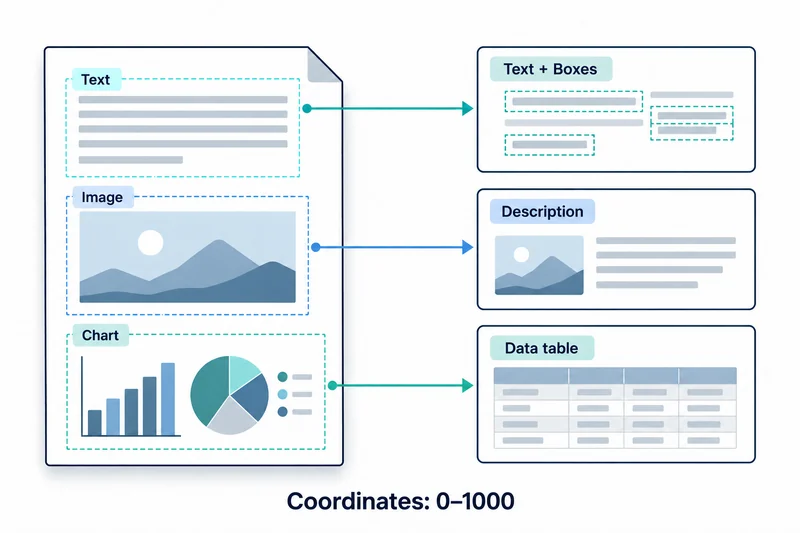
With an empty text prompt, the models transcribe the page as earlier generations did. With the grounding prompt, each block is prefixed with a type label and a bounding box, and image descriptions and chart data as HTML tables are added.
A bounding box is the rectangle coordinates enclosing a region. LightOnOCR-3 outputs these coordinates normalized to 0–1000 relative to the page.
Output that turns from a text field into region records
Systems that only took transcription now handle region type, position and content type together. If image descriptions and text read from the page are merged into one field, they cannot be separated again.
Reading normalized coordinates as pixel positions puts highlights in the wrong place. Storing page size and rendering transforms with the results makes it possible to jump accurately from a retrieved sentence to its source location.
Caveats: out-of-distribution instructions and longer output
The model card defines instructions other than the empty prompt and grounding as out of distribution. The 4B model was trained and evaluated with thinking disabled.
Average output per page for the 4B is 1,433 tokens with grounding and 1,158 with plain transcription, about 25% more. Adding free-form instructions is not a documented usage.
How rendering resolution changes scores and throughput
LightOn’s speed comparison uses the same 512 pages, one H100 per model and vLLM 0.30.0 with identical flags. The 0.8B and 4B reached their best olmOCR-Bench scores at 400 DPI with a 5 MP cap, about 4,800 image tokens per page.
Rendering at 1540 px on the long side cuts image tokens by almost two thirds and raises peak throughput by 44% for the 0.8B and 66% for the 4B. The model card example renders at 400 DPI and then resizes the long side to 2,048 px.
The three settings are not interchangeable benchmark conditions. LightOn says it applied output normalization before scoring.
An adoption order that starts with whether coordinates are needed
If only searchable text is stored, plain transcription remains the baseline. When page highlights, figure descriptions or chart extraction are needed, each output is defined separately in the parser contract.
A table that parses is not evidence that the extracted values are correct. Chart values are checked against the source separately.
The evaluation set includes small text, dense tables, multiple columns and pages whose information sits in visuals. High-resolution scores and low-resolution throughput are not mixed, and full requests are compared including the extra output at the chosen resolution.
No document inference was run for this article.
LightOnOCR-3 grounding does not just give more text; it is a new output contract that must preserve coordinates and content types.