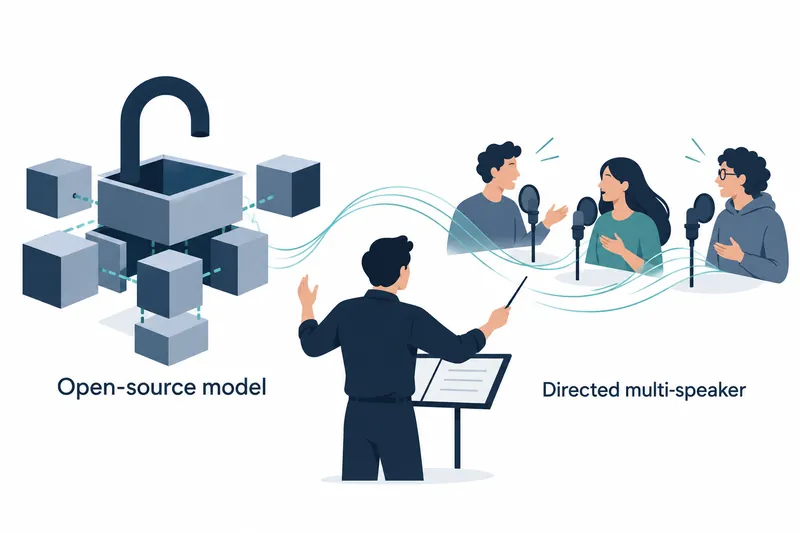
Fish Audio released a speech synthesis model that reads multi-speaker scripts and revises delivery as if re-recording. Developers building dialogue content can use one model to generate voices, adjust acting, and replace parts of existing audio.
1. Total model size differs from actual computation
Fish Audio Drama 3, released on October 13, 2026, is a preview ahead of the full release.
Its text component uses an MoE architecture that activates about 3 billion of its 35 billion parameters per token. It selects only some experts for each task. Memory needed to hold the full model differs from the amount computed each time.
The audio generation component has a 13-layer decoder that replaces the previous generation's decoder.
2. Revising direction differs from replacing segments
Direction is added to the script. [laughs] marks where laughter should occur, while <whisper>...</whisper> encloses a whispered segment. Natural-language style or direction notes are also supported.
Instructions in the next dialogue turn trigger regeneration with the original reference audio and previous output kept in context. Release notes report Step-Audio-Edit results after three revisions. Emotion accuracy rose from 55.5% to 58.2%, and style accuracy from 76.5% to 81.8%. These results show the effect of iterative revision in that evaluation.
Words or sentences can also be inserted, deleted, or replaced in existing recordings. Only the specified segment is regenerated, preserving surrounding audio. Unlike retrying an entire performance, this limits the scope of editing.
3. Deployment options and required hardware
The GitHub release tag is v3.0.0-beta. The model card lists SGLang-Omni and vLLM-Omni as deployment options. Below is the original command for starting the server after installing the former.
sgl-omni serve --model-path fishaudio/drama-3 --port 8000The release notes specify a minimum of an NVIDIA GPU with at least 48GB of memory using FP8, which reduces the numerical precision of weights.
The existing S2-Pro remains supported through the same command line, server, and web interface. The model type is identified by reading the configuration from a checkpoint containing saved model weights and settings.
4. Throughput and response latency must be considered together
The model card's performance table uses streaming requests with Seed-TTS English scripts on one H200. Each request used one pre-encoded reference audio clip and transcript. Each value averages four runs. Sampling settings were temperature 1.0, top_p 0.9, top_k 30, and max_new_tokens 500.
Acoustic frames are units of generated sound, and frames per second measures throughput across all concurrent requests. With 1 concurrent request, throughput was 166.7 acoustic frames per second, with median time to first audio of 88.9 milliseconds. At 16 concurrent requests, throughput rose to 927.6 frames per second, but median time to first audio also rose to 210.1 milliseconds. Even under comparable conditions, higher throughput does not imply lower response latency.
A separate H200 batch comparison used 256 concurrent requests. Moving waveform conversion from the model's GPU to a second GPU raised throughput from 2,422 to 4,160 frames per second. Median time to first audio fell from 3,403 to 2,146 milliseconds. This reduced a bottleneck where the converter became saturated at high concurrency and first audio waited in a queue.
This comparison used the converter's default GPU assignment, sending 1,088 requests per concurrency level and averaging six server starts. It also counted end frames in throughput. Hardware placement and aggregation differed from the earlier test, so the figures should not be mixed for comparison.
5. Production convenience requires checking operations and usage terms
A text can contain up to 16 speakers, but long texts are split into chunks of about 300 bytes when UTF-8 encoded. Each chunk can contain at most 3 speakers. All chunks are validated before generation. The speaker limit for a full script differs from the limit for each processing chunk.
Training scripts and fine-tuning tools were removed from the repository. The provided inference features and retraining the model yourself should not be treated as having the same scope of support.
A publicly available model still requires checking usage terms. The release and model card text point to the Fish Audio Community License, but the card metadata retains a name corresponding to the Fish Audio Research License. Since the labels differ, check the license file for the terms that actually apply.
This model centers on controlling multi-speaker performances and revision scope, while adoption decisions must consider hardware, training tools, and license terms alongside throughput.