Google released EmbeddingGemma 2 on October 6 to embed text, code, images, video and audio in one retrieval space. Its reported 768-dimensional MTEB Code v1 score rose from 68.76 to 78.68, a 9.92-point gain. Multilingual MTEB v2 moved only from 61.15 to 61.36.
The code-retrieval improvement should not be assumed for every kind of search. In local deployments, memory used to load the model and storage consumed by accumulated vectors are different costs.
Two settings for model memory and vector storage
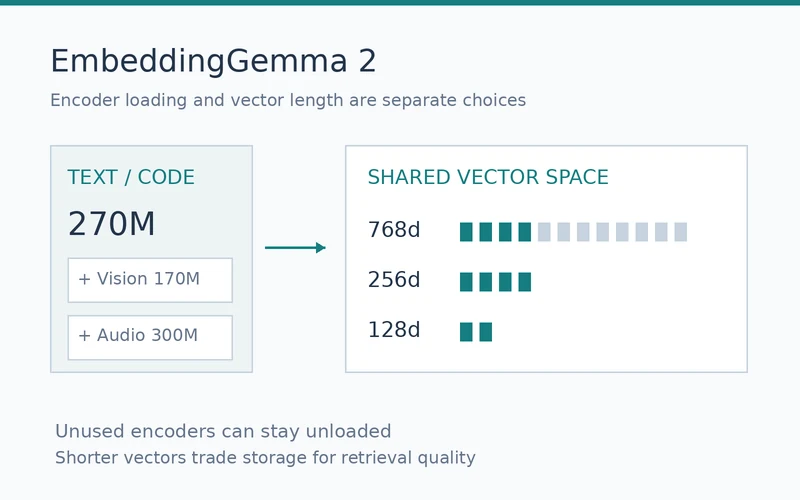
Text and code use 270M parameters; adding both vision and audio encoders brings the total to 740M. The optional encoders still use the same checkpoint's retrieval space.
The output defaults to 768 dimensions and can be cut to 512, 256 or 128. At the same datatype and vector count, a 256-dimensional payload uses one-third the storage of a 768-dimensional one. Index structures and metadata do not necessarily shrink by that ratio.
The model card reports little loss down to 256 dimensions but substantial degradation for image, video and audio search at 128. That vendor finding does not guarantee the same outcome for an individual dataset.
Queries and documents need matching dimensions, and shortened vectors must be renormalized. The card recommends bfloat16 or float32 because float16 may produce invalid embeddings.
Encoder selection controls EmbeddingGemma 2’s execution memory, while vector dimensions control retrieval storage and quality.