An inference project for developers running large AI models on personal PCs has been renamed and expanded its model support. It also reported running a 552 billion-parameter model on one GPU, but the PC had ample RAM and fast storage.
1. Renaming and engine consolidation
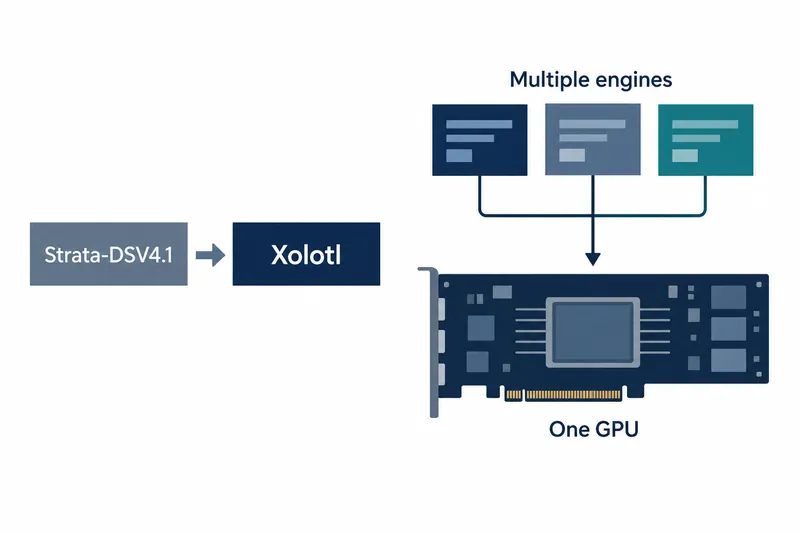
A model card update on October 17, 2026 announced that Strata-DSV4.1 is now called Xolotl. The existing engine remains, and old links redirect to the new repository. Beyond renaming, it brings execution code for several models into one repository.
A GLM-5.3-Flash engine has been added alongside the existing DeepSeek-V4.1-Flash engine.
Qwen3.8-Flash-Next and Qwen3.8-27B are also supported within the same server framework.
OpenAI- and Anthropic-compatible APIs allow existing clients to connect. However, settings and launch commands differ by model. This does not mean a single server switches models automatically.
2. Conditions behind roughly 27 tokens per second
The test PC had an RTX 4090 24 GB, Ryzen 7 5700X, 90 GB of DDR4 RAM, and one NVMe drive. A live server handled 21 coding problems, 10 tool calls, and 3 agent bug fixes. It always chose the most likely token, with a reasoning budget of 32K tokens.
The README and model card list DeepSeek's generation speed as 26.8 tokens per second. However, the completed benchmark results show 26.4 tokens per second. No explanation for the discrepancy was provided. All 21 coding problems, 10 tool calls, and 3 bug fixes reportedly passed.
On the same task suite, GLM generated 25.3 tokens per second and passed 19 coding problems. It used settings that reduced some computation and a routing bias of 0.25. The two Qwen models reached 127.8 and 98.5 tokens per second, respectively. Their model sizes and compression methods differ, so these results alone cannot rank the engines.
Results change with long inputs. A separate test kept other apps' GPU memory use below 1 GB. DeepSeek generated 256 tokens after fresh inputs of about 6K and 16.5K tokens, reaching 23.5 and 21.2 tokens per second, respectively. The roughly 27 tokens per second on short coding problems should not be assumed for long conversations.
3. The cost of saving memory
MoE is a model architecture that uses only some expert computation modules for each token. Keeping frequently used modules in GPU memory and the rest in RAM and NVMe is like moving only needed books onto a desk. It does not mean the entire model fits into 24 GB of GPU memory.
Routing bias favors experts in GPU memory and penalizes those on NVMe to reduce disk reads. This boosts speed but changes which experts participate in computation, potentially reducing quality. The current default is 0.5 times the previous strength. This differs from the full-strength default shown in the model card's historical comparison table.
4. Setup and execution
The DeepSeek engine is for Linux; operation with 16 GB of GPU memory or under WSL2 has not been verified. Reducing system RAM increases disk reads and lowers speed.
The distributed files cannot be read by standard llama.cpp or Ollama because they use an expert-specific compression format.
The model card says roughly 366 GB of fast SSD space is needed: 163 GB for the model and 203 GB for the Engram memory table. Extracting the table temporarily requires about 203 GB more. Merging model shards also requires extra space or deleting shards as they are merged.
Prepare the model and the separately distributed table, build the engine, and update the model path in the configuration file. The README provides this server launch example:
python3 tools/v41/serve/serve_ds41.py --engine strata --config tools/v41/serve/strata-ds41.json --port 8150 # DeepSeek-V4.1-Flash5. Feasibility is not quality parity
On 7 multistep coding tasks using identical prompts and temperature 0, the official API solved 5 and the local model with default bias solved 4. The sample was small, and the local model combined compression with refusal removal, preventing isolation of the cause. Whether the API used exactly the same checkpoint was also unconfirmed.
Xolotl expands the options for running large models locally, but roughly 27 tokens per second alone does not establish quality parity with official services.