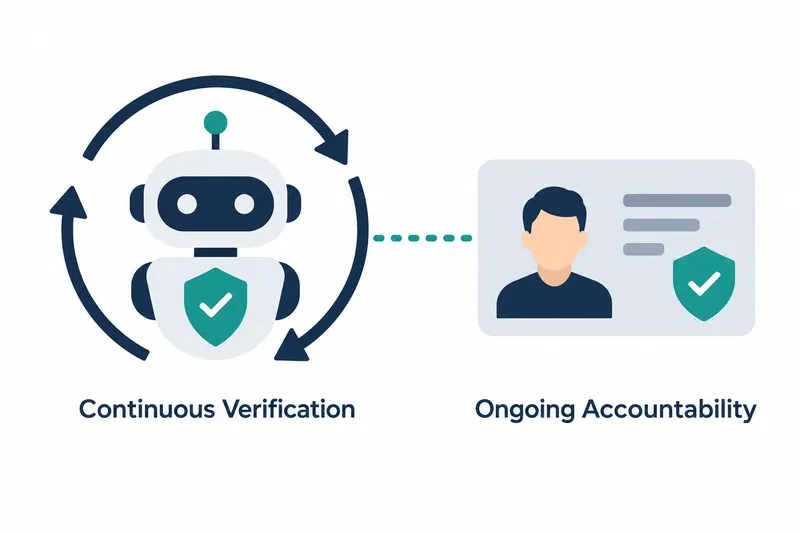
Cloudflare introduced a system to assess whether bots whose identities it has verified continue to follow site instructions. Site operators gain a basis for judging automated access by looking beyond verification to subsequent behavior.
1. Identity Verification and Trust Assessment Differ
Verification confirms identity, not responsible future behavior. A driver's license likewise proves identity and a passed test, not future safe driving. Cloudflare says verified bots may disregard site preferences or burden servers because of misconfiguration or bugs, rather than malice.
Verified bots must identify themselves accurately and securely, act only for their stated purposes, and avoid abusive behavior.
Web Bot Auth verifies identity through request signatures, and BotBase organizes this information in a public format. The new assessment system links these verified identities to evidence of subsequent behavior.
An individual request's risk can change from moment to moment, but trust builds through consistent behavior. A one-off violation does not immediately determine long-term trust, so request blocking and trust assessments of repeated behavior must be distinguished. Cloudflare cited its removal of Perplexity's bot from the verified list in 2025 for trying to access resources on sites that rejected crawling, then attempting to bypass controls after being blocked.
2. Assessing Compliance and Responses to Feedback
The initial assessment uses two signals: whether bots follow instructions and respond to direct feedback. Observations become trust bands showing how consistently they respect site preferences. These are not permanent judgments of bots or operators, but ranges explaining the behavior behind an assessment.
The main way to convey site preferences is robots.txt. The system checks whether actual traffic follows the file's published instructions over time. The source says bots are expected to check and follow instructions under RFC 9309, the standard for site crawling directives. It focuses on repeated patterns of ignoring instructions rather than isolated violations.
This file sets minimum rules for what bots must not do. An action's absence from it does not imply permission. If a site signals in other ways that access is unwanted, bots should consider those signals too.
3. Even Allowed Paths Require Rate Adjustments
Bots can place substantial load on a site while visiting only allowed paths. An HTTP 429 response signals a need to slow down and may specify how long to wait before retrying. Whether a path is accessible and whether a bot responds to the server's request to slow down are therefore assessed separately.
The system observes whether bots slow down or pause after this response, or keep requesting at the same rate. Consistently slowing or stopping increases trust, while repeatedly ignoring signals reduces it. This behavior is reflected in trust bands over time.
4. Evidence and Responsibilities for Operators
Site operators gain context to judge whether allowed bots actually follow instructions, while bot operators can demonstrate responsible behavior. This emphasizes bot operators' responsibility to keep adapting to instructions and response signals beyond identity verification. Once customers can select trust criteria, site operators will still decide how to handle bots at each trust level.
Customers can currently use Bot Preference Sync to align published instructions with configured policies and Bot Management to decide how automated traffic is handled. The new system observes whether bots actually follow those instructions.
5. Public Scores and Customer Features Are Future Plans
Cloudflare is building an internal observation history and refining how to turn it into useful guidance. It plans to publish scores on Radar and expand its assessment approach. It also plans to offer the system to all customers so they can choose trust thresholds for handling verified bot traffic. A threshold defines the trust level used in handling decisions.
No specific scoring formula, observation period, or publication schedule was provided. The published description alone therefore cannot establish how bots rank relative to one another in trust.
The key change is to judge trust through accumulated compliance and responses to feedback, rather than treating verification as unconditional grounds for access.