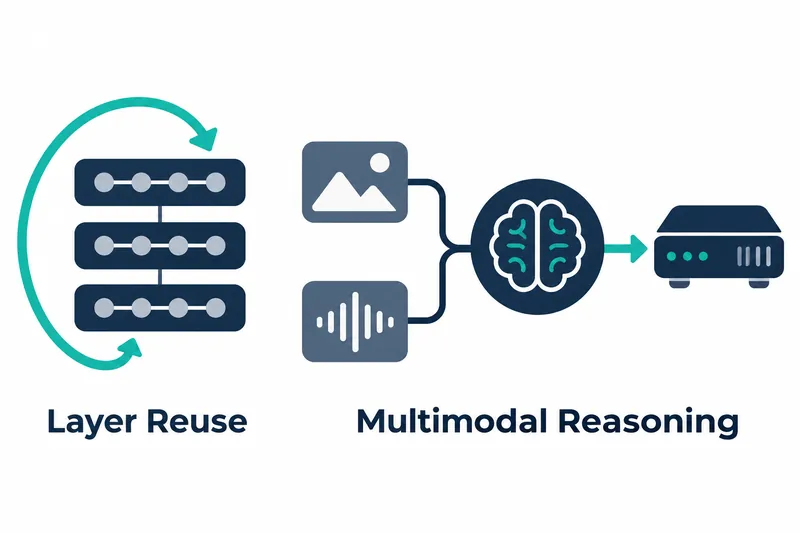
On November 17, SenseNova released an approximately 9-billion-parameter model that takes images and text as input and generates text. It increases computational depth by reusing middle-layer weights, the internal values learned during training. Developers can use it for long-context, coding, and tool-use tasks, and adjust deployment memory with 4-bit weights.
1. Reusing layers to increase computational depth
The model stores 32 distinct decoder layers, computational stages that transform input into output, and runs the middle 24 layers twice. According to the company, processing an input involves 56 layer computations. Rather than adding new layers, it deepens computation by passing through the same section again.
Inputs are text and images; output is text. The model card states support for context lengths of up to 512K tokens and says training included code and tool-use workflows. Its targets therefore include coding, agents, and data analysis as well as general conversation.
2. Company-reported benchmarks and loop-count experiments
According to company results, the final release improved over the preview from 14.33 to 36.67 on AutomationBench and from 40.45 to 59.55 on Terminal-Bench 2.1. The company highlighted gains in agent, coding, and data analysis tasks as key changes in the final release.
Company-reported GAIA scores rose from 37.86 to 69.90, and BIRD scores from 71.38 to 72.34. The latter gain was 0.96 percentage points.
In the company's comparison with Qwen3.8-27B, both models scored 36.67 on AutomationBench.
Against the same competing model, company-reported AIDABench scores were 65.31 for the final release versus 65.01, while NL2Repo scores were 41.36 versus 44.60. Results varied by task, giving users reason to compare models on their intended workloads.
Loop-count experiments used a single-pass configuration as the baseline, holding training data and other settings fixed. The company reported gains of 6.42% on AIDABench-QA and 16.93% on Workbuddy-office with three loops.
The company reported gains over baseline of 8.10% on LiveCodeBench V6 and 8.55% on AIDABench data visualization with four loops. Increasing from two to four loops added 1.04 and 1.35 percentage points, respectively. Peak scores occurred at three or four loops depending on the task, so the benefits of repeated computation also varied by workload.
3. Trading memory savings for additional computation
The company reports approximately 4.9 GB of weights with 4-bit quantization, which stores values using fewer bits at lower precision. An official 4-bit quantized version has been available since release day. Below are estimated minimum GPU memory requirements by context length using 4-bit weights and an 8-bit KV cache, memory that stores intermediate values for reuse.
Table: Estimated minimum GPU memory by context length
Conditions: 4-bit weights, 8-bit KV cache, company model card estimates
Unit: GiB; all values are approximate
| Context length | Minimum GPU memory |
|---|---|
| 64K | 10 |
| 128K | 12 |
| 256K | 15 |
The company reports that reducing the KV cache to 4 bits requires about 9, 10, and 12 GiB for the same context lengths, respectively. Even with compact weight storage, memory for processing long inputs must be allocated separately.
The recurrent architecture benefits from reusing stored weights, at the cost of repeatedly computing the same middle layers. To account for inference efficiency, the company set the default loop count to two for both the preview and final releases.
4. Installation and deployment requirements
The preview environment verified in the model card uses Transformers 5.18.0 and PyTorch 2.11.0.
This environment uses CUDA 13.0. The instructions recommend first installing a compatible training framework build.
Loading the model requires enabling execution of the repository's custom implementation code. An example for installing the remaining dependencies follows.
python -m pip install "transformers==5.18.0" accelerate safetensorsLightLLM provides a deployment example using four GPUs. SGLang points to the version in pull request 47281, which includes the implementation.
vLLM points to the version in pull request 64832. The model card says these deployment commands come from preview examples and should use the final-release path instead. It also says engine versions and settings for the final release will receive further updates.
Downloading the weights requires logging in and accepting the terms of use. The project license is Apache 2.0.
5. Assessing suitability by task
The company says the model may miss requirements in complex tool definitions or instructions with multiple constraints, and performance may vary on coding and general agent tasks. Web development involving complex 3D scenes and animation may also require multiple revisions.
Choosing this model depends not just on its small parameter count, but on whether task-specific gains from repeated computation justify the memory costs of long contexts.