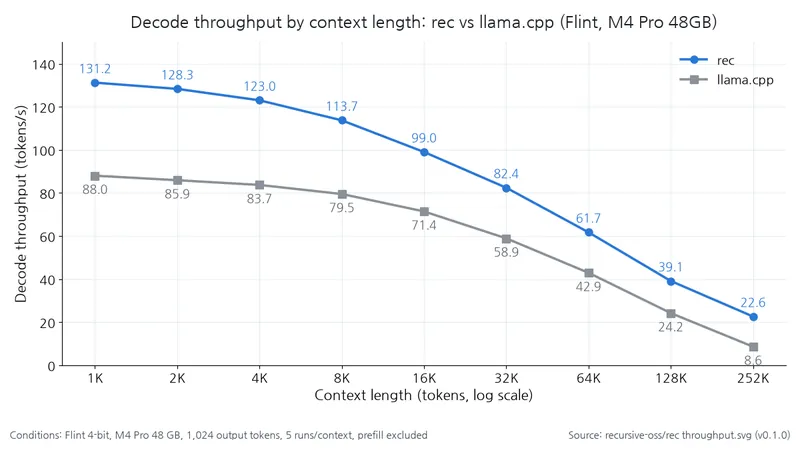
Flint is a language model for coding that runs locally on Macs. On October 21, 2026, Recursive released v0.1.0, the first official version of its dedicated inference engine rec, to make the model faster and easier to use on supported Macs. A single command downloads the model, starts a server, and connects a harness, the execution environment that links coding tools. In company tests on an M4 Pro 48GB, Flint’s 4-bit weights delivered 1.4~2.6 times the decode throughput of llama.cpp across 1K~252K-token contexts.
3 key changes
The company says it fused the entire decode path into a Metal megakernel. According to the announcement, M4 and M5 chips run the full computation for generating one token in a single Metal megakernel.
The quantization described in the announcement reduces the memory burden of reading weights for each token. Flint activates only about 2.5B of its total 39.8B parameters per token. The company says this makes the output layer a large share of the weights read for each token. It reduced this layer to 4-bit precision, then recovered accuracy through offline distillation using a 16-bit model as the teacher. It says the final NVFP4 model’s benchmark scores differ from the 16-bit model’s by no more than 0.7 points. The announcement gives that figure for its NVFP4 checkpoint and does not say it also covers the 4-bit weights measured on Apple Silicon in rec’s throughput tests.
It introduced a command-line interface, or CLI, for the first time. It automates model management, server startup, and coding harness connections.
It provides an OpenAI-compatible Chat Completions API. Other clients, such as Cline and VS Code Chat, can also connect to the local server.
Model specifications
Model performance metrics were released alongside speed figures. The official model card reports mean pass@1, the single-attempt success rate, from at least 5 runs of each tool-using agentic evaluation. Flint scored 54.9% on Terminal-Bench 2.1, which tests coding tasks performed with tools. It scored 89.7% on SWE-bench Pro v2 and 74.2% on SWE-bench Verified, which test coding agents’ problem-solving abilities.
The company claims it leads agentic coding evaluations among MoE models under 50B that activate only some parameters for each token.
The specifications below also follow the official model card.
Table: Flint model specifications
Conditions: Recursive’s official model card (specifications and company-reported evaluation scores)
Units: B for parameters; tokens for context and vocabulary
| Item | Value |
|---|---|
| Total parameters | 39.8B |
| Active parameters (per token) | About 2.5B |
| Context setting | 262,144 |
The context setting includes both the prompt and generated output.
Throughput by context length
The company also reported comparable scores to 25~40B dense models, which use all parameters for every input, while running more than 5 times faster.
The table below uses the test conditions in the official repository and the throughput SVG.
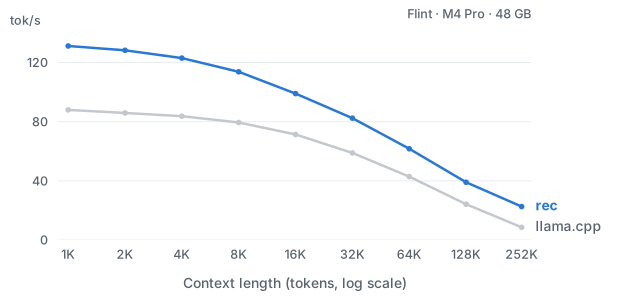
Table: Decode throughput by context length and rec’s ratio to llama.cpp
Conditions: Flint 4-bit weights, Apple M4 Pro 48GB, 1K~252K-token prompts, 1,024 output tokens, and 5 runs per context length. Decode generation speed excludes prompt processing. Intermediate values were derived from coordinates in the repository chart (throughput.svg). Ratios divide the two throughput values. Endpoint values are stated in the chart description.
Units: tokens/second, times
| Context | rec (tokens/second) | llama.cpp (tokens/second) | Ratio |
|---|---|---|---|
| 1K | 131.2 | 88.0 | 1.49 |
| 2K | 128.3 | 85.9 | 1.49 |
| 4K | 123.0 | 83.7 | 1.47 |
| 8K | 113.7 | 79.5 | 1.43 |
| 16K | 99.0 | 71.4 | 1.39 |
| 32K | 82.4 | 58.9 | 1.4 |
| 64K | 61.7 | 42.9 | 1.44 |
| 128K | 39.1 | 24.2 | 1.61 |
| 252K | 22.6 | 8.6 | 2.63 |
The absolute throughput gap narrows from 43.2 tokens/second at a 1K context to 14.0 tokens/second at a 252K context. The relative ratio falls from 1.49 at 1K to 1.39 at 16K, then rises to 2.63 at 252K. rec has higher throughput at all 9 listed points. With long code or conversation histories, rec therefore generates faster than llama.cpp. However, increasing context length means waiting longer for the same amount of output.
How to upgrade
Requirements are a Mac with M4 Pro, M5 Pro, or M5 Max, at least 48GB of unified memory, and about 30GB of free disk space. Running pi and OpenCode also requires Node.js 22 and npm.
Installation takes one script command.
curl -fsSL https://raw.githubusercontent.com/recursive-oss/rec/main/install.sh | bashThe installation script verifies the binary’s checksum and size, and stops on systems without Apple Silicon.
After installation, run rec launch pi in your project directory. On the first run, it downloads the model and harness, then automatically starts and connects the server. OpenCode connects the same way with rec launch opencode. The company recommends the pi harness for the best model performance. An informal report in the company documentation estimates that pi is about 1.5 times faster than OpenCode across the full coding workflow. Results vary by task, hardware, and configuration.
For management, use rec doctor to check hardware, rec pull to download the model in advance, rec stop to stop the server, and rec update to install a new release.
Connections: For other clients, start the server with rec serve, then connect to the OpenAI-compatible API. The default address is http://127.0.0.1:11500/v1, the model ID is flint, and the key is the output of rec auth token.
This is the first version, with no prior official release. There are limitations to note in advance.
The model will not download if the supported-chip and memory requirements are not met. The engine handles only one generation at a time and may return HTTP 429 for overlapping requests. NVIDIA RTX Spark support is still in preparation.
Who it matters to
For developers using a local coding model on supported Macs, rec handles model management, server startup, and harness setup together. pi and OpenCode use bundled launch configurations, so no separate harness installation is needed. Editor extensions and custom apps can connect through the OpenAI-compatible local API.
rec’s relative advantage grows with long contexts, but both engines slow down in absolute generation speed.