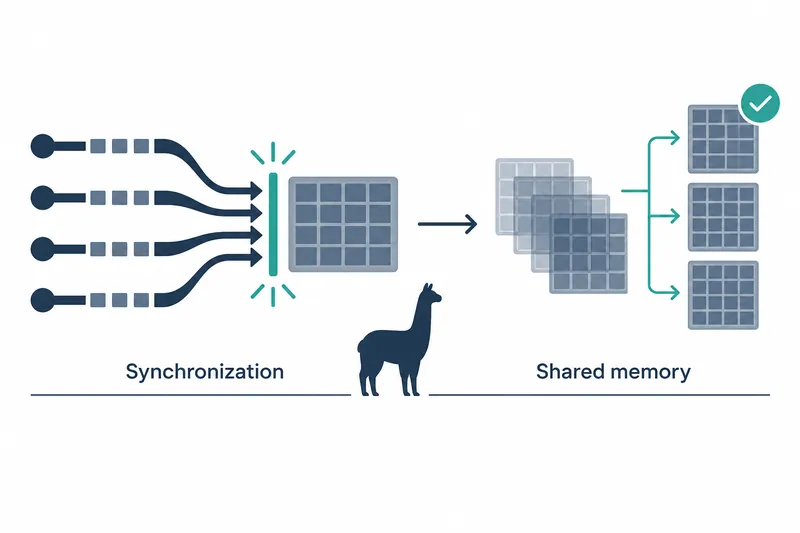
For developers running or validating local language models with CUDA, a fix prevents some computations from overwriting memory while other work is still reading it. The developer reported that warnings from a tool detecting overlapping operations disappeared. This change concerns safe computation ordering rather than speed.
1. Where the issue occurred
Released on October 19, 2026, llama.cpp b11724 is a prerelease that includes this fix. It targets the CUDA vectorized flash attention kernel, the code that performs attention computations on the GPU.
The issue arose when computed scores were stored in shared memory and the same space was reused in the next iteration. It is like overwriting a shared notepad before everyone has finished reading it. The developer described this as a write-after-read race.
2. How the fix works
The patch adds warp-level synchronization at the end of the loop. A warp is a group of threads, and a lane is an individual execution unit within it. This makes the next overwrite wait until reads in the same group finish.
ggml_cuda_syncwarp(); // Needed for KQ synchronization.The code above is the exact line added by the patch. The developer said this synchronization scope is sufficient because the relevant reads and writes occur within the same warp. This is an internal kernel change, not an example of changing user settings.
3. Validation results and scope
The developer tested on an RTX 3090 at baseline commit e467e5b.
The GPU architecture was sm_86, and the NVIDIA driver version was 610.43.03.
The race check targeted the same operation as the correctness checks below, with hsk=256 and nb=1.
Under these conditions, racecheck warnings about conflicting memory access ordering fell from 8,007,424 before the fix to 0 afterward.
All 38 selected correctness checks passed both before and after the fix. After the fix, all 3,993 of 3,993 full FLASH_ATTN_EXT correctness checks also passed. No pre-fix result for the full suite was provided. The author added that they had not observed this race causing incorrect output.
4. Expected effects and remaining questions
The benefit is guaranteed ordering of reads and writes when shared memory is reused, at the cost of an added waiting point between threads. However, the published material provides no performance changes. This wait should not be read as an actual slowdown, nor fewer warnings as higher throughput.
When deciding whether the fix applies, first check whether your execution path is affected. Published validation is limited to the hardware and settings above. No validation results were provided for other hardware or non-CUDA execution paths.
This is a stability patch that corrects CUDA shared memory reuse ordering and removes checking-tool warnings, rather than promising improved output.