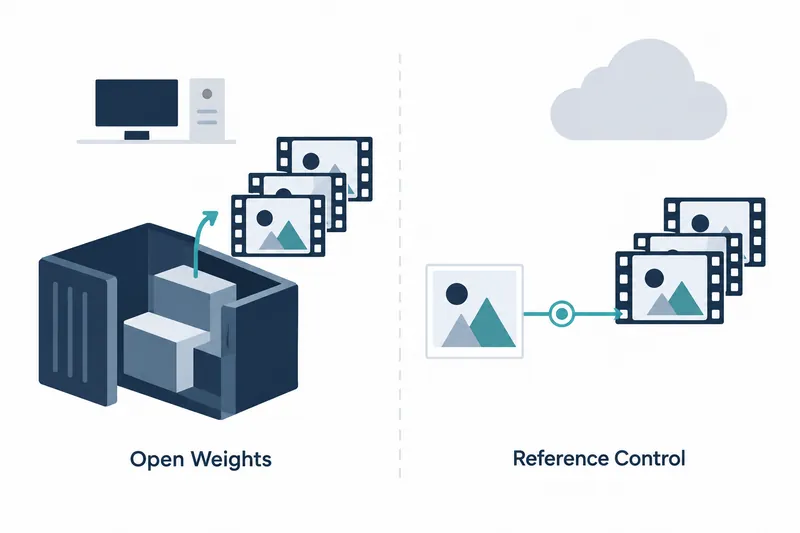
On October 29, Pika released H3 Flex weights and inference code, software that generates results with a trained model, for creating video with sound. Developers can download it, run it on their own hardware, and guide scenes with image, video, and audio references. High-resolution upscaling and audio component separation remain Pika API features, dividing roles between local execution and hosting, which provides features on external servers.
1. Video and sound generation reduced to six steps
H3 Flex is a model further trained from MiniMax H3. It generates video and stereo audio together, reducing iterative denoising steps from the original model's 50 to 6. The company reported transformer computation as low as 7 seconds for 15 seconds of 768p video with synchronized audio in controlled benchmarks, tests comparing performance on a common basis. Transformers are neural network architectures that learn contextual relationships.
According to the company, at launch it ranked 1st among open-weight models and 7th overall on DesignArena's text-to-video leaderboard. The company said it would also offer the model in its video creation product starting November 2.
2. Assign characters, backgrounds, and motion by reference
Users can supply up to 12 references at once to specify characters, backgrounds, and motion separately. The model card, a document explaining usage and limits, and the repository list the following file limits for multi-reference mode, which uses several references together.
Table: Input limits by type for multi-reference generation
Conditions: Pika H3 Flex multi-reference mode, up to 12 reference files in total
Unit: files
| Item | Maximum files |
|---|---|
| Images | 9 |
| Videos | 3 |
| Standalone audio | 3 |
Both per-type and total limits apply, so combine references with at least one image or video. Videos and standalone audio files must each be 2–15 seconds long. Total video duration and total standalone audio duration must also each be no more than 15 seconds.
The prompt, the instructions given to the model, can explain each reference's role and the scene's progression. For example, it can combine a character from one image with a background from another, using a video to guide action or camera movement. Reference-based editing was also introduced for changing unwanted elements using reference material. It can change clothing, props, or backgrounds while preserving the original performance and timing.
3. Generate locally and finish with hosted features
The released package supports text-based, first-and-last-frame, and multi-reference generation. Locally generated videos are 480p or 768p and include mixed stereo audio. Adapters, additional weights attached to the base model, and execution code let users run the model on their own hardware and process prompts and inputs into MP4 output.
The Pika API offers upscaling, which raises video resolution, to 1080p, 2K, or 4K, plus separation into five audio track types. It also offers optional prompt enhancement, which automatically refines input instructions. The separable tracks are dialogue, music, sound effects, action sounds, and ambience. Creators needing higher finishing resolution or separate audio handling during editing will additionally use these hosted features.
4. Local execution offers control at an infrastructure cost
Local execution gives developers more scope to run the model themselves and build new tools, but requires their own hardware and storage. Downloading weights for both tasks from the repository yielded about 210GB of base files and 5.5GB of adapters. Actual generation loads the model components needed for the selected task.
The repository says representative 480p and 768p requests were tested on a single H100 80GB. An optional feature keeps part of the model on the CPU to reduce GPU memory demands, but increases system memory use and data transfer time.
The 7 seconds cited earlier is not the full API response time. Actual completion time varies with reference inputs, high-resolution finishing, audio separation, hardware, and service processing overhead. The local package handles each request on one GPU and does not support multi-GPU distribution, which splits work across GPUs. Long videos or large reference combinations may therefore exceed GPU memory.
Installation starts by cloning the repository in an environment with Python 3.12, an NVIDIA GPU, and compatible drivers. Below are the README commands for installing dependencies and applying patches. Package installation and generation commands follow afterward.
python -m pip install -r requirements.txt
python tools/apply_diffusers_patches.py
Inference and loader code is provided under Apache-2.0, while adapters follow the MiniMax H3 Community License Agreement.
H3 Flex is an optional production tool that brings iterative generation and scene control to local execution while leaving high-resolution finishing and audio separation to hosted services.