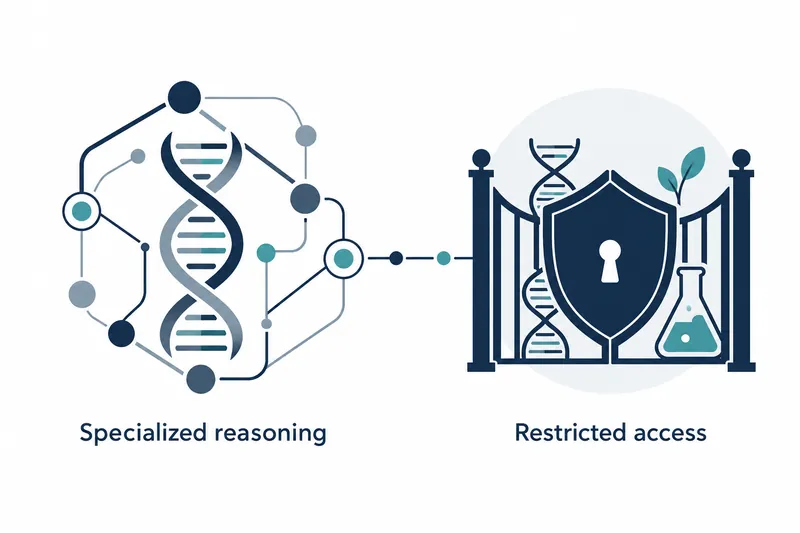
OpenAI unveiled a new AI model specializing in life science research. It connects biological data interpretation with analysis using scientific tools to help research teams develop hypotheses and plan experiments. Organizations must undergo a separate review to gain access. Approved researchers can select the model in research workspaces or development tools.
1. Biological reasoning tailored to early exploratory research
OpenAI announced the release of GPT-6 Rosalind in its October 30, 2026 changelog. The model combines specialized biological reasoning with scientific tool use to support complex life science research. Listed applications include target research and research identifying biological entities linked to disease. Others include genomics, sequencing, protein analysis, medicinal chemistry, drug candidate structure and properties, literature synthesis, and experiment planning.
OpenAI describes this model family as most useful for early exploration and hypothesis generation. Beyond writing documents with general-purpose models, it focuses on examining literature alongside biological data and deciding the next direction for analysis or experiments.
Access is divided into Research, supporting advanced biological research, and Discovery, supporting routine scientific tasks. The new model belongs to the former. The latter applies additional safeguards and stricter monitoring to the existing 5.5 model. Organizational review determines the available tier and model.
2. Connecting analysis and interpretation in a workspace
Rosalind Workbench brings together scientific tools, data viewers, and guided research procedures in a workspace. Available in ChatGPT and Codex, it can be used independently of model approval. At launch, it includes custom procedures for next-generation sequencing, which reads genetic material sequences at scale.
Supported tasks include quality checks on FASTQ raw sequence files and RNA sequencing. The latter examines gene expression, through which genetic information leads to function, in pooled cells or individual cells. Researchers can use these tools and guidance to connect the stages of data analysis.
For large biological datasets such as genomes, the recommendation is to keep files in local directories, databases, or approved repositories and request analyses rather than place entire files in the model input. Tools analyze only the portions needed for a question, and the results are interpreted. OpenAI says useful processes can be organized into reusable workflows. This is generally faster and more effective than directly inputting the entire dataset.
3. Access through organizational review and user setup
Eligible organizations with Enterprise or Business contracts can apply to the trusted access program. US university labs can apply through a separate Business-based academic plan. Institutional applications require information about research and intended use. After review, a verified owner or administrator must review the terms and pricing and approve activation.
Approved researchers can select GPT-6 Rosalind Research in Work. In Codex, they sign in to an approved workspace, install the life science research plugin, and choose the model in a new task. Enterprise workspaces start with a 2-week administrator preview, during which administrators enable access for approved researchers.
Developing internal research tools or workflows through the API requires separate organizational approval. Approved API organizations use gpt-6-rosalind as the model identifier. This structure requires separate approvals for researchers' workspace use and development teams' programmatic integration.
4. Existing model pricing and new model rates are separate
The September 8, 2026 pricing notice in the changelog gives standard rates for the existing gpt-rosalind-research, with billing starting on October 5 that year. The amounts below are separate rates for input, cached input, and output tokens for that model.
Table: Standard API rates for the existing research model
Conditions: Standard gpt-rosalind-research rates, announced September 8, 2026, with billing starting October 5, 2026
Unit: Dollars per 1 million tokens
| Item | Rate |
|---|---|
| Input | 5 |
| Cached input | 0.50 |
| Output | 25 |
OpenAI's original pricing page lists GPT-6 Rosalind's standard short-context rates per 1 million tokens as $15.00 for input, $1.50 for cached input, and $75.00 for output. The corresponding short-context rates for the existing gpt-rosalind-research are $5.00, $0.50, and $25.00, as shown above. The new model costs 3x as much in all three categories. With identical token usage and composition, the budget for those token charges is also 3x as much. The Discovery tier follows existing 5.5 rates. Adoption budgets should therefore be based on the actual model selected and the organization's contract.
5. Research tool benefits come with approval and data management duties
Focused tool-based analysis and reusable research procedures are expected benefits, while organizational applications and user permission management add implementation work. Enterprise deployments offer security and administrative controls. OpenAI states that it does not use enterprise customer data for training by default. Data handling must be determined by checking the approved product, contract, and workspace settings.
Current access covers approved users' internal research, excluding customer-facing products and external commercial applications. The Business-based academic plan does not include API access or credits, and enterprise contract data protections do not apply automatically.
The value of adopting GPT-6 Rosalind depends not only on connecting life science tools, but also on whether an organization can manage approval and data governance procedures.