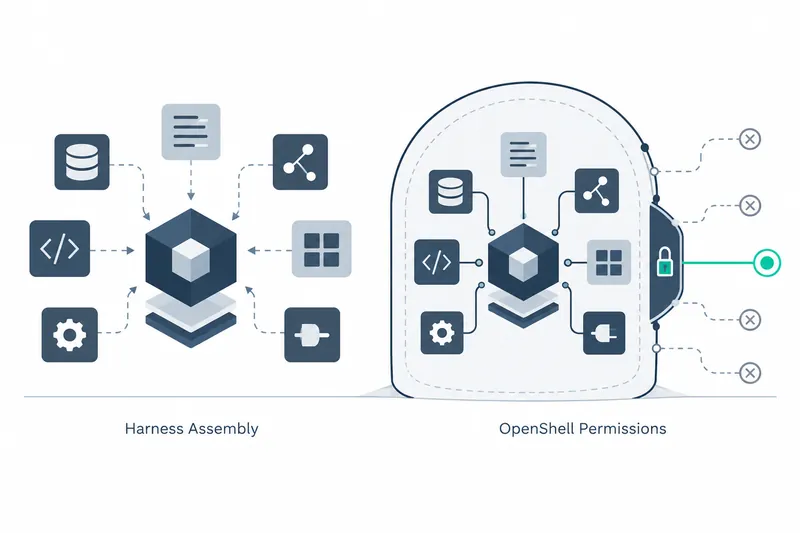
NVIDIA unveiled NemoClaw blueprints, reference configurations that add models and execution controls to existing agents. Teams connecting agents to internal systems can retain their workflow tools while controlling file and network access and reviewing execution logs.
The key is to treat how an agent works and what it can access as separate layers. Rather than replacing the existing workflow framework, the approach assembles model optimization and access policies around it.
1. Assembling models and operational tools around existing workflows
A harness defines how an agent uses tools and progresses through tasks. NemoClaw combines models, optimization tools, and a security runtime with the developer's chosen harness. The runtime manages access permissions during execution.
OpenClaw, a supported harness, handles files and applications, writes code, runs subagents, and maintains context across sessions. Hermes Agent turns patterns learned from repeated tasks into reusable skills.
LangChain Deep Agents provides planning, context management, memory, and delegation to specialist subagents. Developers already using these harnesses can assemble the surrounding components without rewriting their agents.
Each configuration includes Nemotron open models and NeMo optimization tools. These tools observe and improve execution. They also route requests to suitable models, which can help improve throughput, or work processed per unit of time, as well as cost and reliability.
2. Focusing on the working environment rather than model retraining
NVIDIA explains that a mismatch between a model and its harness can cause repeated requests for context or loops without progress. Optimization targets not just the model itself but also the environment in which it works.
LangChain tuned its harness for Nemotron 3 Ultra. It adjusted prompts, tools, and middleware without retraining the model.
According to the company, the tuned setup delivers near-top-tier performance at about 1/10 the cost per run of leading closed models, whose weights are not public. The source omits evaluation tasks, hardware, and cost calculation criteria, limiting direct comparison with real workloads.
The tuned configuration is included in the NemoClaw blueprint for LangChain. Developers using the same model and harness combination can apply it without repeating the tuning work.
3. OpenShell uses policies to constrain access during execution
OpenShell manages agent access to files, networks, credentials, and tools through policies. NVIDIA's Hermes-based memory assistant configuration controls file system, process, and network access. Credentials for inference services and external tools remain outside the sandbox, an isolated execution space.
This setup lets runtime policies control access even when memories or retrieved context lead to unintended actions. It separates management of what an agent remembers from where it can actually gain access.
NeMo Relay integrates with the assistant's sessions to collect execution records. It closes trace spans, which group records of a task's execution, at session start, reset, or expiry boundaries and exports records for audits and further optimization.
In the OpenClaw quickstart setup, users first choose optional web search and messaging, then a network policy. The default Balanced policy includes presets for developer tool repositories and the chosen search provider. A preset that populates session cost records is also added automatically.
4. Starting installation with coding-agent guidance or a terminal
Developers can paste a setup prompt into a coding agent such as Cursor or Claude Code, or use the interactive terminal installer. The coding-agent prompt instructs it to confirm choices first and seek permission before installation, system changes, large downloads, or credential handling.
The following source example runs a non-interactive installation, requiring no user input, with NVIDIA's inference service, which requests answers from trained models.
curl -fsSL https://www.nvidia.com/nemoclaw.sh | \
  NEMOCLAW_NON_INTERACTIVE=1 \
  NEMOCLAW_ACCEPT_THIRD_PARTY_SOFTWARE=1 \
  NEMOCLAW_AGENT=openclaw \
  NEMOCLAW_PROVIDER=build \
  NVIDIA_INFERENCE_API_KEY=<your-key> \
  NEMOCLAW_SANDBOX_NAME=my-gpt-claw \
  bash
After preflight checks and starting the OpenShell gateway, the terminal installer collects the provider, model, credentials, and sandbox name. Enrollment follows review of the configuration summary, and creating the first sandbox may take a few minutes. Presets supporting both modes can be set to read-only or read-write.
5. Control and observability require configuration management
The blueprints offer separate runtime policies to control agents' access to real systems and traces showing their execution steps. Teams must choose not only harness and model combinations but also network policies, presets, search, messaging, and credential settings. Keeping the existing stack brings convenience alongside the burden of managing operational settings.
NemoClaw's core is not a new harness, but a deployment pattern that adds both model optimization and runtime access controls to existing agents.