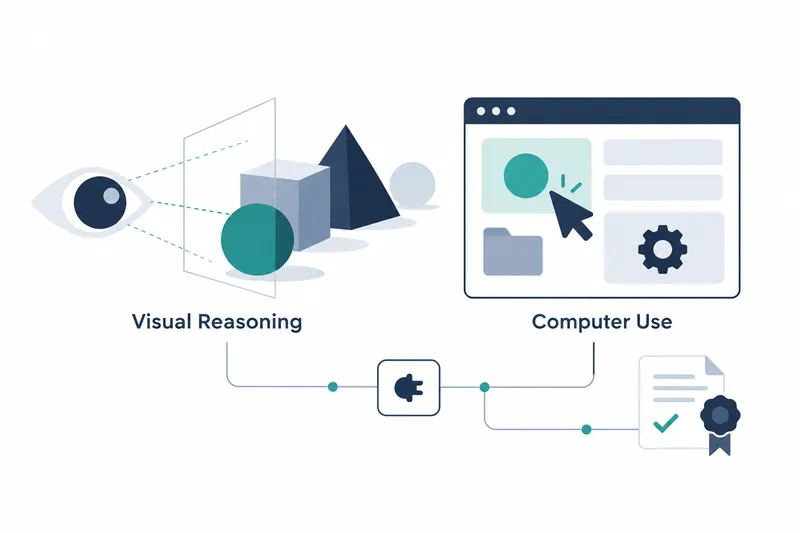
OpenAI has unveiled GPT-6.1 Terra, a model that reads screens, makes decisions, and operates apps. Users on select ChatGPT Work and Codex plans and API developers can use it to interpret documents, fill out forms, and automate screen-based workflows.
1. From understanding screens to operating them
GPT-6.1 Terra combines visual reasoning, computer use, and natural writing in one model. OpenAI's examples include matching product photos to catalog entries, interpreting technical drawings, working in app interfaces, and drafting and revising text. It also cited proposal writing and video editing as work use cases.
Agents' Last Exam evaluates professional tasks, including turning architectural drawings into 3D models and reviewing animation scene by scene to create time logs for restoration teams. According to OpenAI, at medium reasoning, the new model scored 15 percentage points above GPT-5.6 Terra at about one-third of the task cost. It said the model matched GPT-6 Astra's performance at one-tenth of the price per token.
At maximum reasoning, OpenAI said the model was over 3 times as token-efficient as Claude Opus 5.5 on the same tasks, at one-quarter of the price per token. Together, the two factors brought the cost per task to about one-ninth, according to the company.
OpenAI said the model completed tasks in this professional evaluation over 3 times faster than GPT-6 Astra and GPT-6.1 Sol. For developers processing screen-based work at scale, cost per task and completion time matter alongside accuracy.
2. Changes seen in visual and desktop evaluations
OpenAI said the model outperformed GPT-5.6 Terra at every reasoning setting on the visual reasoning evaluation MMMU-Pro.
The company said it also nearly matched GPT-6 Astra and GPT-6.1 Sol at much lower cost. Its claim is that both screen interpretation and the cost of that capability improved.
OSWorld 2.1 evaluates multistep tasks in desktop apps. OpenAI said the new model at medium reasoning exceeded GPT-5.6 Terra's highest score at a much lower cost per task. The evaluation measures not just reading image content but also completing tasks across multiple screens.
3. Company reports fewer errors and better coding results
According to OpenAI, an internal evaluation using prompts designed to induce errors showed the error rate at low reasoning falling from 53.6% for GPT-5.6 Terra to 16.7% for GPT-6.1 Terra.
At maximum reasoning, the error rate fell by 18 percentage points to 4.3%, nearly matching GPT-6 Astra and GPT-6.1 Sol, the company said.
OpenAI said the new model solved 50.3% of tasks at maximum reasoning on Terminal-Bench 4.0, which evaluates command-line coding tasks. GPT-5.6 Terra's published score, cited for comparison, was 21.5%, making the new model's solve rate more than twice as high.
OpenAI said the new model at maximum reasoning outperformed GPT-6.1 Sol at lower cost on Terminal-Bench-Science 0.1, a coding evaluation for scientific research.
According to the company, its score was within 5 points of Claude Opus 5.5 at less than one-fifth of the estimated cost. The evaluation covers research coding tasks such as tracking cell division in time-lapse footage.
4. Connecting screen-based workflows through the API
Developers can access the model through the API as gpt-6.1-terra. Tool calls require the Responses API. It accepts text and image inputs, outputs text, and supports tools including web search, file search, code execution, and computer use.
It has been released to Plus, Pro, Enterprise, and Edu users in ChatGPT Work and Codex. API usage limits vary by usage tier and, according to the documentation, increase automatically as usage and spending grow.
Audio and video inputs and fine-tuning, which trains an existing model on additional data, are not supported. The company said GPT-6.1 Sol or GPT-6 Astra is a better choice for the most complex coding tasks.
5. Lower standard rates with usage-based extra costs
OpenAI said standard API prices are 50% lower than those of GPT-5.6 Terra and GPT-6.1 Sol. The developer documentation lists the standard text rates below. Caching is billed on both sides. A cached input read, which reuses input stored earlier, costs $0.05 per million tokens. A cache write, the charge for storing input in the cache, costs $1.25 per million tokens for 30-minute retention and $2.50 for 12-hour retention, before long-input surcharges.
Table: Standard API text rates
Conditions: Standard rates in OpenAI's developer documentation, before long-input surcharges, with cache-write rates listed for 30-minute and 12-hour retention
Unit: Dollars per 1 million tokens
| Item | Rate |
|---|---|
| Input | 1.00 |
| Cached input (read) | 0.05 |
| Cache writes (30-minute retention) | 1.25 |
| Cache writes (12-hour retention) | 2.50 |
| Output | 5.00 |
Lower rates and faster processing could reduce automation costs for high-volume work, such as reading invoices and entering them into accounting software. However, search and computer-use tool calls incur separate fees. If input exceeds 272,000 tokens, input and cache rates double and output rates rise to 1.5 times for the entire request. The 2x cache rate applies to cache writes as well as cached reads, so operating budgets must account for these costs too.
GPT-6.1 Terra links screen-reading reasoning to actual app operation, aiming to handle high-volume work with lower standard prices and faster processing.