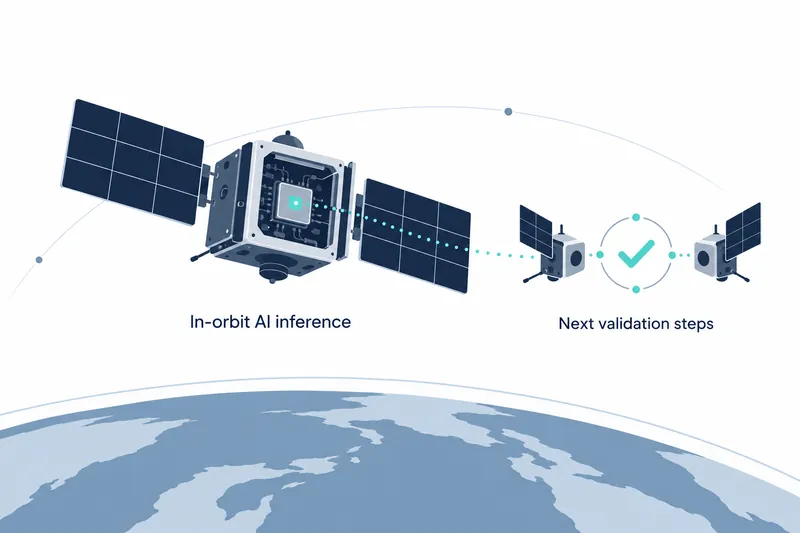
Google announced that an AI chip aboard a satellite generated a response and sent it back to Earth. For developers and industry watching space computing, this demonstrates actual model operation after launch. The next tasks are testing chip reliability in space and connecting two satellites in 2027.
1. From launch to an orbital response
Google launched a Project Suncatcher test satellite built with Planet on October 1, 2026. SpaceX's Transporter-18 is a launch mission carrying multiple payloads, equipment sent into space aboard satellites. Google said it contacted the satellite on launch day and confirmed it was working as expected.
The project's long-term goal is to explore whether scalable machine-learning infrastructure can be placed in space. Such infrastructure uses technology that learns patterns from data. This satellite is the first step in testing that possibility in orbit. Following launch and contact, the experiment progressed to onboard computing.
In the weeks after launch, Google completed commissioning checks, including powering up and running initial machine-learning tests. On October 30, it reported the first AI response generated in orbit by a TPU, which it describes as a data-center-class AI computing chip.
2. Answering a ground prompt with a haiku
In the first test, a prompt was uploaded during a communication window with a ground station, a facility that contacts satellites. Google asked the onboard open model Gemma 4 to describe being in space in a haiku, a short Japanese poem. The response was downloaded as the satellite passed over Svalbard, Norway.
The response described the blue Earth below, quietly flowing data, and starlight filling its core. The onboard model generated text in response to a brief creative request. The key was the round trip: a question sent from Earth, an answer generated in orbit, and the result received back on Earth.
Google then tested a space-themed limerick, a humorous five-line poem with a fixed form. It also used prompts for telemetry, which reads remote device status through communications, to report the onboard system's technical condition. This expanded testing from creative requests to requests about device status.
3. Heat and radiation are next
Google plans further orbital tests to assess how thermal stress, the strain extreme temperatures put on equipment, and radiation exposure affect TPU operation. Beyond generating a single answer, the aim is to see whether computing tasks can run reliably in space.
The October 1 announcement outlined plans to collect data on the physical stresses of spaceflight and extreme thermal and radiation conditions in space. The October 30 announcement reported initial operations and identified heat and radiation tests as the next task. Together, the announcements trace a path from launch through initial operation to environmental testing.
Google's next stated goal is two interconnected satellites in 2027. The company said verifying that TPUs can reliably handle computing tasks in space underpins that goal. The focus of the next experiments extends from chip operation to links between satellites.
4. The value and cost of orbital experiments
The benefit is that data gathered in actual orbit can inform chip and system design improvements. The cost is that validation also requires launching and operating a satellite, with commands and results exchanged during ground-station passes. Testing a computing chip thus becomes an experiment involving satellites and communications.
A paper describing the research background appeared in the journal Joule after peer review, a process in which experts evaluate research. Google said it would use lessons from the experiment to improve its designs. As orbital tests feed into design revisions, follow-up environmental tests will provide data for the next satellite configuration.
Neither announcement provides figures for throughput, the amount of data processed over time, power, or response time, making comparisons with ground systems difficult. Reliability in space remains a subject for the upcoming thermal and radiation tests.
The key achievement is receiving an actual answer from orbit; further progress depends on verifying chip reliability and the connection between two satellites.