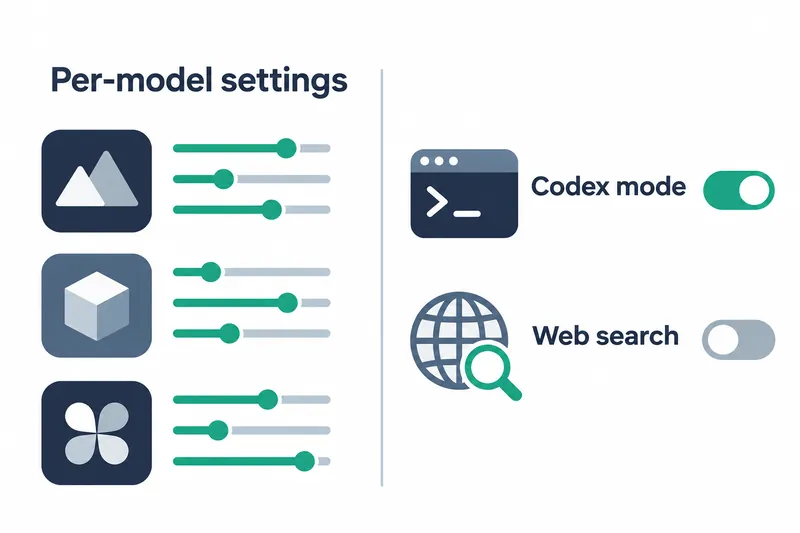
Xiaomi released its AI coding tool MiMo-Code 0.1.17 on November 13. Developers now use model metadata and explicit settings instead of settings inferred from model names. Dedicated coding mode and built-in web search become opt-in features.
1. Using metadata and settings instead of model names
According to the release notes, context and output limits and reasoning effort now come from models.dev metadata and user settings, not model-name guesses. Context is the input a model can handle at once. Reasoning effort sets how much work a model puts into reasoning when generating an answer.
The default request no longer includes temperature and top_p, which control sampling, or how answer candidates are selected. Sampling values and step termination conditions now follow model metadata. Requests thus rely on explicit information rather than markers in model names.
Reasoning effort is available in /variants under the level names defined in the configuration. Subagents that handle delegated tasks inherit the parent session's effort level, applying the same reasoning setting to delegated work.
2. Coding mode and web search become optional
The automatic application of Codex-style prompts and tools to GPT models has changed. All models now use the same default setup. Choosing a model and enabling a dedicated coding configuration are now separate decisions.
Built-in web search no longer uses the Xiaomi gateway, and Exa search is now opt-in. The release notes also explain how to add MCP servers, which follow a protocol for connecting external tools, to connect external search tools.
The environment variables for enabling dedicated coding mode and built-in search are shown below. The first line enables coding mode, and the second enables search. Select the ones for the features you need.
MIMOCODE_CODEX_MODE=true
MIMOCODE_ENABLE_EXA=1
DuckDuckGo search has also been restored as a fallback in research prompts. Alongside making built-in search optional, the update revises a separate search path. Users who need search should first check how their tools connect to it.
3. Fixes for retries after quota exhaustion and failed compaction residue
The update fixes requests being retried after usage limits are exhausted. It also limits repeated empty steps during checkpoint recording, the process of saving task state for recovery.
It also fixes boundary metadata left behind after conversation compaction fails. This metadata marks the start and end of compaction, which condenses conversation content. The fix prevents this residue from remaining in the session after a failure.
Request body logging has also stopped. This changes the scope of request information retained in logs.
Memory search now finds relevant content using partial Chinese strings, and existing indexes are migrated. These indexes organize content for searching. Users retrieving memories stored in Chinese may notice this search change directly.
Xiaomi API keys and Token Plan keys can now be used while signed in with both. The two credentials, which verify identity, are stored as separate providers. This allows both key types to be managed in the same tool.
4. Feature selection shifts to configuration management
The benefit is that model selection and feature selection can be managed separately. Users who want the previously automatic dedicated setup must now enable it and check their model metadata and settings. After updating, they should review whether their reasoning effort and search connections fit the new defaults.
Cloud session sharing and third-party uploads have also been removed. Users of these features need to account for changes to their sharing workflow when planning the update.
MiMo-Code 0.1.17 removes model-based guesswork and expands explicit choices through configuration.