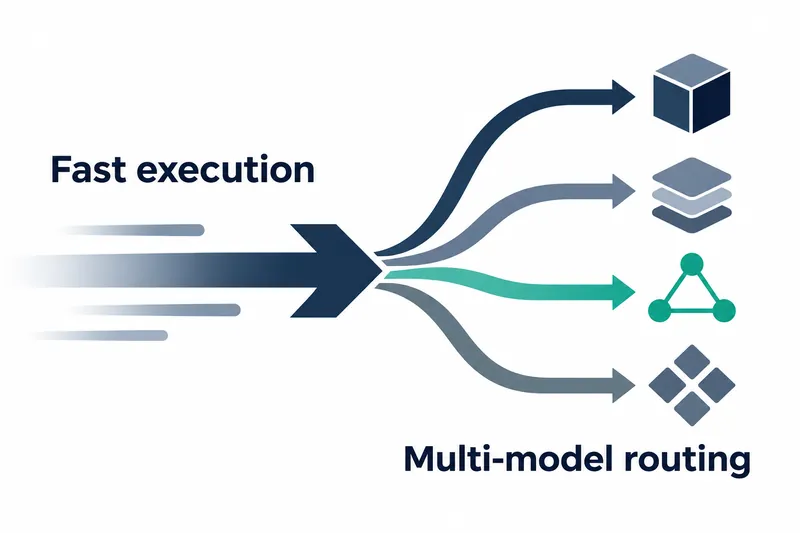
Google unveiled Gemini 4 Hydrogen on November 12 to help developers handle repetitive coding and testing faster. It also offers automatic model switching within a task. For complex tasks, a model strong in judgment plans, while one strong in execution handles edits and verification.
1. Focus on repetitive code edits and testing
Gemini 4 Hydrogen focuses on frequently repeated tasks such as writing code, exploring repositories, and testing. While Carbon and Argon handle problems requiring deep reasoning, Hydrogen handles everyday development alone or alongside them.
According to Google, Hydrogen finishes tasks 2.5 times faster than Gemini 3.8 Flash at the default reasoning level, which sets how deeply the model seeks answers. It scores 57% on Terminal-Bench 4.1, a coding task benchmark, versus 3.8 Flash's 18.2%. The company also says fabricated claims based on guesses fell by more than a factor of 5.
When exploring repositories, it batches file-reading and search tool calls for parallel processing rather than reading files one by one. Google says it also improved how the model adjusts its next action when tool calls fail or searches return no results.
2. Switch between judgment and execution models during a task
Antigravity's Orchestrator differs from choosing one model for an entire task based only on the initial request. Carbon can inspect dependencies in read-only mode and plan, then Hydrogen can edit code, update packages, and test. If Hydrogen gets stuck, Carbon reviews the current state, replans, and hands execution back.
According to Google, Orchestrator achieved a task success rate close to Carbon's on Terminal-Bench 4.0 while using 24% less quota on average and finishing tasks 19% faster than Carbon. However, the Antigravity blog labels the benchmark version for the same results as Terminal-Bench 4.1.
Orchestrator reduces manual model switching at each step and splits judgment and execution as long tasks progress. Developers seeking direct control over roles can combine Carbon and Hydrogen through the Antigravity SDK. Carbon can also coordinate Hydrogen agents that handle coding and verification in parallel.
3. Adjust speed and cost through reasoning depth
Hydrogen offers four reasoning levels. Lower levels suit light conversation or high throughput, while the default high level is a starting point for complex coding or tool use. The highest level targets difficult multistep tasks that the default level cannot solve.
Assigning repetitive tasks to a fast execution model can reduce usage of higher-level reasoning models. However, raising the reasoning level increases token usage and wait times, and reasoning tokens count toward output charges. Google recommends evaluating each task and choosing the lowest level that meets quality requirements.
Paid tiers apply the same unit rates across the entire context window, the amount of information a conversation can hold. Cached input that reuses stored input costs less, so input reuse also affects costs for tasks with repetitive input.
Table: Hydrogen paid-tier token pricing
Conditions: Gemini 4 Hydrogen, paid standard rates across the full 1M context window, cached input rates apply to implicit cache hits
Unit: Dollars per 1 million tokens
| Item | Rate |
|---|---|
| Input | 1.50 |
| Cached input | 0.075 |
| Output and reasoning | 7.50 |
4. From free API access to subscription-based automatic switching
It is available on both free and paid tiers in Google AI Studio and the Gemini API, and developers can also build in Android Studio. Enterprise users can access it through Gemini for business.
In Antigravity, paid Google AI Pro and Ultra subscribers can select Hydrogen as a standalone model. Orchestrator is rolling out as a Carbon and Argon option for Ultra subscribers and an Argon option for Pro subscribers.
5. Check default reasoning settings and output size in existing apps first
Input, reasoning, and output share a unified window of up to 1,048,576 tokens. Synchronous responses, which wait until the request finishes, support up to 65,536 tokens. For longer output, raise the output limit and use background execution or the continuation feature.
Migrating from 3.8 Flash changes the default reasoning level from medium to high. Below is Google's example requesting an interactive web app at the default level without additional settings.
from google import genai

client = genai.Client()

interaction = client.interactions.create(
    model="gemini-4-hydrogen",
    input="Build an interactive single-file HTML token bucket rate-limiter simulator with live sliders for burst size and request traffic."
)

print(interaction.output_text)
Hydrogen's core value is not just fast standalone execution, but connecting judgment and execution models within a single session for complex development tasks.