Liquid AI has released a model that reasons before answering while using only part of the full model for computation. Developers building AI that calls external tools on-device now have another option for reducing computational demands.
1. Computing with only part of the model and reading longer contexts
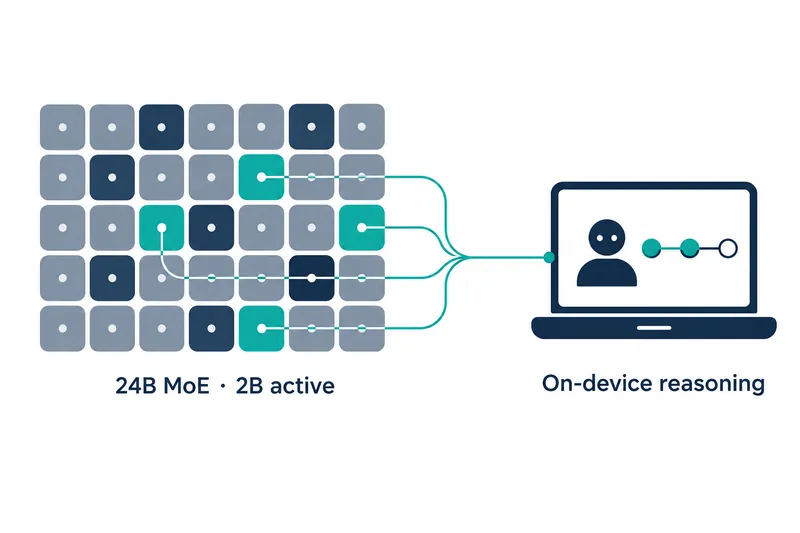
LFM2.5-24B-A2B has 24 billion total parameters, with 2.45 billion active per token. The ‘2B’ in its name is shorthand, and a token is a unit the model uses to process text. Its mixture-of-experts (MoE) architecture deploys only some of its work teams, selecting 4 of the 64 experts in each block.
Compared with its predecessor, LFM2-24B-A2B, its context capacity has grown from about 32,000 to 131,072 tokens. Its vocabulary has also expanded from about 65,000 to 128,000 entries, aiming to improve handling of non-Latin scripts such as Korean.
The source describes it as a model that always reasons before answering, unlike its predecessor. Its chat template directly inserts a reasoning-start tag at the beginning of a response. This change in response behavior is separate from its support for longer contexts.
2. Assessing on-device speed alongside measurement conditions
The company's own device measurements used llama.cpp, Q4_K_M quantization, and an input context of 4,000 tokens. Quantization reduces storage requirements by representing weights with fewer bits.
Under these conditions, the company reported generation speeds of 184 tokens per second on Apple's M5 Max and 114 on the AMD Ryzen AI Max+ 395. It reported speeds up to 1.7 times those of the next-fastest model tested. These results cannot be generalized to other hardware or settings.
3. Running locally and connecting tools are separate steps
Local execution can use the GGUF format and llama.cpp. The following command is reproduced unchanged from the converted model's card.
llama-cli -hf LiquidAI/LFM2.5-24B-A2B-GGUF \
    --temp 0.1 --top-k 50 --repeat-penalty 1.05
Recommended generation settings are also stored in each file's metadata and applied as defaults. To connect an agent, run the model as a local server and configure the program managing tasks to connect through an OpenAI-compatible API.
Tool use proceeds through tool definitions, call generation, call execution and returned results, then a final answer. The model generating a call and the program actually executing a tool are separate steps. Calls use Python-style lists by default, but system instructions can request JSON output.
4. Tool-use scores do not substitute for knowledge capabilities
One comparison model in the model card is Qwen3.6-35B-A3B. Both evaluations below used vLLM, but their generation settings differed, so comparisons between the two models should stay within each evaluation.
On the LiveClaw agent-task evaluation, this model scored 48.09 against the comparison model's 38.19, with temperature 1.0 and a maximum output of 8,192 tokens. Temperature controls randomness in output selection.
On the GPQA Diamond knowledge evaluation, however, it scored 74.42 against the comparison model's 83.69, with temperature 0.6 and a maximum output of 32,768 tokens. The company also advises against standalone use for knowledge-focused tasks and recommends combining it with retrieval or web search.
The SWE-Bench Verified code-editing evaluation used OpenCode, temperature 0.6, and a maximum output of 32,768 tokens. This model scored 51.00, while the comparison model scored 66.20. Strength in tool calling does not imply superiority across coding tasks.
5. Distinguishing computational savings from deployment costs
Activating only some parameters saves computation per token, but does not eliminate storage demands for the full weights. The converted model page lists 4-bit files of 13.6GB and 14.5GB. Because the model also generates reasoning, both reasoning and answer lengths matter; total generation volumes per task were not provided.
Among the 4-bit versions, Q4_0 is a QAD checkpoint trained to recover accuracy lost through quantization. Its file size is not equivalent to the memory required to run it, and total memory requirements by context length were not provided.
Both model cards list the license as lfm1.0. It restricts commercial use based on an annual revenue threshold of $10 million. That threshold does not apply to noncommercial and research use by qualifying nonprofit organizations. Businesses must check this clause before deployment, regardless of download availability.
This model is better viewed as a candidate to consider for combining on-device reasoning and tool execution than as a replacement for general-purpose knowledge answers.