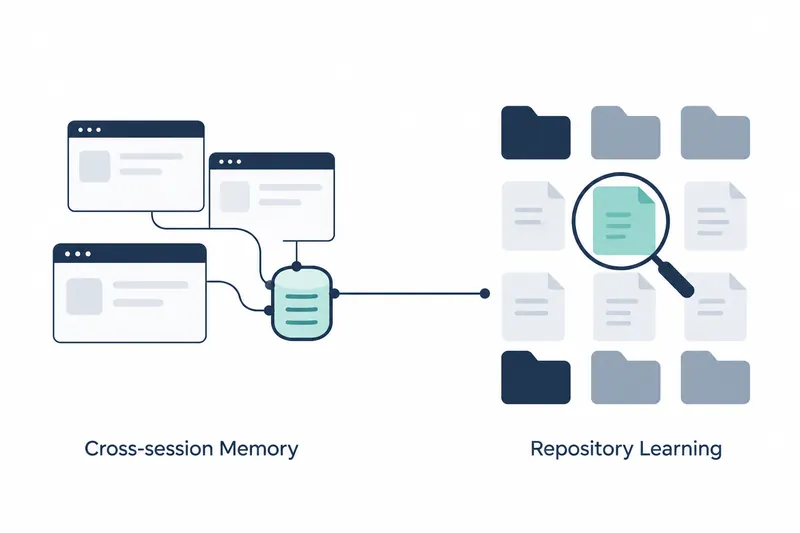
GitHub announced GitHub intelligence, which lets Copilot reuse personal preferences and repository conventions learned from earlier tasks. Developers can repeat fewer explanations and search related repositories without cloning them locally. This helps them understand relationships between code scattered across projects.
1. Carry team knowledge into the next task
GitHub intelligence is a layer that lets agents use context and learning from GitHub's data graph, a network of interconnected data. It uses personal preferences, repository conventions, custom instructions, and code from related repositories to reduce the need to gather knowledge again each session. Think of it as a notebook that carries team knowledge into the next task.
Its features are memory for retaining knowledge, dreaming for revisiting past work to update memories, and code search for exploring related repositories. Repository memories can include why a particular exception matters and which tests check it.
2. Memory reduces repeated instructions
Memory is generally available on paid Copilot plans. It carries personal preferences and repository conventions across sessions and clients. Copilot sessions create and organize memories based on interactions.
For example, it can remember a preference to start pull request descriptions with a short summary, or the test commands a team expects, and apply them to later tasks. Users can view or delete saved preferences in personal settings.
Memories are created across work environments, including the Copilot app, command-line tools, editors, cloud agents, code review, and mobile apps. Environments that support interactive memory management include the Copilot app, CLI, and VS Code.
According to the company, agents followed developer preferences better in 93% of reviewed Copilot CLI sessions that used memory during the public preview. In 42% of the same reviewed sessions, memories included in the session context made workflows more efficient.
3. Dreaming refines guidance from past work
Dreaming is a public preview feature that revisits past work to improve context for future agent sessions. It can organize memories from personal conversations, improve repository memories, skills, and instructions, or turn repeatedly accepted code review feedback into review instructions. Skills are task procedures agents can use.
Dreaming can add, edit, and delete personal and repository memories. Changes to skills and custom instruction files stored in a repository are proposed as pull requests for team review.
4. Search repositories without cloning them
Code search helps Copilot find code, configuration, schemas that define data structures, and documentation in related projects and dependencies without local clones. It supports exact text, symbols or names identified in code, and regular expressions that describe string patterns. Searches can be narrowed by repository, path, and language. Semantic search finds code by describing its behavior, even without knowing file or function names.
For example, suppose retry handling for failed payments is spread across a payment service, shared libraries, and background jobs. A developer can use /research to ask how each component retries payments and where retries might overlap.
Copilot examines implementations and call sites across those repositories to help explain how system components fit together. It can also identify migration targets and old API usage across repositories, trace implementations related to bugs, and find an organization's existing patterns in unfamiliar repositories. Its practical benefit is reducing the effort of cloning projects, finding files, and copying code into a conversation.
5. Convenient memory updates come with costs and review
Dreaming is an opt-in feature. Individual subscribers enable personal memory organization in personal settings and repository dreaming in each repository's settings. In organizations and enterprises, administrators enable it through policies, and enterprise administrators can delegate configuration to organization administrators.
Repository dreaming operates within the scope allowed by memory's repository access settings, and users must also enable personal dreaming. Each dreaming run consumes AI credits, the units used to measure AI feature usage.
The benefits of fewer repeated instructions and less context gathering come with credit costs for updating memories and the work of reviewing proposed repository file changes. As teams use automatically refined instructions, they also need to incorporate proposal review into their workflows.
GitHub intelligence moves Copilot from a tool that waits for explanations each time toward one that starts the next task with knowledge the team has accumulated.