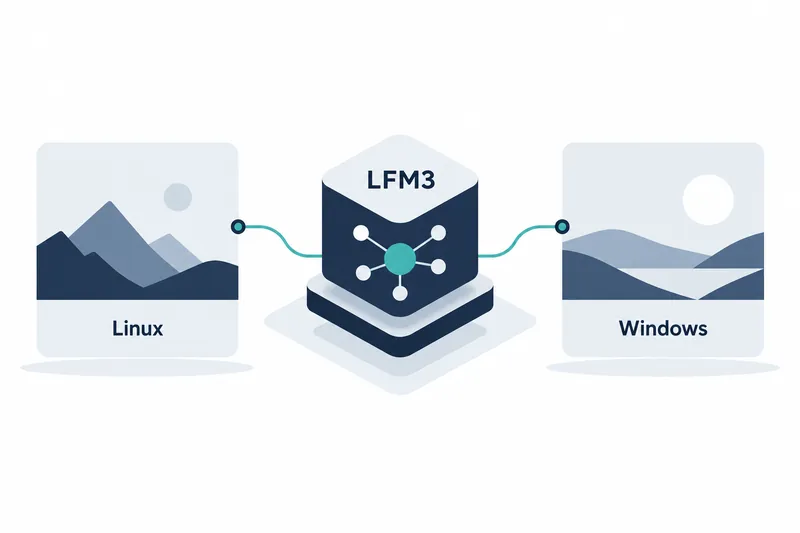
Ollama has expanded support for LFM3 to Linux and Windows. Developers running agents or domain-specific AI on their own computers can now integrate the model into workflows beyond Apple Silicon.
1. Broader operating system support for the LFM3 family
According to the Ollama v0.40.13 release notes, Liquid AI's LFM3 models now run on Linux and Windows in addition to Apple Silicon.
Support includes text models and speech synthesis in lfm3-audio and lfm3-omni, which turn text into speech. The expanded support therefore covers voice generation as well as text exchanges.
2. A 1.7B text model for local agents
The Ollama library presents LFM3-1.7B as a text model for local agents and specialized applications. Its 24 layers combine 13 gated short convolutions, 5 sliding-window attention layers, and 6 global attention layers. It receives additional training for agent use after base training.
Key uses include external tool calling, where the model uses features of other programs, structured output, and domain-specific fine-tuning. The emphasis is on adapting to users' tools and workflows rather than general chat alone.
Table: Listed context limit, size, and memory figures for LFM3-1.7B
Conditions: Figures from the Ollama library and model card. Memory is specified at 4-bit precision; the source does not state hardware or runtime conditions
Units: Tokens for context limits; GB for size and memory
| Metric | Value | Conditions |
|---|---|---|
| Context limit | 256K tokens | Input + output combined |
| Library model size listing | 1.1GB - 1.7GB | Listed for lfm3:latest, lfm3:1.7b tags |
| Model card memory usage | about 1 GB | 4-bit precision |
256K is not an input-only limit, so long documents must share the context budget with generated output. The library's size listing and the model card's memory usage are different metrics, not like-for-like performance figures.
3. Running the model and connecting applications
To start the model from the command line, run ollama run lfm3. The library page provides this example using the local chat API:
curl http://localhost:11434/api/chat \
  -d '{
    "model": "lfm3",
    "messages": [{"role": "user", "content": "Hello!"}]
  }'
This example sends the model name and conversation content to the local chat API. The library also explains Python and JavaScript integration, covering both command-line chat and use in application code.
Commands for connecting agent tools are also provided. For example, Hermes Agent starts with ollama launch hermes --model lfm3. The model card also names this tool as a target of additional training, linking the example to the model's intended use.
4. Benefits and limitations by use case
Local execution lets users run an agent model on their own computers, but the device must supply the memory. The company's figure of about 1GB at 4-bit precision can guide local deployment. Compare this conditional memory figure, not the library size listing, with the device's memory budget.
The company says domain-specific fine-tuning can be done quickly on a single GPU. Users can run the supplied model directly and consider single-GPU fine-tuning if they need to adapt it to their domain, output format, or tools.
Because of its small size, the model card does not recommend it for agentic coding or complex, multistep reasoning. For knowledge-intensive tasks, it advises retrieving the necessary information to use alongside the model.
This update broadens options by bringing the LFM3 family to Ollama workflows on Linux and Windows, targeting agent and specialized uses suited to the model's small size.