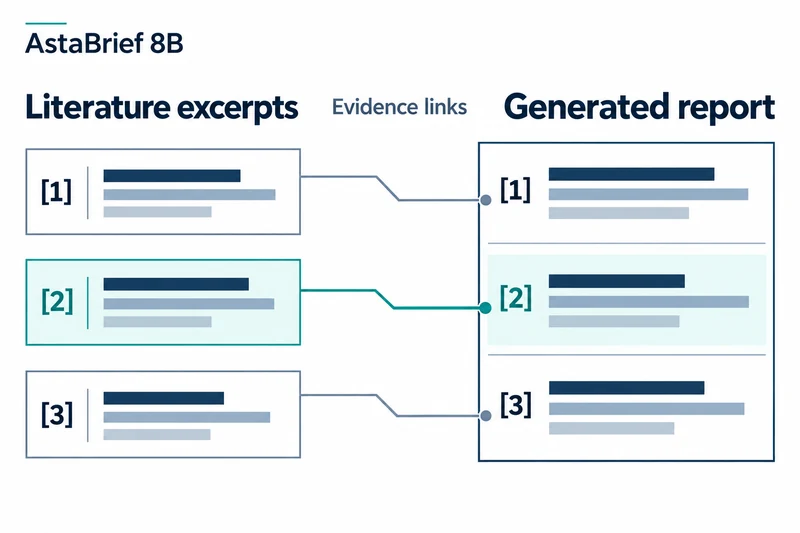
Ai2 released AstaBrief 8B on October 2. It turns a research question and retrieved literature excerpts into a cited report and runs the Fast mode of Asta’s report feature.
Ai2 says Fast mode averages 51.1 seconds per report across the full Asta pipeline, against 178.5 seconds for Claude-powered Thinking mode. That is roughly 3.5x.
The gap comes from the structure. Thinking mode summarizes and clusters excerpts and writes section by section, while AstaBrief was trained to produce the final report in one pass from the question and excerpts.
Most training and evaluation finished in 2025, and Ai2 says it has not rerun the full evaluation against today’s frontier models. That makes the speed hard to read as a current comparative advantage.
Citation-ID excerpts as the model’s input
The checkpoint is allenai/AstaBrief_8B, starting from Qwen3-8B and trained with SFT and offline DPO.
The model card recommends using the training prompt format at inference. It notes that a different format may lead to degraded or inconsistent behavior.
That prompt supplies the question with excerpts keyed by citation IDs and has claims from the model’s own knowledge marked separately as (LLM Memory).
The references are given as input rather than found by the model. The checkpoint alone does not retrieve or verify literature.
Apache 2.0 model, CC BY-NC 4.0 data
The model card states an Apache 2.0 license and research and educational use.
The SFT and DPO data cards are CC BY-NC 4.0 and note that synthetic outputs from third-party models follow each provider’s terms. The prompt repository also carries a CC BY-NC 4.0 label.
Published license labels do not settle permission for a particular deployment. Nor does every component inherit the model’s license.
Auditing citations with fixed questions and excerpts
In practice, report quality is tied to the quality of the input excerpts. Whether each citation actually supports the adjacent claim appears to matter before generation speed.
Even a correct citation can broaden a study’s population or conditions. Counting (LLM Memory) claims separately makes the review burden easier to see.
The inference settings on the model card are below. The approach is to fix one set of questions and excerpts, generate with these settings and record whether citations resolve and match the evidence.
model_name = "allenai/AstaBrief_8B"
sampling_params = SamplingParams(
    temperature=0.7,
    top_p=0.95,
    max_tokens=4096,
)
This is a proposed review procedure; this article did not run the model or reproduce a benchmark. Retrieval, parsing and serving also need checking before the whole workflow can be called local.
AstaBrief’s speed can be trusted no further than the evidence retrieval hands it.