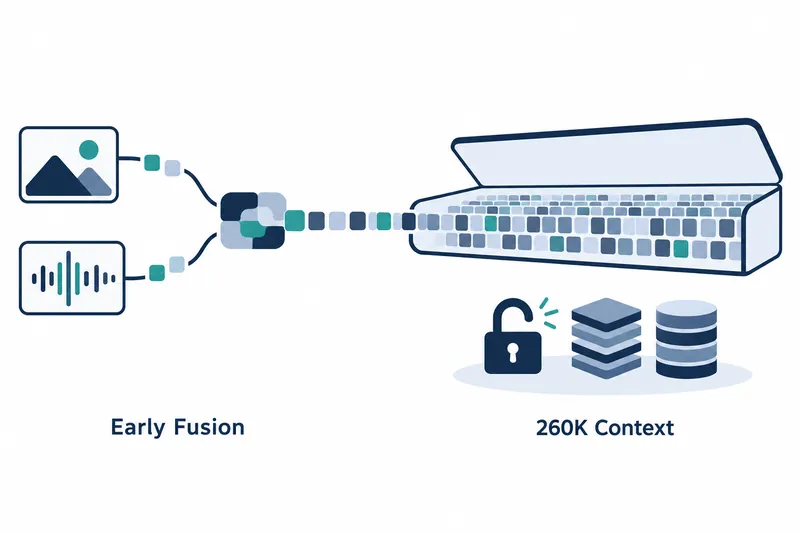
Released by the Swiss AI Initiative, Apertus 1.5 adds image and audio input to models that handled text and quadruples how much they can read at once. Developers can examine model weights, training resources, and stage-by-stage weights to assess suitability or reproduce training.
1. An update built through continued training
Rather than rebuilding the previous generation from scratch, the team continued pretraining to develop foundational capabilities. It added 4 trillion tokens to the 8B model and 2 trillion to the 70B model, bringing total training to 19 trillion and 17 trillion tokens, respectively. Tokens are the units a model processes.
The weights were released on July 24, 2026, under Apache 2.0. The technical report was released on October 11, followed by release notes summarizing it on October 15.
The context length is 262,144 tokens, four times that of the previous generation. The team says users can select a thinking mode that reasons before answering, and that instruction following and external tool use have improved.
2. A design that first combines inputs as tokens
The core approach is early fusion: combining different inputs in the tokenizer, which converts inputs into tokens. Instead of adding a separate vision encoder, it puts images, audio, and text in the same token sequence, expanding token types while leaving the model architecture unchanged.
Images are processed with the Emu3.5 tokenizer. A 512×512 image becomes 1,024 tokens. Audio uses WavTokenizer at 40 tokens per second. The team says spoken language understanding remains experimental.
3. Training process and released resources
Pretraining introduced the new inputs through standalone images and audio, then linked them to language using paired captions and transcripts. It continued with math and code data and long-context training. More than half of the training tokens were text-only to preserve existing language capabilities.
Post-training refined responses by learning from example answers using 3.7 million text samples and image and speech data. It then revisited long contexts and incorporated verifiable rewards and response preferences. Among the released final models, only 8B underwent the final alignment stage based on a constitution.
The base model and weights from each post-training stage are available, allowing researchers to investigate when response characteristics changed. The report covers data composition, training settings, and experiments that vary individual elements to test their effects.
Instructions for running the models are in the model cards and quick-start guides on the distribution pages. The following is not model execution code, but a command for reading the paper provided on the report page.
hf papers read 2610.155424. Performance claims and deployment caveats
The team reports that the 8B model outperformed similarly sized open-weight models on instruction following and multilingual tasks, and that thinking mode helps mathematical reasoning. However, it also says overall performance trails the leading open-weight models.
The report rates image and audio understanding as competitive with fully open multimodal models. It notes that specialized models lead in visual recognition and speech transcription for data-rich languages such as English.
Broader input support and longer context are advantages, but images and audio also become tokens and occupy context space. Output remains limited to text, so this is not a model for generating images or speech.
When comparing scores, consider who performed the evaluation, how the model was accessed, and the response generation settings. The project records this information with evaluation results and provides open evaluation tools to rerun text evaluations under the same settings.
Apertus 1.5 matters less for top performance than for developers examining input and context expansion within an existing architecture alongside openly documented training stages.