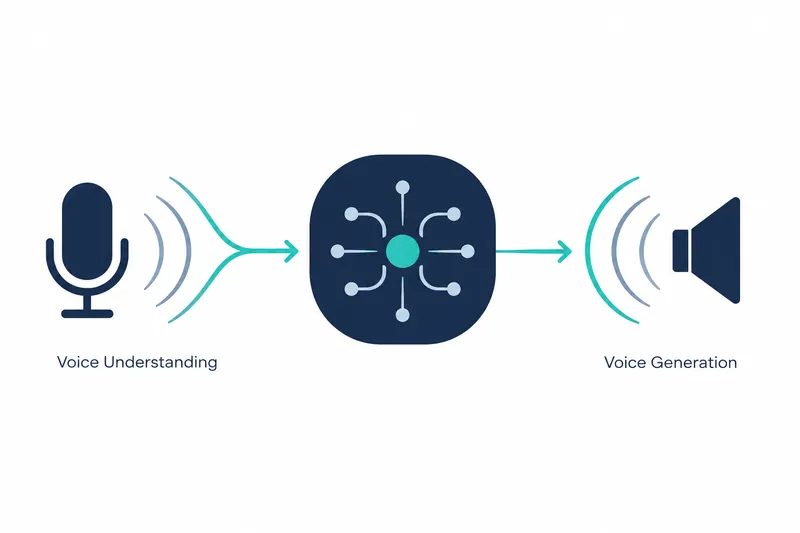
ServiceNow released an open model that understands voice requests and generates answers and tool calls in context. Developers building voice assistants or customer support services can connect listening and subsequent decisions in one model. They need not pass speech recognition results to a separate language model.
1. Speech and screens share one conversational context
Apriel Voice 27B Preview is based on the post-trained Gemma 4 26B-A4B model. An audio encoder converts audio into numerical representations, and a trained connector passes them to the existing reasoning model in a compatible form.
Training had two stages: first freezing the reasoning backbone and training the connector, then jointly tuning the connector and the reasoning backbone.
The model weights use the MIT license.
Speech, text, images, and tool results enter the same conversational context. For example, a user can describe an account lockout aloud and share a screen, letting the model consider both to decide what to do next. The app executes tool calls and returns their results to the conversation.
2. Synthesizer flexibility comes with app implementation work
An external speech synthesis service turns answer text into speech. The Apriel Live app uses Cartesia Sonic 3.6, captures audio, detects when speech ends, and controls interruptions. Synthesizers or voices can change without retraining the reasoning model, but deployers must integrate these supporting functions.
The model card specifies a standard image based on vLLM 0.32.0, running a server on four GPUs with an OpenAI-compatible API on port 8000. The settings below are copied verbatim from the original serving command.
  --max-num-batched-tokens 16384 \
  --tensor-parallel-size 4 \
  --gpu-memory-utilization 0.95 \
  --speculative-config '{"model":"google/gemma-4-26B-A4B-it-assistant","num_speculative_tokens":3}' \
  --default-chat-template-kwargs '{"enable_thinking":true}' \
  --enable-auto-tool-choice \
  --tool-call-parser gemma4 \
  --reasoning-parser gemma4
3. Accuracy and conversational experience were evaluated separately
The company reports English EVA-A accuracy of 51.27% and an EVA-X conversational experience score of 74.13%. The former assesses task completion faithful to speech content and facts; the latter covers conciseness, conversational flow, and turn-taking.
On τ-Voice, which tests airline, retail, and telecom tasks, the company reports a task success rate of 65.51% and average response latency of 1.91 seconds.
EVA and τ-Voice evaluations enabled thinking mode, which reasons before answering, and averaged results with equal weight for each domain.
The evaluations used an optimized serving configuration and Cartesia Sonic 3.5 synthesis. Latency represents the full system, including answer generation and speech synthesis.
Table: English voice evaluation of Apriel Voice and Flux + Gemma 4-26B (company-reported)
Conditions: EVA and τ-Voice use equal-weight domain averages; Apriel uses thinking mode. Both systems use Cartesia Sonic 3.5 synthesis. Latency covers the full system, including response generation and synthesis.
Units: EVA and success rate in % (higher is better); latency in seconds (lower is better)
| System | EVA-A (%) | EVA-X (%) | τ-Voice success rate (%) | Latency (seconds) |
|---|---|---|---|---|
| Flux + Gemma 4-26B | 36.07 | 29.22 | 65.92 | 2.92 |
| Apriel Voice 27B Preview | 51.27 | 74.13 | 65.51 | 1.91 |
Apriel exceeds Flux + Gemma 4-26B by 15.20 percentage points on EVA-A and 44.91 on EVA-X. Its τ-Voice success rate is 0.41 percentage points lower, while average latency is 1.01 seconds shorter. Against this baseline, the τ-Voice advantage is faster responses rather than higher success. These company-reported full-system comparisons cannot attribute the differences to a single model component.
The company reports an audio reasoning score of 85.84, an equal-weight average across 8 benchmarks using audio input in thinking mode.
On four H100 80GB GPUs, optimized output token throughput was 1.96x the existing Apriel vLLM setup at 1 concurrent request and 1.83x at 50. This measures generated tokens per second and is distinct from conversational latency.
4. Text reasoning was also checked after adding voice
The model card also presents text evaluations before and after adding voice capabilities. Below is a selection of company-reported results with both models using text input and thinking mode.
Table: Text evaluation before and after voice adaptation
Conditions: Gemma 4 26B-A4B and Apriel Voice, text input, thinking mode
Units: Score (0–100, higher is better)
| Benchmark | Gemma 4 26B-A4B | Apriel Voice |
|---|---|---|
| MMLU-Pro | 85.27 | 84.42 |
| GPQA Diamond | 77.80 | 80.40 |
| MATH-500 | 92.76 | 92.88 |
Compared with the base model, MMLU-Pro fell 0.85 points, GPQA Diamond rose 2.60 points, and MATH-500 rose 0.12 points. GPQA Diamond had the largest gain of these three, while MATH-500 changed little, showing that voice adaptation affected evaluations differently. This indicates that adding voice should be assessed not only for listening performance but also for how well existing text capabilities are preserved.
5. Split long recordings and verify important actions
Input is 16kHz mono audio, and the processor, which prepares audio for the model, splits long recordings into 30-second segments. The model card reports good performance on continuous recordings up to about 30 minutes. Audio and the rest of the conversation share the total context budget, and thinking mode is recommended for long recordings.
Performance may decline on longer recordings, with reliability limits for multilingual speech, noise, distant microphones, and complex tool tasks. For important tasks, the model card recommends checking tool arguments, the inputs passed to tools, as well as results and final completion, and applying human oversight.
Apriel Voice unifies voice understanding and reasoning in one model, but the quality of a conversational product depends on the application responsible for synthesis and turn handling.