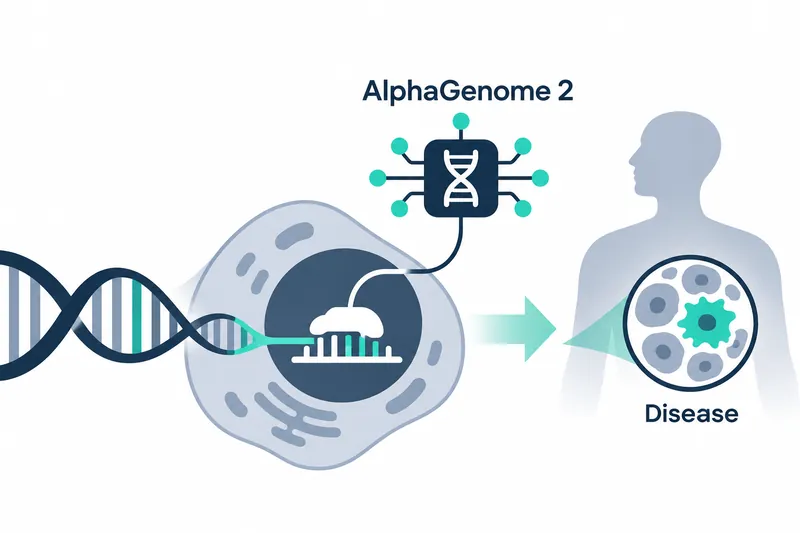
Google DeepMind has unveiled AlphaGenome 2 to predict how DNA variants affect gene activity across cell types and states. Genomics researchers can narrow variant candidates by cell. They can also estimate unobserved molecular measurements to prioritize their next experiments.
1. From tissue averages to specific cell conditions
The original AlphaGenome took DNA sequences 1 million letters long and predicted experimental results across tissues, cell lines, and lab-grown cell populations at once. This was efficient but struggled to distinguish closely related cell types in detail. The new model takes a tissue, cell type, or cell state as a condition to predict how the same DNA sequence is read differently in each cell.
Cell conditions are incorporated from the model's early stages through to its outputs. The architecture learns how different cells read the same blueprint differently.
The model predicts gene activity and chromatin accessibility: how open the DNA structure wrapped around proteins is. Methylation, the attachment of chemical marks to DNA, is also a new prediction target.
Training used bulk tissue measurements and single-cell data from humans and mice. The single-cell measurements comprise more than 107 million records from 68 tissues.
2. Improved cell-level variant predictions
According to the company, recall for candidate causal variants across 28 peripheral blood immune cell types in TenK10K was 30% at 90% precision. This exceeded the 16% of a baseline built by fine-tuning the previous model on single-cell data. Precision is the share of selected candidates that are correct; recall is the share of actual causal candidates found. The model thus found more candidates while maintaining their reliability.
The new model also had a higher area under the precision-recall curve, which summarizes performance across candidate selection thresholds. Below are results from the same evaluation in the company's paper. A larger area indicates better candidate discrimination.
Table: TenK10K candidate causal variant discrimination
Conditions: Pooled evaluation of 28 peripheral blood immune cell types; 6346 causal candidates and negative controls expected to have no effect, at 1:1; predictions using matching cell conditions from training data
Unit: Area under the precision-recall curve
| Model | Area under the curve |
|---|---|
| AlphaGenome 2 | 0.76 |
| AlphaGenome fine-tuned on single-cell data | 0.72 |
| Scooby | 0.69 |
According to the company, recall for predicting whether variants increase or decrease gene activity in TenK10K was 43% at 90% accuracy, versus 23% for the baseline. In a separate IBDverse evaluation of 47 intestinal cell types, directional recall at the same accuracy was 45% versus 31%.
3. Applying new cell data without retraining
Researchers can select cell conditions from a reference list or supply their own single-cell gene expression data. New data passes through a cell encoder that compresses cell states into representations used as prediction conditions, without retraining the model.
In the paper's TenK10K evaluation, variant effect prediction performance held up even with just 128, 16, or 1 cell per cell type.
Using vaccination study data, the model distinguished T cells activated by a COVID-19 vaccine from resting, unstimulated T cells. It also predicted that variants linked to severe COVID-19 could disrupt gene activity more strongly in the activated state.
The paper also reports an evaluation using brain tissue data from 190 people, including patients with Parkinson's disease and controls. The model predicted variant effect direction more accurately than a comparison model trained directly on the new data.
4. Precision gains and computational costs
Cell-specific predictions reveal signals that tissue averages may obscure. They also help select follow-up experiments by estimating unmeasured properties such as DNA accessibility. However, each condition requires a separate prediction, increasing computation compared with models that produce fixed outputs in one pass.
The paper describes how condition information is incorporated into the model's internal representations with the following pseudocode.
defFiLM(x: Array[B, S, C], c: Array[B, D]) -> Array[B, S, C]:
c = c * Parameter('input_scale', shape=[D], init=TruncatedNormal())
c = c + Parameter('input_offset', shape=[D], init=Zeros())
c = GeLU(c)
scale = Tanh(Linear(C, w_init=TruncatedNormal(1e-8), b_init=Ones())(c))
offset = Linear(C, w_init=TruncatedNormal(1e-8), b_init=Zeros())(c)
returnscale * x + offset
5. Research API and precomputed data
AlphaGenome 2 is available through an API for noncommercial research and interactive learning materials that use cell expression data as conditions. Commercial researchers can access it through a private preview.
The researchers provide precomputed links between genes and enhancers, DNA regions that regulate distant genes, across 640 conditions. They also provide prediction scores for about 7 million variants across 510 conditions, reducing the need for researchers to run large-scale computations themselves.
Source code and weights are planned for release upon final publication of the paper.
The model is for research and has not been validated or approved for clinical or diagnostic use. The researchers note that cell conditions learned from observational data reflect correlations. It remains uncertain whether the model can predict responses when genes are switched off or cell states change.
AlphaGenome 2's core value is narrowing genetic variants into cell-specific experimental candidates and using newly acquired cell data to prioritize the next experiments.