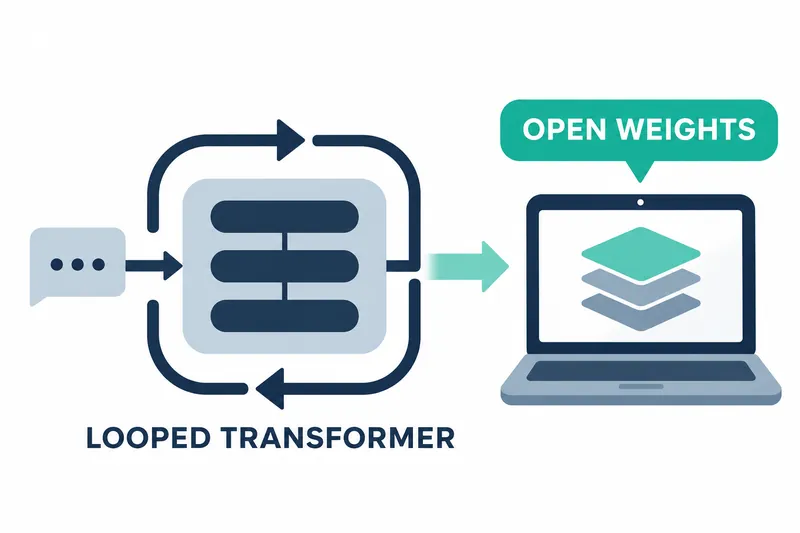
Thinking Machines Lab released Inkling 2 Mini on November 20, 2026, as an AI model designed for laptops and desktops. Developers building coding tools can download the weights for multistep problem-solving tasks and fine-tuning.
1. An architecture that repeats the middle layers
Inkling 2 Mini repeats computation by passing through its middle layers three times with the same weights. Reusing the same computation segment increases computational depth rather than model size.
The model card describes a mixture-of-experts model with 26.4 billion total parameters. It activates 3.4 billion parameters per token, or an effective 5.4 billion when repeated computation is included.
Of its 24 stored layers, 12 are traversed three times, yielding 48 layer computations per token. The company announcement reports larger accuracy gains from looping middle layers than the final 12 layers in 27 of 28 evaluations.
Most weights are trained and distributed in 4-bit NVFP4, while the final four layers use 8-bit MXFP8. The model card puts the distributed checkpoint at about 20GB.
It accepts text and images and responds with text, with a context length of up to 1 million tokens.
2. Coding evaluation results highlighted by the company
The company announcement reports a lead on DeepSWE v1.1 and Vals Index v2.2 among open-weight models with under 100 billion total parameters. Its score on the latter is 46.5%. The table below collects reported resolution rates using the same coding evaluation and evaluation tool. Evaluation environments may differ by model.
Table: DeepSWE v1.1 coding task resolution rates
Conditions: Company announcement, DeepSWE v1.1, mini-swe-agent v2.4.6
Unit: %
| Model | Resolution rate |
|---|---|
| Inkling 2 Mini | 48.2 |
| Qwen3.8-27B | 42.2 |
| Nemotron 3.5 Super VL | 24.7 |
| Muse Glimmer | 4.4 |
| Gemma 4 31B | 0.3 |
Inkling 2 Mini's 48.2% resolution rate exceeded Qwen3.8-27B's 42.2% by 6.0 percentage points. If resolution rates on these coding tasks matter most, this supports trying Inkling 2 Mini first as a candidate for local coding tools.
The company announcement also reports 77.9% on SWE-bench Pro v2 (Hard) and 5.6% on Terminal Bench v4.0 in other tests using the same evaluation tool. The latter tied the highest score among the competing models in the table.
3. Trading more computation for local use
The looped architecture enables more computation without lengthy intermediate reasoning output, but increases computation per token. The company announcement compares models before expert pruning. The non-looped model used 7.5% less training compute. However, it needed 140% more inference compute to reach the same prediction error on 512,000-token agent trajectories.
A variable-loop research model released alongside it allows experiments with different repetition counts. A separate company experiment tested some Think Fast tasks without reasoning text. At a 50% success rate, task length measured by human completion time rose from 16 seconds with one pass to 37 seconds with three passes.
A Stanford team's energy-efficiency evaluation in the company announcement scored Inkling 2 Mini at 0.703 and Qwen3.6-35B-A3B at 0.430. This metric evaluates the energy needed to reach a given performance level. Inkling 2 Mini ran on a DGX Spark 128GB with MXFP8 and low reasoning effort, while the comparison model used NVFP4, so precision settings differed.
4. How to download and run it
The weights are available from Hugging Face under the Apache 2.0 license. Tinker offers inference and fine-tuning.
The model card supports Apple silicon devices with at least 32GB of memory and recommends at least 32GB of VRAM for other GPUs. Ollama can be used on Apple silicon, while llama.cpp can run the quantized GGUF format.
The repository's chat template maps reasoning effort names to numeric values. The original code defining that mapping is:
{%- set effort_map = {"none": 0.0, "minimal": 0.1, "low": 0.2, "medium": 0.7, "high": 0.9, "xhigh": 0.99, "max": 0.99} -%}The model card notes weaknesses in multiturn conversations, complex instructions, and languages other than English. It recommends output and action limits, sandboxed execution, and confirmation before destructive actions to guard against repetitive reasoning and unconfirmed file deletion or overwriting.
Inkling 2 Mini's key proposition is testing open weights on small devices, using repeated computation to strengthen coding reasoning rather than moving an entire large model onto local hardware.