strata-mlx is an MLX engine that runs Qwen3.8-Flash-Next on Apple Silicon. It reads the GGUF files Strata uses and speaks Strata's line protocol, so Strata's server and web page can drive it.
Its README calls it an independent, unofficial, experimental project unaffiliated with Strata. It was announced on Reddit on October 10.
Small-machine figures simulated on a 128GB Mac
The engine keeps expert weights in the file's original quantized blocks and reads experts that do not fit in memory from the SSD as tokens ask for them.
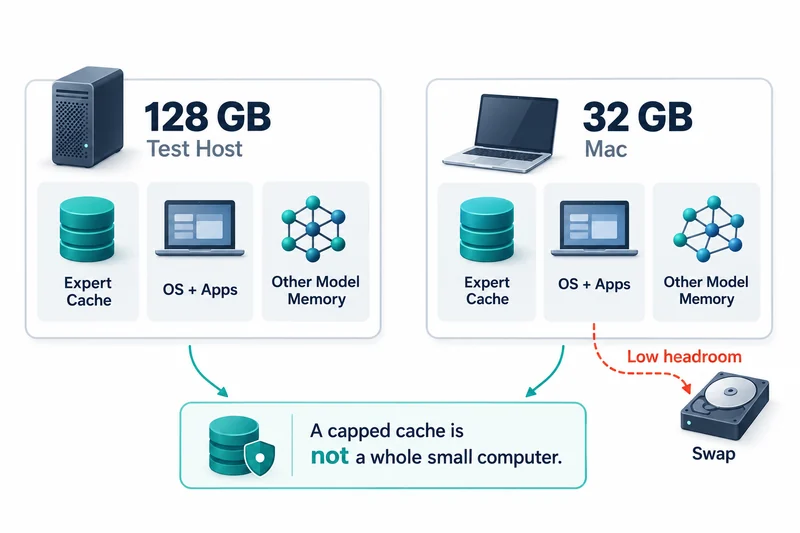
The early small-machine figures came from a 128GB M4 Max with the expert budget limited to stand in for 16, 24 and 32GB machines. That only limits how many experts the engine keeps; it does not make macOS and other apps compete for the same physical memory.
The current README separates those simulated figures from reports by owners of real machines.
Measurements on a real 32GB MacBook Air M5
Issue 6, opened October 11, collected contributor guoggg's measurements. The setup was a 32GB MacBook Air M5, macOS 27.0.1, MLX 0.32.3, commit 1d75ad4 and Q2_0 with the draft head.
At the default 20.5GB expert budget the mean was 11.9 tok/s with 106GB swapped out during the run; at 16GB it was 25.3 tok/s with 1.7GB. Each row is a single run of four prompts, two rounds of 200 tokens each.
Measured by contributor guoggg. Commit 1d75ad4, Q2_0 with the draft head and about 2GB of other programs open; bench/paged.py ran four prompts twice at 200 tokens each. Each row is one run.
| Experts in memory | Draft head mean (tok/s) | Range (tok/s) | Swapped out during run |
|---|---|---|---|
| 14 GB | 23.6 | 20.9–24.8 | not recorded |
| 16 GB | 25.3 | 23.4–26.8 | 1.7 GB |
| 18 GB | 15.4 | 12.0–24.4 | 39 GB |
| 20.5 GB (default) | 11.9 | 5.8–19.2 | 106 GB |
The maintainer concluded that the 4.5GB the engine left to macOS and other programs was too little. Even with all apps closed, macOS itself was using about 6GB.
The 106GB is swap traffic accumulated during the run, not swap the 32GB machine held at once.
Keeping one more expert in memory saves an SSD read for the engine but can push other memory out to OS swap. So maximizing the expert budget does not minimize the wait for answers.
Caveats: ongoing calibration on a single machine
The maintainer first shipped a default that leaves macOS 8.5GB (commit 2f9d1ab). With apps closed it matched the 16GB row, but a run with apps open swapped out 16.8GB.
An --expert-memory available option was then added to set the expert budget from memory available when the engine starts. In an October 13 run with many apps open, an 8.08GB budget gave a mean 17.1 tok/s with no swap-out.
The following 10GB and 12GB runs started with different free memory and compression states, so they do not show an optimal budget under equal conditions. All of this comes from one person's single machine.
Conditions to match when comparing on your own Mac
A comparison on an existing Mac can match the model revision, prompts, output length and background apps, and record swap changes alongside generation speed.
An idle test machine and a laptop whose editor and browser must stay responsive answer different questions.
A smaller cache is not always the answer
Too few resident experts means more deliberate SSD reads, and too many brings the hard-to-predict cost of swap. What this report shows is the process of finding that balance on one machine.
The strata-mlx 32GB Mac report is a case where protecting macOS's share of memory was faster than growing the expert cache, and it does not set a default for every Mac.