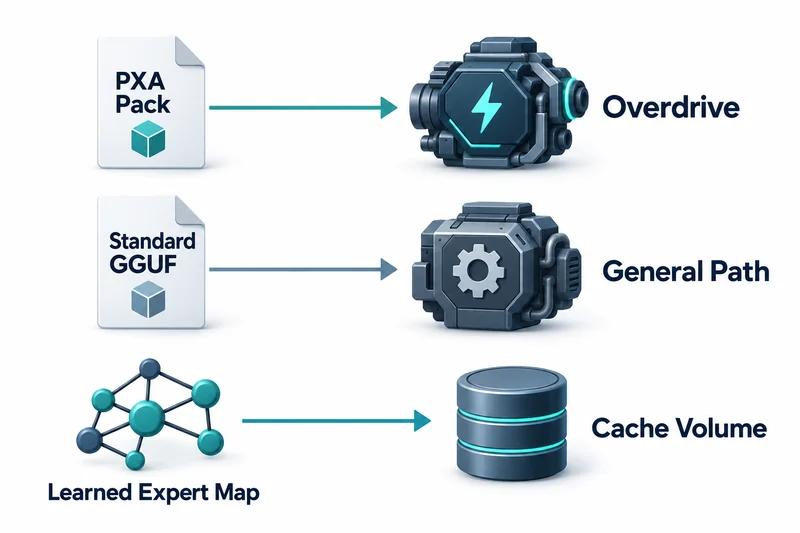
PXA v3.1 was released on October 11 Korea time (October 10 UTC). Its headline is the Overdrive preset, a speed setting for Flash-Next models tuned on a Tesla P100 and said to be faster on V100 and two-card setups as well.
v3.1 uses the same model files as v3. The Overdrive preset, however, needs the PXQN library that ships in the package.
File compatibility is not the same as speed tuning
The README describes PXA as a language-model server for Pascal and Volta cards such as the Tesla P100, Tesla V100 and GTX 1080 Ti. Its GPU code targets the P100 (sm_60), the 1080 Ti and P40 (sm_61) and the V100 (sm_70), using instructions these cards really have.
Standard GGUF quants such as Q4_K_M and Q8_0 also load and run on the same server. But the GPU code, planner and speed tables are built around PXA's own PXQ and PXQN files.
An expert map learned during use
Mixture-of-experts (MoE) models ship with a routing map, and the server can learn a second map from your own use. The learned map is saved after a session, used only when it measures faster than the shipped map, and survives restarts.
The release notes say the learned map beat the shipped map by about 12% on prose decode and 18% on code decode. With Overdrive on one P100, decode reached about 30.3 tok/s on prose and 34.9 on code.
These are the project's own figures from the v3.1 release build, measured at the same point in a session. They are not an independent benchmark.
Docker users need to mount the cache folder as a named volume so the learned map survives removing the container. The release notes give this mount argument.
-v pxa-cache:/work/.cache/pxaLearned state leaking into version comparisons
With a learned map kept, restarting the server does not return to the same starting point. If one run uses the learned map and another the shipped map, binary differences mix with adaptation effects.
When comparing versions, one option is to record the map state, or to split tests from the initial state and after adaptation.
Caveats: different licences for different components
The repository's licensing map separates the root inference engine under MIT from the PXQ4 quantization plugin for vLLM under Apache-2.0. The document says they are compatible but not the same licence.
The release notes say supporters can update and roll back the licensed library from PXA Control. This article did not audit that library's terms.
The release notes also say containers running Flash-Next with the expert cache on a machine with more than one CPU socket need the SYS_NICE capability.
An order of checks for P100 and V100 users
For existing P100 or V100 users, a natural order is to check first whether the wanted model has a PXA pack and whether the required library fits deployment needs.
Comparing real prose and code requests separately after that keeps different workloads from blending into one headline speed.
Choosing between a specialized format and portability
Standard GGUF is convenient when moving between engines, and a PXA pack is the right path for evaluating PXA's tuning. Neither is evidence that a new pack preserves quality on every task.
PXA 3.1's Overdrive speed comes from a deployment where the PXA pack, the bundled library and a preserved expert map are all in place.