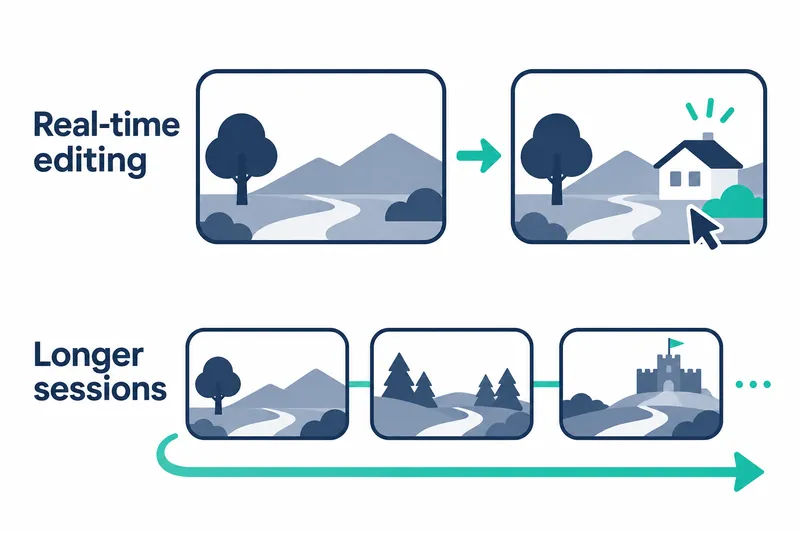
Google DeepMind announced Genie 4 for Project Genie in its November 18 announcement. This new world model is an AI that generates changes in virtual spaces. Users can edit scenes in real time with text while exploring and generate matching sound.
1. Change worlds and hear sound while exploring
In Genie 4, users can change the weather, add people and objects, and steer a scene using natural language while moving through a world. The October 27 research overview says requests are applied in context. Gemini continually observes the scene and breaks goals into steps. It reviews the images Genie 4 generates to check progress and whether each step succeeds. It adjusts the plan when the world changes or the user intervenes. Rather than only setting a prompt at the start, users can revise upcoming scenes as they explore.
Sound is generated alongside the world without a separate editing step. Google DeepMind describes Genie 4 as its first world model to generate real-time audio directly. Ambient sounds, such as wind through trees or waves on a beach, accompany scenes. Character dialogue changes in response to user input or events within the world.
2. Genie 3 focuses on longer exploration and panoramas
Genie 4 focuses on visual fidelity, or resemblance to reality, as well as physics, object motion and audio. Genie 3 handles longer exploration and tasks that start from panoramic images. Users can select Genie 3 in Project Genie for longer exploration or to start from a panorama, an image capturing a wide field of view.
The November 18 announcement details Genie 3's longer sessions. Exploration per generation rises from 60 seconds to up to 3 minutes (180 seconds). That is a 3x increase in the exploration time limit, not a 3x improvement in generation speed or performance. Users can start a new world from a 360-degree panorama. They can also change the environment with natural-language prompts during exploration.
Multiple worlds can also be connected into a continuous journey through forests, underwater ruins and icy seas. This suits users who want to explore a created space for longer or travel between different spaces.
3. Conversational creation and sharing change the workflow
The November 18 announcement introduces a new Project Genie agent. This AI coordinates multiple tasks. When users describe an idea in natural language, it coordinates image and sound models to create an initial scene and add background music to match the mood. Rather than relying on a single prompt for the entire result, creators can build worlds while refining their ideas through conversation.
During exploration, users can call on a Gemini model to observe the screen and suggest where to go next, or automatically trigger events that suit the journey.
In the new community gallery, users can explore worlds made by others and create their own versions by changing world structures, background music and rules. They can publish finished worlds in the gallery for others to explore and modify. The gallery also offers an experience that turns personal photos into spaces users can walk through.
4. Creative experiments speed up, but review remains necessary
The October 27 research overview features testers using Genie 4 to quickly try out creative drafts. Filmmakers test scenes by changing camera angles, lighting and dialogue. Photojournalists explore reconstructing environments from documentary photographs. Google says game developers explore ideas before writing game engine code, testing them as prototypes, early versions whose behavior they can examine.
Faster early visualization and iteration leave creators responsible for checking generated scenes for physical and spatial accuracy and continuity. Google discusses limitations in its October 27 research overview. Genie 4 is a research preview, a test release before a full launch. Visual details and the persistence of objects can vary during long exploration or complex edits. Research continues on complex physical interactions, sound and text rendering, spatial accuracy and long-term consistency, or how well content persists over time.
5. Access starts with eligible Ultra subscribers
The November 18 announcement outlines access. Project Genie's new experience rolls out to eligible Google AI Ultra subscribers starting November 18, 2026. Google AI Pro users can join a waiting list on the same page. The earlier October 27 research overview also outlined plans for early-access partners using the Gemini API and Google AI Studio.
Google describes safeguards in its November 18 announcement. It adds SynthID watermarks, markers that identify provenance, to generated video and audio, and applies safety checks to model inputs and outputs. These identifiers support the sharing workflow in which worlds are published and reworked.
The update goes beyond more realistic scenes: users can choose models for their goals, edit worlds while exploring and build on other people's creations.