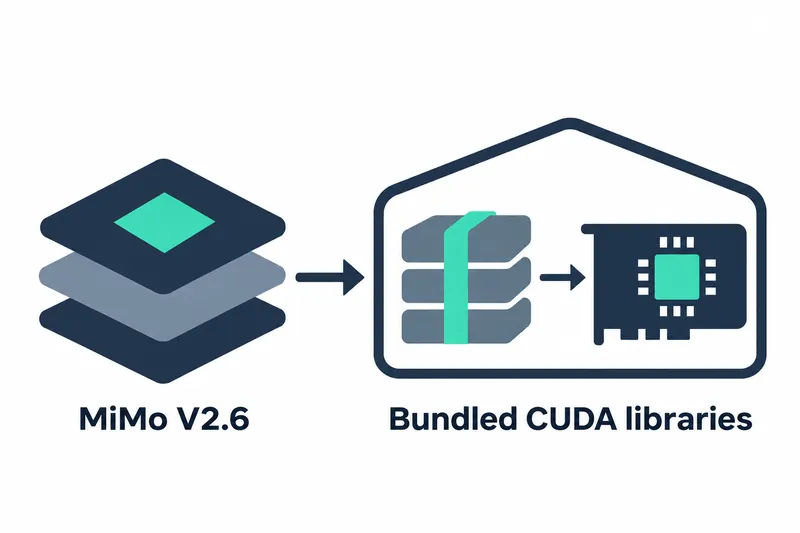
Ollama's new release candidate adds a model for coding and multistep tasks using tools. Developers can run it directly by model name, while Linux server operators can reduce model execution failures caused by GPU library version conflicts. Loading bundled libraries first prevents other versions installed on the server from interfering.
1. New model support and Linux fix included since the first candidate
MiMo support and the Linux library fix were included from this release's first candidate. The v0.40.15-rc2 tag and the final v0.40.15 tag point to the same commit, a record of code changes. The new model support described in the final release notes is therefore also available in this candidate.
The final release notes announce Ollama support for Xiaomi MiMo's 9B model for coding and agent tasks. The model library says it was fine-tuned from Qwen3.5-9B through additional training for specific uses. It handles text and images, supports reasoning and tool use, and offers a context window of up to 256K tokens.
2. Download and run directly by model name
Run it using the name registered in the official model library. The final release notes provide this example:
ollama run mimo-v2.6Ollama adds a renderer that converts messages and tool calls into the model's conversation format, while reusing the Qwen3.5 parser to interpret responses. The runtime handles model-specific formats instead of developers assembling conversation markers themselves.
The model library lists understanding unfamiliar code, investigating bugs and drafting fixes, and implementing features from screen images as example uses. Connecting tools also enables multistep tasks, expanding its uses beyond simple chat to development work.
3. Higher tool-task scores than the base model in company evaluations
In Xiaomi's company-reported evaluations, MiMo-V2.6-Distill-Qwen-9B scored 61.1 on SWE Verified and 44.6 on SWE Pro. Its base model, Qwen3.5-9B, scored 60.0 and 32.0, respectively. Both evaluations use avg@3, the average of three attempts.
For tool and agent tasks, the two models were compared using avg@1, based on a single attempt. The results below appear in the model library and are company-reported figures.
Table: Scores by model in tool and agent evaluations
Conditions: Qwen3.5-9B and MiMo-V2.6-Distill-Qwen-9B; each evaluation uses avg@1.
Unit: Score
| Evaluation | Qwen3.5-9B | MiMo-V2.6-Distill-Qwen-9B |
|---|---|---|
| AutomationBench v1.0.6 | 5.0 | 30.3 |
| Terminal Bench 2.1 | 27.0 | 37.1 |
| Toolathlon-Verified | 25.9 | 35.2 |
The new model scored higher than the base model in every evaluation in the table. Detailed evaluation settings and additional results are provided in the model card, which documents configuration and usage, and the technical report.
4. Loading bundled libraries first resolves version conflicts
On Linux, MLX, which runs models, loads CUDA libraries. Some NVIDIA libraries searched only their own directory for other required files, causing server-installed copies to be selected instead of bundled ones. If the two copies had incompatible versions, MLX could not load.
Changing the library search path during execution did not affect the stage when the server itself loaded MLX. Rather than relying on search path settings, the fix preloads required bundled files into memory using their full paths before loading MLX.
The loader, which loads required libraries, follows dependencies recorded in library files to load prerequisites first; this runs only on Linux. It establishes links to bundled copies first rather than letting the server happen to find files with the same names.
5. Easier execution brings responsibility for retaining libraries
Developers can leave the new model's conversation format to the runtime, while server operators eliminate one source of conflicts with system-installed CUDA copies. In exchange, preloaded libraries remain until the program exits. Responsibility for selecting and retaining bundled copies moves inside the program.
This version lets developers use the new model directly and reduces execution failures on Linux servers by explicitly preparing bundled CUDA libraries.