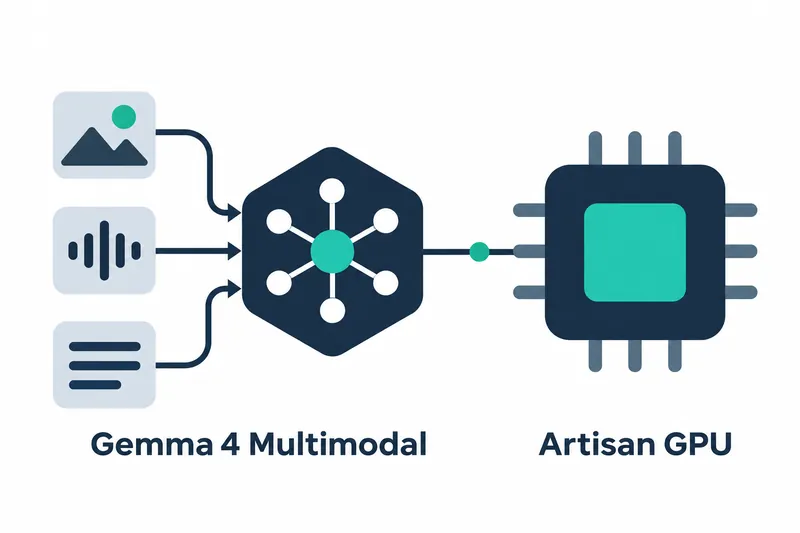
The new version of LiteRT-LM, software for running models, expands model execution options for developers building image and voice features. It supports Gemma 4 models that handle images and audio on the Artisan GPU execution path. It also expands vision processing and adds support for combining audio processing components with GPU text processing components.
1. Bringing Gemma 4 vision and audio input to the GPU execution path
Google's LiteRT-LM project released v0.19.1 on November 5, 2026.
The first change in the release notes is support for multimodal Gemma 4 models on the Artisan GPU backend. Here, multimodal means handling different types of input: vision and audio.
A backend is the execution infrastructure that handles model computations. The Artisan GPU backend is where support for these models has been added.
2. Enabling bidirectional attention for vision
The vision change enables bidirectional attention in GPU Artisan models. Bidirectional attention uses information from both directions rather than referencing input in only one direction. While the first item covers supported models, this item covers how visual information is processed within a model.
3. Supporting audio input and text processing components together
The audio change supports using the LiteRT audio encoder together with the Artisan GPU text decoder. This allows a component that processes audio input to be combined with one that handles text output. The support list explicitly includes component combinations, not just model names.
4. Checking release files and choosing a deployment configuration
The release page lists 7 assets, including source code archives. The 2 framework archives are CLiteRTLM.xcframework.zip and CLiteRTLM_mac.xcframework.zip. The dynamic library loaded at runtime is libGemmaModelConstraintProvider.dylib. The arm64 builds for macOS ARM-based 64-bit processors come as an archive and an executable. The remaining 2 assets are source code archives in zip and tar.gz formats.
The release notes do not provide specific supported model identifiers, a hardware list, or execution instructions. They also provide no performance measurements or resource usage figures, making it difficult to quantify speed or accuracy gains or additional resource costs from this material.
These changes address three distinct layers: model support, vision processing methods, and audio component combinations.