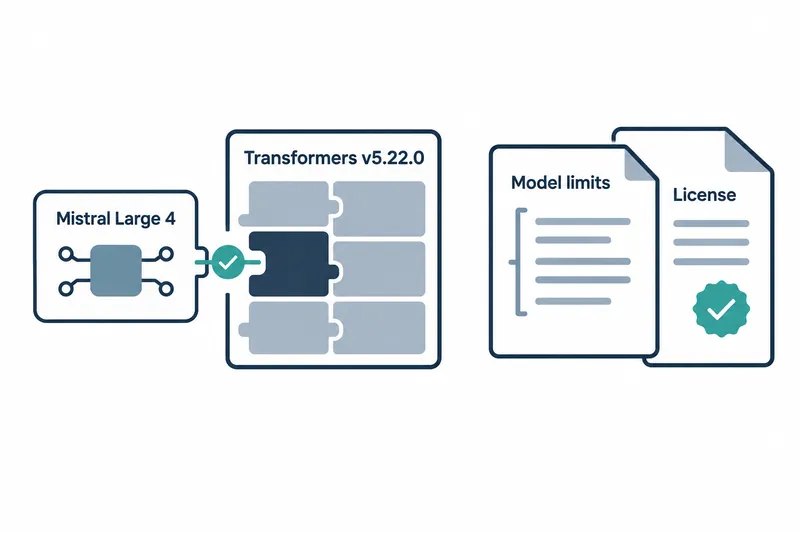
Hugging Face's AI model library now supports Mistral's new large model. Developers building services for documents and images can use familiar tools and check context limits, inference settings, and licensing. Context limits define how much information can be processed at once.
1. A large model with long context and image input
Transformers v5.22.0, released on October 29, adds support for Mistral Large 4. The model accepts text and images and responds with text, supporting analysis of documents, charts, and technical drawings.
The model has 1 trillion parameters and uses a mixture-of-experts architecture, selecting some specialized modules rather than the entire model each time. The release notes list 49 billion active parameters per token, meaning those actually used in processing. Including input and output layers, which connect inputs and outputs to the model, the figure is 52 billion. Mistral's announcement lists 52 billion active parameters.
The supported context length is 1 million tokens. The release notes describe proficiency in more than 160 languages, including all official European Union languages.
2. Choosing reasoning effort for each task
One model handles instruction following, coding, and multistep tasks using tools. Reasoning effort, the level of computation used to produce an answer, has three levels: low, medium, and high, with high as the default. The release notes recommend high for complex requests and tool use, low for fast conversations, and medium for everyday use.
The settings controlling the range of choices during answer generation have the same recommended values regardless of reasoning effort. Below are the settings exactly as listed in the release notes.
reasoning_effort="high"
temperature=1.0
top_p=0.95
For tool-based tasks, the release notes recommend clearly stating the environment and purpose in the system prompt and providing only necessary tools. The system prompt defines the model's role and instructions in advance. The model supports function calling, which invokes program functionality, and JSON output. Output can also be constrained to a specified data structure.
3. Company-reported performance and evaluation conditions
According to the company, the model scored 61.7% on the DeepSWE v1.1 coding evaluation and 28.3% on the Terminal-Bench 4 terminal task evaluation.
The company reported a score of 49.8% on the Coding Agent Index, which aggregates coding tasks.
The company reported 59.9% on AutomationBench, which evaluates 657 workflows using business apps. This means the evaluation covers not only coding but also work that produces results across multiple apps.
In a blind evaluation of coding results, Surge AI's expert evaluators rated outputs from 1 to 5 without knowing the model names. According to the company, Mistral's preview model ranked second among the five models below in this evaluation.
Table: Blind evaluation of coding results
Conditions: Surge AI evaluation; expert evaluators rated outputs from 1 to 5 with model names hidden
Unit: points (1–5 scale)
| Model | Score |
|---|---|
| Claude Opus 5 | 4.22 |
| Mistral Large 4 Preview | 3.74 |
| GLM-5.3 | 3.60 |
| Kimi K3 | 3.59 |
| GLM-5.2 | 3.40 |
In this evaluation, Mistral scored below the leading model and above the other three. On Dense 200, a separate evaluation of localization within images, the company reported 42%, above GPT-6-Astra's 41%.
4. Licensing and deployment conditions
The release notes state that the model is available under the Mistral Ecosystem Open-Weight License. This modified MIT license permits commercial and noncommercial use.
However, offering the model itself as a service requires a separate commercial license from Mistral. In its October 6 announcement, Mistral scheduled weight distribution for late October. The access option provided at the time was a public preview API in Mistral Studio.
5. Broader uses and operational burdens
Supporting long context, image input, and tool calling in one model makes it easier to combine reading documents and charts with subsequent tool use. Developers can select reasoning effort per request, using the same model for fast conversations and complex tasks.
Self-hosting offers more scope to adapt the model to internal workflows. However, operators must bear the hardware and memory burden of handling large weights, the model's internal numerical values set through training. Adoption hinges less on a single coding ranking than on balancing operational resources against the value of combining document processing with tool execution.
This support connects a new model to development tools; adoption depends on balancing the value of long-text, image, and tool capabilities against operating costs.