Nanbeige LLM Lab published Nanbeige4.3-33B weights on Hugging Face. The model API records the repository's createdAt timestamp as October 24, 2026. That creation timestamp does not establish when the weights first became publicly available. It supports up to 524,288 tokens (512K) of context, adding an option for teams running coding agents and internal workflow automation themselves. The model card marks 17 of 20 benchmarks as best among compared models. The publisher claims leading agent performance among 30B-class open-weight models.
Performance: Leading the comparison on coding agent benchmarks
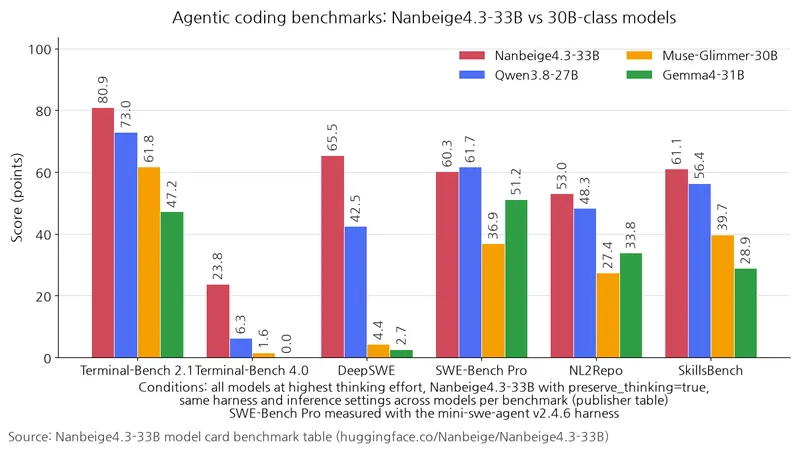
It scored highest among compared models on 7 of 8 coding agent benchmarks. It led by 17.5 and 23.0 points on the table's first two tests but trailed by 1.4 points on the third, showing that its advantage varied by coding task.
Table: Representative coding agent performance
Conditions: Based on the publisher's model card. All models used maximum reasoning effort, with identical harnesses and inference settings across models for each test. Nanbeige4.3-33B was evaluated with preserve_thinking=true. In this table, mini-swe-agent v2.4.6 applies only to Terminal-Bench 4.0 and DeepSWE, as specified in the source.
| Benchmark | Nanbeige4.3-33B | Qwen3.8-27B |
|---|---|---|
| Terminal-Bench 4.0 | 23.8 | 6.3 |
| DeepSWE | 65.5 | 42.5 |
| SWE-Bench Pro | 60.3 | 61.7 |
Unit: Score (higher is better)
It also scored highest among compared models on 8 of 9 workflow automation benchmarks. Beyond an evaluation of 600 public tasks, it outperformed the reference model in most occupations in an evaluation covering 35 occupations.
Table: Representative workflow automation results
Conditions: Evaluations from the publisher's model card. Automation Bench v1.0.6 used 600 public tasks, while JobBench evaluated 35 occupations using the Claude Code harness equipped with a search tool. YC-bench retained only the latest 10 turns of user conversation as prior context immediately before each model call.
Unit: Score; dollars ($) for YC-bench only
| Benchmark | Nanbeige4.3-33B | Qwen3.8-27B |
|---|---|---|
| Automation Bench v1.0.6 | 54.2 | 38.3 |
| JobBench | 44.8 | 34.5 |
| YC-bench | $1,025,437 | $641,290 |
In reasoning evaluations, GPQA Diamond scored 89.5, below Gemma4-31B's 91.3, while AIME 2026 scored 95.2, ahead of Qwen3.8-27B's 94.5. Unlike its broad advantage in workflow automation, its relative reasoning performance varied by evaluation.
Self-hosting
The weights use Apache-2.0, and the card's deployment examples assume self-hosting. The vLLM and SGLang examples use tensor parallelism of 4, combining four GPUs for one model. The Nanbeige organization on GitHub publishes forks of llama.cpp, sglang, vllm, and ollama: copies of existing code developed separately.
Use cases: From a 33B teacher to smaller models
The preceding small model, Nanbeige4.2-3B, had a 256K context, while this 33B model supports 512K of context. The publisher says Nanbeige4.3-33B was designed as a teacher model to guide small-model training. It forms the foundation for plans to distill agent behavior into smaller models, with Nanbeige4.3-3B named as the next target.
Nanbeige4.3-33B-Base, the base model before further training, was also released. The base model card reports MMLU-Pro 66.9 and GPQA 62.0, ahead of Gemma4-31B-Base's 59.3 and 41.5.
Getting started
The model card's chat template provides three switches. enable_thinking is on by default, while preserve_thinking keeps reasoning from earlier responses in the conversation history. The latter is recommended off for general chat and question answering, and on for multistep tool use, office tasks, and coding agents. xml is recommended for tool calls, and json is also supported. The default system prompt, which supplies the model's basic instructions, is in Chinese, so it is better to set the language with your own system message.
The recommended inference settings for tool tasks are temperature 1.0, top_p 0.95, and 65,536 maximum new tokens. For reasoning and chat, they are 0.6, 0.95, and 262,144. Unlike the maximum context of 524,288 tokens for input and conversation history, maximum new tokens limits newly generated output. The recommended output limit for tool tasks is one quarter of that for reasoning and chat.
vllm serve Nanbeige/Nanbeige4.3-33B \
  --tensor-parallel-size 4 \
  --enable-auto-tool-choice \
  --reasoning-parser qwen3 \
  --tool-call-parser qwen3_coder
Limitations
In the publisher's evaluations, Qwen3.8-27B led on GDPval, scored using a revised rubric of evaluation items and scoring criteria. Terminal-Bench 4.0 scores were low in absolute terms.
This release follows a teacher-model strategy for distilling small agents, and adoption decisions should focus on suitability for multistep tool use and coding tasks rather than general reasoning rankings.