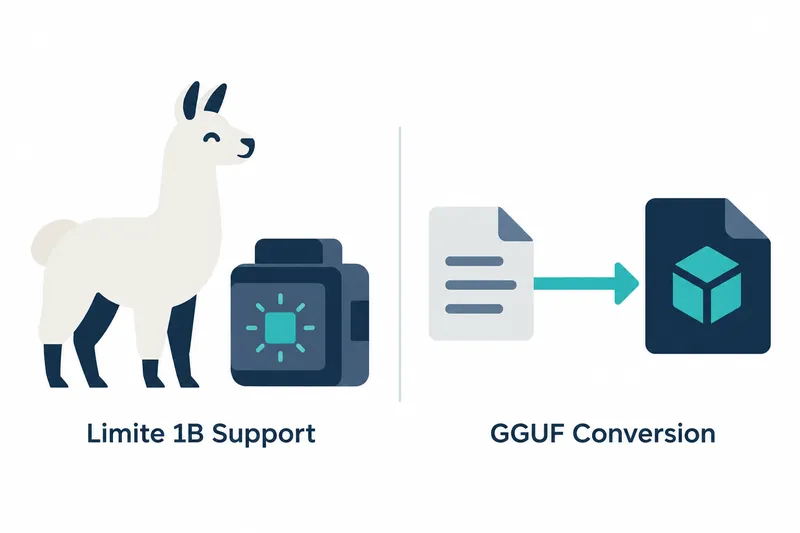
llama.cpp now supports Limite 1B ‘Violetto’, a small mathematical reasoning model. Developers testing it locally can use the new conversion feature and distributed builds instead of adding dedicated execution code themselves.
1. Support from conversion to execution
Build b11988, which includes this support, was posted on GitHub as a prerelease on October 29, 2026. The changes register the architecture in the file format, convert the original model, and implement execution. They connect conversion and execution rather than merely adding a name to a list.
GGUF is a file format for model weights and settings needed for execution. Developers can convert the original model to this format and run it with the new build. The converter lists paradigma-inc/limite-1b-violetto as an example model, identifying the target model.
2. Dedicated inference implementation and quantization trade-offs
The dedicated execution code handles model-specific computations, including MUDD connections that mix and pass information across layers. The converter maps the original configuration and weights to the structure read by the execution code.
Quantization, which reduces size by lowering weight precision, also gets model-specific handling. Gates controlling information flow and small tensors used for inter-layer mixing remain at F32 precision, or 32-bit floating point, as in the reference implementation used for comparison. They are also excluded from subsequent quantization. This trade-off allows other weights to shrink while preserving the precision of these small weights, which are excluded from size reduction.
3. Chat handling for single-request mathematical reasoning
A participant from the model repository explained that the model was designed for mathematical reasoning on a single question. The recommended input uses a fixed math system message and the current question rather than appending prior conversation. Local math-solving tests should start by structuring requests for this use case.
The PR also proposed a chat template change that extracts reasoning content from responses into a <think> section. In a September 27 comment, the model repository side said it had applied the change and clarified the single-request use case in the model card. The proposed addition follows.
+    {%- elif message.role == 'assistant' %}
+        {{- '<|im_start|>assistant\n' }}
+        {%- if message.reasoning_content is string and message.reasoning_content %}
+            {{- '<think>\n' + message.reasoning_content + '\n</think>\n\n' }}
+        {%- endif %}
+        {{- message.content + '<|im_end|>\n' }}
4. Throughput observed in Vulkan measurements
The PR author reported that local tests after changes to MUDD mixing calculations showed the model working and running faster. The measured model was listed as Limite 1B BF16, a 16-bit floating-point format, at 1.93 GiB with 1.04 B parameters.
Measurements used the Vulkan backend with ngl -1. According to the author, the pp512 prompt processing test rose from 8847.75 ± 1208.96 before the change to 9814.88 ± 44.44 tokens/second afterward.
The tg128 generation test reportedly rose from 99.46 ± 6.66 to 122.70 ± 4.40 tokens/second with the same model, backend, and settings. The calculation changes thus showed effects in both input processing and response generation.
5. What changes for developers
The release lists builds for Linux, Windows, macOS, and Android, along with CPU and multiple accelerator backend builds. Developers should first choose a build for their environment and prepare both model conversion and the chat template.
The comment does not identify the hardware used for the measurements, so expected speeds on specific devices require further checks. The execution implementation does not support mixed batches that process different requests together. It only supports looking up value embeddings, numerical vector representations of tokens, by token ID rather than accepting precomputed input vectors.
The practical change in b11988 is a unified path from Limite 1B GGUF conversion to dedicated execution, lowering the barrier to local mathematical reasoning experiments.