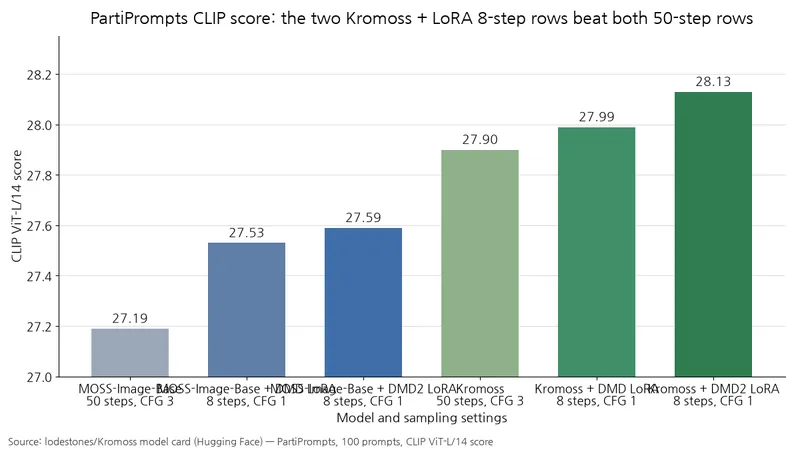
lodestones released the Kromoss image model and two adapters that reduce generation from 50 steps to 8 on Hugging Face. In the creator's evaluation on 100 PartiPrompts prompts, the 8-step path with the recommended adapter scored 28.13 on CLIP, which measures image–prompt alignment. This exceeded 50-step Kromoss at 27.90. The difference is 0.23 points, or 0.94 points above the base model's 50-step score of 27.19. This offers an option for reducing generation steps while maintaining performance on this metric.
Evaluation method
This is the creator's own evaluation of image–prompt alignment for images generated from the same 100 prompts. The 50-step model and adapter-equipped 8-step model also differ in prompt guidance strength and generation path. It should therefore be read as a comparison of two complete generation paths, not a controlled experiment changing only the step count. Detailed settings are listed below.
Both adapters use LoRA, which trains small additional matrices. They comprise DMD, trained to reduce generation steps, and DMD2, which extends that training.
Results
Table: CLIP score comparison on 100 PartiPrompts prompts
Conditions: As listed in the creator's model card; 100 PartiPrompts prompts; CLIP ViT-L/14 scoring; Kromoss rows use EMA weights from fine-tuning update 11000. The 50-step path uses CFG 3; the 8-step path uses CFG 1; sampler: flow-matching Euler, shift 5.
| Configuration group | Model · Settings | CLIP ViT-L/14 score |
|---|---|---|
| 50 steps · CFG 3 | MOSS-Image-Base, 50 steps, CFG 3 | 27.19 |
| 50 steps · CFG 3 | Kromoss, 50 steps, CFG 3 | 27.90 |
| 8 steps · CFG 1 + LoRA | MOSS-Image-Base + 8-steps-dmd-lora, 8 steps, CFG 1 | 27.53 |
| 8 steps · CFG 1 + LoRA | MOSS-Image-Base + 8-steps-dmd2-lora, 8 steps, CFG 1 | 27.59 |
| 8 steps · CFG 1 + LoRA | Kromoss + 8-steps-dmd-lora, 8 steps, CFG 1 | 27.99 |
| 8 steps · CFG 1 + LoRA | Kromoss + 8-steps-dmd2-lora, 8 steps, CFG 1 | 28.13 |
Only the two 8-step rows combining Kromoss with LoRA outperformed both 50-step rows. At 50 steps, Kromoss beats the base model by 0.71 points. Adding LoRA to Kromoss for the 8-step path raises this by another 0.09 points for DMD and 0.23 for DMD2. This separates the difference from additional model training from that of the adapter path. DMD2 LoRA also scores slightly above DMD LoRA.
The paths differ in three respects: steps, CFG, and handling of the negative branch, which suppresses unwanted elements. Steps drop from 50 to 8 and CFG from 3 to 1, while the negative branch disappears entirely in the 8-step path. The 50-step path skips the layer at index 22 in the negative branch.
File sizes are considered separately. Single-file versions for ComfyUI, a node-based image generation tool, are 10.16 GB in bf16 (16-bit floating point) and 5.41 GB in int8 (8-bit integer) ConvRot. The qwen3.5_9b_bf16 text encoder is 19.31 GB, and each 8-step LoRA is 1.19 GB. These distribution file sizes were checked in the Hugging Face file listing.
Model training and 8-step distillation
According to the creator's model card, Kromoss was further trained at 1024 px with all transformer weights updated. A transformer is a neural network architecture that computes contextual relationships, and weights are the numerical values a model learns. Training used 704k images.
In this 8-step project, DMD was used to reduce the base model's 50-step, CFG 3 path to 8 network evaluations. The creator's MOSS-Image-Base 8-step distillation card describes data-space DMD as repeatedly producing estimates of denoised images from fixed noise using a generator.
DMD2 LoRA continues that training for another 3000 iterations at 1/4 of the original learning rate and adds a GAN stage that trains a discriminator against real images. GAN training pits a generator against a discriminator that distinguishes real from fake.
The card says DMD2 slightly increases contrast and detail and achieves the best PartiPrompts score, making it the recommended LoRA.
According to the model card, both LoRAs were distilled from the base model but transfer to Kromoss. Kromoss also outperforms the base model in the 8-step rows using the same LoRA.
This gap comes from scoring 100 prompts, so there is no guarantee that the same margin will be reproduced on other prompt sets.
Selection criteria
If you need fewer steps, apply 8-steps-dmd2-lora.safetensors with KSampler's euler sampler, simple scheduler, 8 steps, and CFG 1. The card says 4 steps also work. If you can afford 50 steps, use the full Kromoss model without LoRA; its score serves as the baseline in this table.
Do not merge the LoRA into bf16 weights; keep it unmerged in diffusers and apply it at strength 1 in ComfyUI. The creator advises against merging into bf16 weights because the deltas are close to the bf16 rounding increment.
The following call example is excerpted from the model card. It assumes that pipe, a diffusers pipeline with the DMD2 adapter applied without merging, the input text prompt, and torch are already prepared.
image = pipe(prompt, height=1024, width=1024, num_inference_steps=8, guidance_scale=1.0,
             generator=torch.Generator("cpu").manual_seed(42)).images[0]
If graphics memory, or VRAM, is tight, use the int8 ConvRot single file, which stores weights with a rotation transform. It stores 168 block linear layers, neural network layers that linearly transform inputs, in int8. It applies a 256-wide Hadamard rotation that mixes weights while preserving magnitude, and ComfyUI reverses the rotation at load time. A separate text encoder is required.
Users of MOSS-Image-SFT can use Kromoss instead. According to the card, the architecture, text encoder, VAE (the encoder that compresses and reconstructs images), and repository layout are identical, so only the files need swapping.
Checkpoints, files that save training state, change frequently. After its release on 2026-10-19, the repository was updated at training iterations 2000, 5000, and 7000 that day, then 9000 and 11000 the next day. DMD2 LoRA was added on 2026-10-20.
In the creator's evaluation on 100 PartiPrompts prompts, Kromoss's DMD2 LoRA path reduced generation from 50 steps to 8 while raising the prompt-alignment score from 27.90 to 28.13.