Local model runner Ollama now supports Recursive's coding model Flint, expanding options for repository work on a Mac without remote APIs. The single command ollama run flint starts an interactive session on your computer. The v0.40.8-rc0 release, published on October 21, is a prerelease test version, with Flint support limited to macOS. Other GPU support will arrive in later RC builds. The documented configuration has a context of 262,144 tokens, and the license is Apache 2.0.
At a glance
Table: Key Ollama Flint specifications
Conditions: Based on the model card and Ollama library.
| Item | Value |
|---|---|
| Model | 39.8B total parameters, about 2.5B active per token |
| Context | 262,144 tokens, including prompt and generated output |
| Ollama distribution | flint:latest·flint:40b, each 23GB·256K context |
Flint is a model for coding agents that understand repositories, track bugs, and implement features and tests. It supports reasoning and multiple rounds of tool use.
MoE computes with only selected experts for each token. Recursive says it quantized even the output layer to 4 bits to reduce memory use and weights read per token, then recovered accuracy through distillation with a 16-bit teacher model. It also says a kernel fusing all operations in a decoding step improves speed on M4 and M5.
Performance: Scores largely hold up at 4 bits
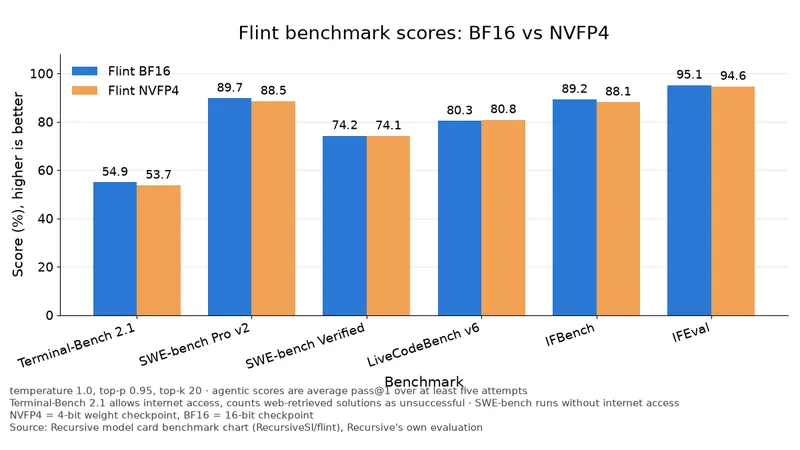
Terminal-Bench 2.1 evaluates terminal tasks, while SWE-bench evaluates repository issue resolution.
Conditions: Based on Recursive's benchmark chart and evaluation notes. Settings: temperature 1.0·top-p 0.95·top-k 20, an agent time limit of up to 5 hours, and average pass@1 over at least 5 runs (whether a single attempt succeeds). Terminal-Bench 2.1 used Terminus 2 XML with internet access, counting solutions found through search as failures. SWE-bench used mini-swe-agent without internet access.
Table: Benchmark scores for BF16 and NVFP4 checkpoints
Unit: %
| Benchmark | Flint BF16 | Flint NVFP4 |
|---|---|---|
| Terminal-Bench 2.1 | 54.9 | 53.7 |
| SWE-bench Pro v2 | 89.7 | 88.5 |
| SWE-bench Verified | 74.2 | 74.1 |
| LiveCodeBench v6 | 80.3 | 80.8 |
| IFBench | 89.2 | 88.1 |
| IFEval | 95.1 | 94.6 |
4-bit NVFP4 trails BF16 by 1.2 percentage points on Terminal-Bench, 1.2 percentage points on SWE-bench Pro, and 0.1 percentage points on Verified. Within the same evaluation, scores largely hold up despite reduced precision.
Speed: How rec engine performance varies with context
Hardware requirements: rec requires an M4 Pro·M5 Pro·M5 Max Mac, at least 48GB of unified memory, and about 30GB of free disk space.
Conditions: Measurements on an Apple M4 Pro 48GB from the rec repository. 4-bit weights, 1,024 output tokens, 5 runs per context length, excluding prompt processing. Representative context lengths from 1K–252K.
Table: Decoding throughput, or token generation speed, for the rec engine and llama.cpp on an M4 Pro 48GB
Unit: tokens/second
| Prompt context | rec | llama.cpp |
|---|---|---|
| 1K | 131.2 | 88.0 |
| 64K | 61.7 | 42.9 |
| 252K | 22.6 | 8.6 |
Throughput drops as context grows, but rec outperforms llama.cpp at the same context lengths. These are not Ollama speed measurements.
Pricing and execution
Conditions: Based on Ollama's pricing page and Recursive's documentation (checked October 21, 2026).
Ollama's Free plan costs $0 and includes local model execution. Running models on your own hardware is unlimited regardless of plan. Flint was absent from the checked pricing table, and the official release describes local execution. Recursive's blog also highlights keeping data on your computer and avoiding API costs. Recursive's direct Flint API is available only to selected partners.
Getting started in Ollama takes one line.
ollama run flintUse ollama launch claude --model flint to connect a coding tool.
Recursive treats context size as a capacity limit and does not guarantee uniform accuracy across sequence lengths. The model card also states that Flint may generate incorrect or harmful code and inappropriate tool calls.
To try a local Mac agent, start with ollama run flint, assign it one issue in a familiar repository, and choose weights and an execution engine suited to your deployment environment.