KRAFTON AI released Raon-1 mini preview on Hugging Face on October 21. This 30B-class open-weight model gives teams seeking a Korean model for their services another option. The company highlights Korean conversation and instruction following as strengths. Its MoE design activates only 4.3B of 28.8B parameters per token, using only some experts for each token. Parameters are the numerical values learned during training. It supports a 262,144-token context and tool calling, which lets the model invoke external tools. In company benchmarks, pairing it with the DFlash2 draft model delivers up to 2.18× the output throughput of standard decoding on 1 B300.
At a glance
Table: Raon-1 mini preview key specifications
Conditions: Specifications listed in the Hugging Face model card, released on 2026-10-21
The weights are gated, meaning access requires approval. Once approved, a single HF login lets users download all repositories in the Raon-1 mini preview family. Apache 2.0 covers the weights and configuration files, but not the training data or hosted API.
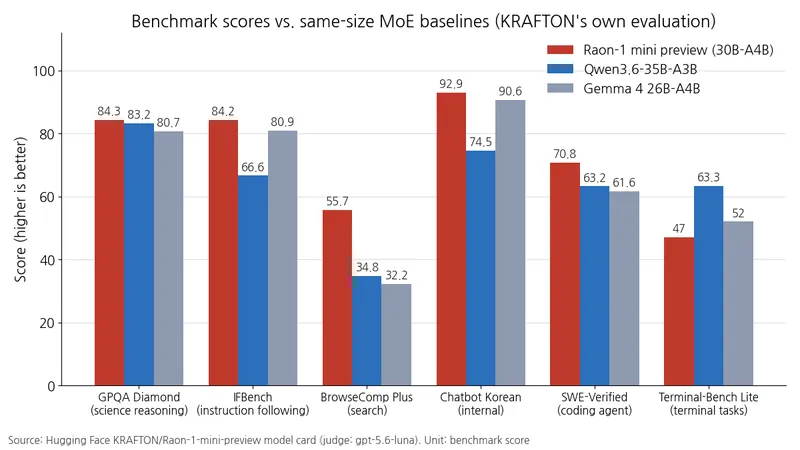
Performance: Ahead of MoE peers in instruction following, search, and Korean conversation
Conditions: KRAFTON internal evaluation, with gpt-5.6-luna as judge and user simulator. SWE-Verified uses the mini-SWE-agent harness, a toolkit for running evaluation tasks. Chatbot Korean is internal; comparisons cover 2 MoE models.
Unit: Benchmark score
Among the 6 evaluations in the table above, the search benchmark BrowseComp Plus showed the largest score gap against peers. It led in coding-agent tasks but trailed peers in terminal tasks. SWE-Verified measures an agent's ability to read a codebase and fix GitHub issues. Its Korean conversation score also exceeded Qwen3.6-35B-A3B by more than 18 points.
Inference speed: The difference DFlash2 drafting makes on 1 B300
Conditions: Single NVIDIA B300, vLLM 0.28.0, MXFP8 target, block size 8 (7 draft tokens), stochastic draft sampling. Settings: temperature 1.0, top-p 0.95, top-k 20, thinking enabled, 4,096 maximum new tokens, concurrency 1. Prompts per benchmark: 128 (80 for MT-Bench).
Units: AL is average accepted tokens per verification; throughput is tok/s; multiples are relative to standard decoding.
Speculative decoding boosts output throughput by having a small model propose several upcoming tokens for the target model to verify. AL means the average number of tokens accepted per verification. In company measurements, the speedup was largest on math problems and smallest on MT-Bench, a conversational evaluation. On MT-Bench, raising concurrency to 8 reduces the speedup to 1.38×, and raising it to 32 reduces it to 1.56×.
Pricing and costs: Hosted API free for a limited time
To mark the launch, KRAFTON made the hosted API and official playground free for a limited time. It noted that per-user token usage and request limits may apply. Users can also download the weights and run them on their own GPUs under Apache 2.0. The platform emails a console invitation link after users submit an application.
What changed: 18 of 25 layers use linear attention
The company says Raon Delta Attention improves long-context performance over KDA by separating Kimi Delta Attention's erase and write gates, which control information flow. It says Raon-mHC speeds up training by reducing the computational cost of DeepSeek's mHC (manifold-constrained hyper-connections). The KV cache, memory storing information about previous tokens, is maintained only for the 7 full attention layers. It uses about 8KiB per token in BF16.
The hidden size, the dimensionality of internal representations, is 2,560. Both linear and full attention use 40 attention heads, and the vocabulary size is 259,840. It uses no positional encoding, which adds token-order information to representations. Quantized formats, which lower the precision of model values, include MXFP8 8-bit and NVFP4 4-bit. The NVFP4 checkpoint, a saved model-state file, is a 4-bit quantization of the 28.8B model. KRAFTON says it runs on a single NVIDIA RTX 5090 with 32GB VRAM. The DFlash2 draft model has 0.68B parameters. KRAFTON says the model was trained in Korean, English, Japanese, Chinese, Spanish, French, and Thai.
How to try it
Weight access requests on Hugging Face are approved automatically. After downloading, running an OpenAI-compatible API server is a convenient option.
vllm serve KRAFTON/Raon-1-mini-preview \
  --max-model-len 262144 \
  --kv-cache-dtype fp8_e4m3 \
  --spec-method dflash \
  --spec-model KRAFTON/Raon-1-mini-preview-dflash2 \
  --spec-tokens 7 \
  --reasoning-parser raon_1 \
  --enable-auto-tool-choice \
  --tool-call-parser raon_1
Install vLLM from KRAFTON's maintained fork, a separately modified version of the original code. The first run reportedly takes about 10 minutes to compile kernels; later runs reuse them. For agent harnesses Hermes Agent, Pi, and OpenCode, register this server's address as an OpenAI-compatible provider with tool calling and the reasoning parser enabled. For terminal-only use, build KRAFTON's llama.cpp branch to run a GGUF checkpoint, or download the MLX checkpoint for Apple silicon. Instructions for running a Docker image are also provided. Recommended sampling defaults are temperature 1.0, top-p 0.95, and top-k 20, with thinking mode enabled by default. For coding and math tasks, the guidance is to lower presence_penalty to 0.
Limitations
As a preview release, specifications and results may change before the final version. The Korean conversation benchmark is internal to KRAFTON. It scores below both MoE peers on MMLU Pro. On long-context evaluations, it trails Qwen3.6-35B-A3B but beats Gemma 4 26B-A4B. The company also states that pricing or policies for the initially free hosted API may change.
Teams can test KRAFTON’s NVFP4 checkpoint on one 32GB NVIDIA RTX 5090 for self-hosting, or use the official playground during its limited free period to check API speed and Korean quality.