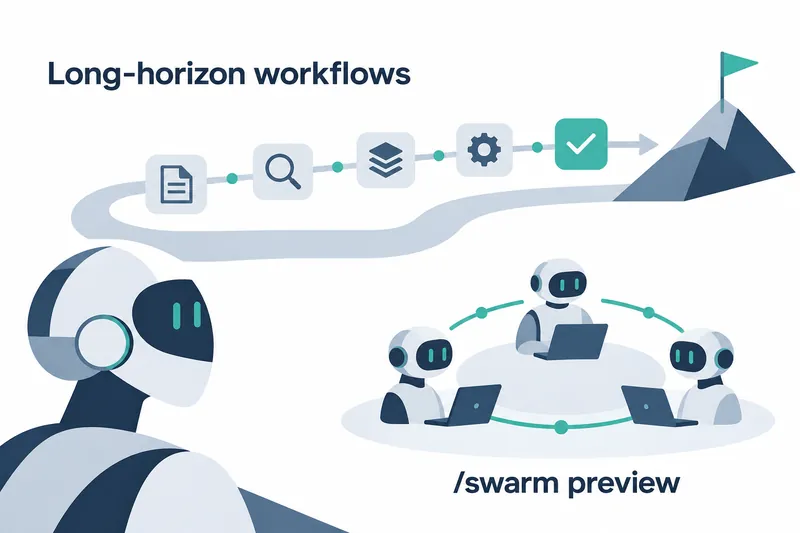
On November 10, Google released its high-performance AI model Gemini 4 Carbon to developers, businesses, scientists and general users. It handles tasks requiring multistep verification, such as complex coding and research. Developers can also preview a feature that splits a single request among multiple agents.
1. A higher-tier model for long-running tasks
Carbon targets tasks involving multiple stages of exploration and verification, such as complex coding, debugging and open-ended scientific research. Google said Carbon uses more tokens than Argon for this purpose.
Developers can access it through paid APIs in Google's developer tools, while businesses can use Gemini for business.
It is also rolling out to Google AI Ultra subscribers in developer tools, the Gemini app and AI Mode in Search.
Its introductory API pricing matches Argon's: $2 per million input tokens and $10 per million output tokens.
2. Expanding one request into an agent team
Available in preview in Google Antigravity, /swarm turns a single request into a team of collaborating agents and shows progress in real time.
Carbon handles design, coordination and auditing, while faster, lighter models can work concurrently in separate workspaces. Like a team leader, it assigns roles and deploys verification agents to test changes.
The usage format is as follows.
/swarmIn one Google example, photos and plans were used to create a 3D exhibit of the Eiffel Tower's construction in 1887~1889. In another, an agent team in Google Antigravity used 206 drawings extracted from 7 city council planning documents and a single prompt to reconstruct the Google Platform 37 office. The reconstruction contained 906K triangles, the faces forming a 3D shape. The work ran over 10 overnight loops.
3. Balancing real-world benchmarks and costs
According to the company, Carbon ranked first on CursorBench 4.0, a benchmark for comparing performance.
The company also reported first-place results on Perplexity's WANDR and Zapier's AutomationBench. Across these three evaluations, its cost per task was more than 2x lower than the external runner-up model's.
The company reported second place on a multimodal knowledge-agent benchmark that handles multiple information formats, including document charts and images. In this evaluation, developed with Artificial Analysis, average cost per task was more than 6x lower than the top-performing model's.
In prerelease financial evaluations, the company said Carbon matched the best model tested on Hebbia's deep financial research assessment. It ranked highest among 23 high-performance model configurations in Balyasny Asset Management's evaluation.
Despite its reported low cost per task in work evaluations, Carbon uses more tokens than Argon for exploration and verification. Even at identical token prices, usage changes the bill per task, so developers must weigh the benefits of solving complex problems against token spending. Google's guidance is to use Argon for general development and knowledge work, and Carbon for complex problems.
4. Reported results in security and scientific research
Google said Carbon for cyber is available to defenders through the Fairwind program and leads on benchmarks for vulnerability discovery, exploitation and patching. In internal Project Fortify evaluations, vulnerability scan recall, the share of actual vulnerabilities found, was 100%. Classification precision, the share of vulnerability judgments that were correct, was 95%. In open-source repository tests, Google reported a relative recall improvement of more than 25% over Argon.
Google said its vulnerability research team demonstrated that two public software bugs were exploitable, prompting maintainers to reclassify them as critical and patch them.
It also described a case in Wiz's Scan for Good program involving checks of two major software-as-a-service providers. Zero-day vulnerabilities, security flaws without available patches, were found within two hours.
Google said Axiom Bio rated Carbon as a leading model for translational science, which connects basic research to drug and treatment development. It also reported finding new toxicity mechanisms, the biological processes through which substances cause harm.
According to the company, searches retrieved an average of 40x more evolutionarily related proteins across 7 protein families with few similar proteins in the CASP17 blind test, where answers are hidden. Rather than retraining structure prediction models that calculate protein shapes, the approach finds more clues to inform predictions.
5. Changes observed in safety evaluations
According to the company, Carbon blocked 99% of attack paths in simulated cyberattacks that revised attack plans and retried. The compromise rate per attempt was 3.1% for Argon and 0.8% for Carbon.
The company reported success rates of 9.86% for Argon and 2.17% for Carbon on Gray Swan's automated cyberattack queries.
Trajectory Labs reported finding no new broadly effective safeguard bypasses across more than 13,000 requests over 132 hours.
According to the company, Carbon's pass rate exceeded Argon's on a 375-task agent honesty evaluation. It also checked whether agents avoided inventing missing data and flagged methodological flaws.
Table: Agent honesty evaluation results
Conditions: Google's 375-task agent honesty benchmark, as reported by the company
Unit: %
| Metric | Carbon | Argon |
|---|---|---|
| Task pass rate | 92 | 70 |
| Rate of refusal to fill in missing experimental data | 98 | — |
| Rate of flagging methodological flaws | 68 | — |
This honesty evaluation examined not only task completion but also behavior when faced with missing data and flawed research methods.
Broader evaluation of protein retrieval is ongoing. Google also said there is room to improve against sophisticated prompt injection in some settings. These attacks steer agents through instructions hidden in external documents or other outside content.
Carbon opens up team-based, multistep workflows, with model selection based on token usage and task complexity remaining essential.