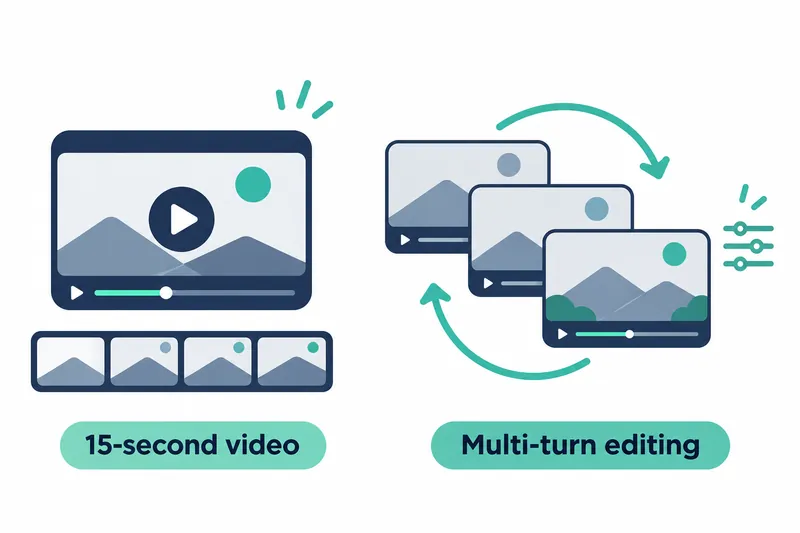
Google has released a generally available video generation model that creates videos up to 15 seconds long and edits them through conversation. Developers and creators can reduce repeated generation from scratch when making variations of short ads or product videos.
1. Videos generated in one pass now reach 15 seconds
Gemini Omni 1.2 Flash extends native video generation, produced directly within the model, from the previous generation's maximum of 10 seconds to 15 seconds. Users can specify 3 to 15 seconds in 1-second increments, creating longer scenes or social ads in a single generation.
According to Google, 720p video costs $0.07 per second, 30% less than Gemini Omni 1.1. Google suggests quickly drafting at lower resolution, refining details, and then upscaling only selected results.
2. Reference details persist through the end of a scene
Generation can combine character, product, and style images with motion videos up to 3 seconds long and audio cues. Google says it improved reference adherence to preserve faces, clothing, packaging text, and brand colors even as camera angles change.
For example, a model photo and front-and-back product photos of three outfits can be combined into a 15-second virtual try-on video showing the clothing on the model. Google's example preserves the model's identity and the clothing's cut, drape, and rear details through 360-degree turns and scene transitions. This targets workflows that turn product photos or character sheets into videos.
It also supports connecting first and last frames or extending existing clips. Google says people, objects, and backgrounds stay more consistent during motion and camera transitions, with less visual wobbling or distortion. A comparison used the same exhibition poster and instructions to animate five layers stacking in sequence. It showed text and materials staying closer to the reference image than with the previous model.
3. Edit through conversation rather than regenerate
The key change is the ability to edit generated clips through multiple conversational turns. Users can keep giving instructions to replace backgrounds or products and adjust lighting, weather, or aspect ratio. Google says edits apply across the full 15-second clip, reducing the need to re-explain or regenerate from scratch for different ad audiences or placements.
Camera directions can specify aerial viewpoint movement, rapid pullbacks, and orbiting a subject. Google says these instructions produce fewer unwanted jump cuts, edits that appear to skip between scenes, and more stable subject sizes on screen.
Google says speech generation improves natural dialogue, lip synchronization, which matches mouth movements to speech, and differentiation between multiple speakers.
Google's background-editing example changes a clip's setting from a tent to a forest, stable, marketplace, and castle while preserving two characters' performances, armor reflections, and framing. In a separate motion-transition example, an octopus created with the first instruction becomes a dancer in the next, with the costume mimicking the octopus's undulating movement.
4. Lower costs and remaining production challenges
Beyond the lower per-second price, follow-up edits can target only necessary changes, reducing full-clip regenerations. With this approach, creators focus on selecting drafts and directing follow-up revisions rather than obtaining a finished result in one pass. Google says users can draft at 360p or 720p, then upscale selected results to 1080p or 4K.
Google identifies fast sports movements, abrupt script changes, and complex physics as areas still being improved.
Generated results include an imperceptible SynthID watermark, a marker embedded in video to identify its origin.
5. Access expands from developers to everyday users
Developers can access the model through the Gemini API. Google directs them to Google AI Studio to build prototypes, early models made for testing, and find starter apps, developer documentation, and pricing information.
Businesses can test it in the Google Cloud console and then scale through the API. They can also reserve throughput, the amount of work processed over a given time. Google says this is the first general availability release for this model family.
In Google Vids, users can generate 15-second clips with a Google account or Google Workspace subscription at no additional cost.
The Gemini app's 15-second video feature is rolling out to Google AI Ultra subscribers.
Flow supports scene instructions and conversational editing, while Google Ads can use the model for video campaign production.
The key change is less about longer clips than a production workflow that reuses one video for multiple purposes by changing products and backgrounds.