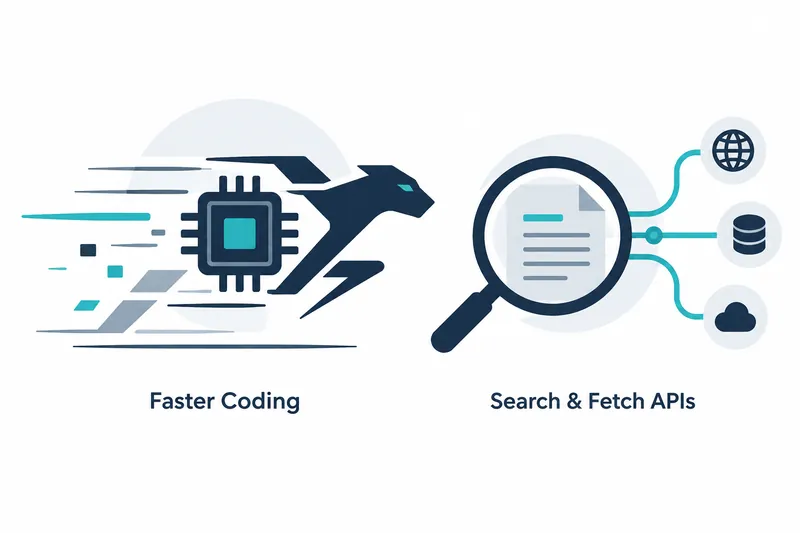
DeepSeek announced a new model with improved coding performance and task speed. Developers can connect web search and page fetching to external programs alongside a model that produces shorter outputs.
1. Scope of the new model
Released on October 17, 2026, DeepSeek-V4.1-Flash-1017 is a minor update to the previous Flash model. Available on the website, app, and API, it reportedly improves reasoning, coding, automation, visual scores, and task times.
For coding tool integration, DeepSeek recommended upgrading DeepSeek Harness to v0.2.1-rc.1 or later. This is guidance for making better use of the model, not an explicitly stated requirement.
The company said it used reinforcement learning with self-generated feedback in internal training. The focus was on improving end-to-end project development, such as game creation and 3D modeling.
2. Improvements shown in the numbers
The model card's Terminal-Bench 4.0 score rose from 31.2 for the previous model to 42.3 for the new one. Both models used the Claude Code harness, a test tool environment that handles task execution.
DeepSWE v1.1 rose from 74.2 to 77.0 using the Mini-SWE-V2 harness. Each evaluation shows changes within the same execution environment, but scores from different tests cannot be compared directly.
HLE without tools rose from 36.8 to 42.6, with its text-only portion increasing from 39.1 to 44.0. Chartography, which uses tools, rose from 78.9 to 83.0.
These are the provider's evaluation results. The saved source gave no specific figures for reductions in task time or output length. Score gains should not be interpreted as speed gains or cost savings in actual services.
3. Pricing for search and page fetching
The public Search & Fetch API provides web search and page fetching using DeepSeek's own search engine. Search finds resources, while fetching reads the pages found.
Each function costs $0.75 per 1,000 calls. However, calls by DeepSeek API users through server-side tools in DeepSeek Harness and Claude Code are currently free.
Calls through Codex's server-side tools are also eligible for free use. Billing for these routes begins on October 31, 2026, at 16:00 UTC. This exception does not apply to all general calls.
4. Integration for self-hosted execution
The repository and weights use the MIT license. This release has no Jinja chat template; instead, it provides a Python reference implementation and tests for converting conversations into model inputs.
The operational tool deepseek-recipe converts requests into model inputs and interprets outputs as responses. It acts as an integration component that adapts conversation formats.
The following example from the model page sends a curl request after a local vLLM server has been started. Its generation settings should be distinguished from the model card's recommended settings.
# Call the server using curl (OpenAI-compatible API):
curl -X POST "http://localhost:8000/v1/completions" \
	-H "Content-Type: application/json" \
	--data '{
		"model": "deepseek-ai/DeepSeek-V4.1-Flash-1017",
		"prompt": "Once upon a time,",
		"max_tokens": 512,
		"temperature": 0.5
	}'
5. The boundary between efficiency gains and operational responsibility
Shorter task times and outputs were presented as reducing waits and costs. In self-hosted deployments, callers handle model inference, tool execution, and HTTP traffic. Format conversion is not a complete execution system.
This update calls for assessing task-level efficiency gains alongside public search access, while separately weighing responsibility for systems you operate yourself.