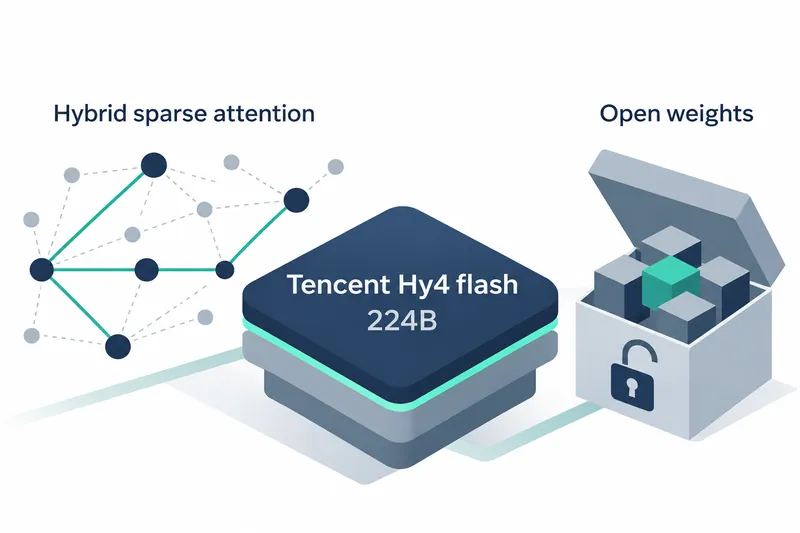
Tencent released Hy4 flash, a language model for everyday work, on November 16, 2026. Open weights and lower fees than its existing flagship let developers choose self-hosting or cloud access to suit their operations.
1. A hybrid architecture that cuts computation
According to Tencent, the model has 224 billion parameters but activates only 12 billion per token. It uses selected portions rather than computing across the entire large model.
Its core hybrid attention combines different attention methods. Sparse attention selects relevant tokens, while sliding-window attention looks only at nearby tokens, reducing computation for context access.
It accepts text and images, generates text, and handles up to 1 million tokens of context. The configuration targets work involving both documents and visual materials.
2. Evaluating cost and performance on internal tasks
Tencent evaluated performance using WorkIndex, built from internal tasks such as slide creation and document editing. According to the company, Hy4 flash scored higher than Hy4 preview but below Hy4.
Table: Internal work evaluation scores
Conditions: 8 WorkIndex evaluation sets, as reported by the company
Unit: Points
| Model | Score |
|---|---|
| Hy4 flash | 42.1 |
| Hy4 preview | 39.7 |
| Hy4 | 51.4 |
Tencent reports average cost per task at 1/13 of Hy4 preview and 1/20 of Hy4. It is 1/8 of DeepSeek-V4.1-Flash-1017's Max-tier peak-hour pricing. The result prioritizes lower task costs over the highest score.
A separate blind test involved 85 internal WorkBuddy users evaluating 259 tasks across 27 categories. Tencent reports satisfaction of 2.79 out of 4, close to Claude Haiku 5.5's 2.81.
In the same test, Tencent reports a median completion time of 6.7 minutes and a cost of 0.26 yuan per task. It says these were the shortest completion time and lowest task cost among the models evaluated.
3. Lower API prices and compute trade-offs
API prices per 1 million tokens on the official page are lower than Hy4 for cached input, input, and output. The rates below apply to token usage, not cost per task.
Table: Official API rates
Conditions: Rates per 1 million tokens on Tencent's official page
Unit: US dollars
| Item | Hy4 flash | Hy4 |
|---|---|---|
| Cached input | 0.003 | 0.042 |
| Input | 0.070 | 0.834 |
| Output | 0.281 | 2.501 |
Tencent says reinforcement learning, which improves outputs based on results, cut average output tokens to task completion by 50%. The KV cache, memory for context processing, fell to 1/24 of Hy3's and 1/6 of Hy4's.
Tencent reports generation speeds above 150 tokens per second by combining megakernels that bundle operations, quantization that reduces weight representation to 4 bits, and DFly2, which proposes upcoming outputs.
Despite lower compute and fees, self-hosters need download and storage resources. Hugging Face lists 440,521,238,479 bytes of weights across 148 files. All weights must be stored even when only some participate in computation.
4. Downloading weights for self-hosting
Tencent released an instruction-tuned model, an FP8 instruction-tuned model with weights reduced to 8-bit floating point, and a pretrained base model. They use the Tencent Hy License.
The model card uses Transformers for local execution. It says support code has not yet been merged into the main development branch and provides this installation command:
pip install "transformers[torch,vision] @ git+https://github.com/huggingface/transformers.git@refs/pull/50903/head"Inference server operators can use the vLLM or SGLang deployment recipes in the official documentation. The two paths are loading the model locally or running a server for API access.
5. Use cases: Everyday work and self-hosted services
Tencent recommends Hy4 flash for everyday tasks such as deep search, document processing, slide creation, simple frontend demos, and computer use. It recommends the more capable Hy4 for complex work such as long-term software engineering.
Hy4 also led all three knowledge tests below, measured with five examples given to pretrained models. Tencent reports macro-averaged accuracy across subject areas, separate from the earlier internal tests of completed work.
Table: Knowledge evaluation of pretrained models
Conditions: Pretrained models in the model card, 5-shot, macro-averaged accuracy (items marked †)
Unit: Points
| Benchmark | Hy4 flash Base | Hy4 Base | Hy3 preview Base |
|---|---|---|---|
| MMLU | 88.7 | 91.6 | 87.5 |
| MMLU-Pro | 71.1 | 73.9 | 65.8 |
| SuperGPQA | 57.8 | 62.7 | 52.3 |
Total parameters differ: 224B in the announcement, 220B in the model card. The card warns that exposure to synthetic instruction data during mid-training may cause answer-format errors in few-shot tests, distorting scores.
Hy4 flash targets everyday deployments with open weights and low service costs, but Hy4 remains the preferred choice for complex development tasks.