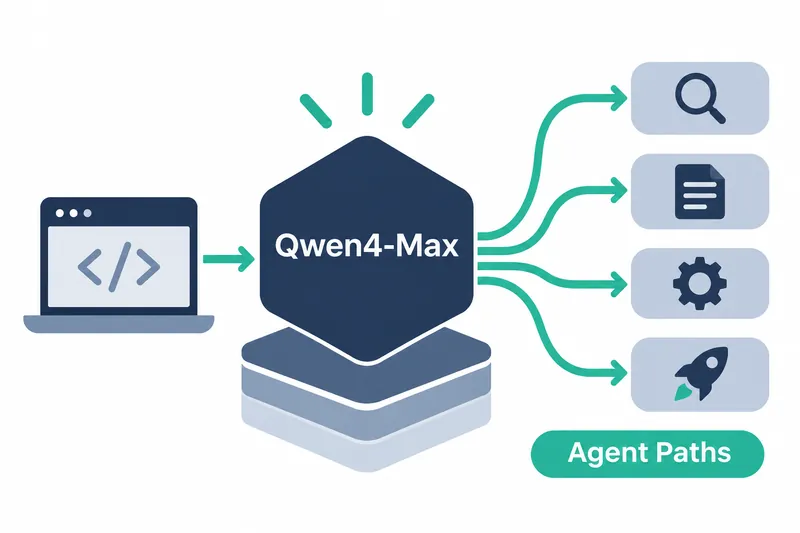
Qwen Code's release on November 17, 2026 added Qwen4-Max support and a common execution foundation for interactive and headless automated tasks. Users can select reasoning effort levels supported by the model and check which execution path a task actually takes.
1. Support for Qwen4-Max model settings
Alongside Qwen4-Max support, this release adds handling for model-specific reasoning effort levels, cache lifetimes, and image detail levels. Beyond making the new model available, it supports settings for reasoning and input processing.
The /effort command now shows only the reasoning effort levels supported by the active model. For developers switching between models, the choices reflect each model's supported range. Rather than expecting the same list across models, users choose from options suited to the current model.
2. Interactive and automated execution share a foundation
Headless sessions and the Ink TUI terminal interface now default to a shared agent loop, a common flow for repeatedly processing requests. Subagents that handle delegated work also default to this path. Multiple entry points thus share a processing flow, extending the common foundation beyond interactive tasks to automation and subtasks.
For sessions connected to external programs, live, read-only Agent Host sessions now use the shared tool set. Program-controlled sessions can also receive permitted cross-session messages. These changes cover not only direct terminal use but also workflows coordinated by programs.
3. Inspect actual execution paths and control switching
A new feature shows the agent loop path actually selected by each execution environment. Loop switches, which change the agent's processing path, can now be forced off as well as on. As more environments default to the shared path, operators gain ways to check its use and control switching.
Record retention has also improved to help trace workflows. The headless shared loop now records canceled tool call results and preserves pending shell output when a process ends. Context compression, which summarizes conversation history, retains the most recent complete task. These changes help users review what ran after cancellation or termination.
4. Extend execution to other workspaces
Managed agents can now run in external workspaces. On the server side, create_sub_session can launch subsessions in other workspaces and continue follow-up work in subsessions created by the caller. This adds a way to delegate work to separate workspaces rather than dividing it only within one workspace.
The release also adds profile-based deployment of managed /loop skill variants. Alongside broader execution locations, it provides an option to deploy managed task capabilities by profile.
5. Weigh shared foundations alongside migration checks
Developers gain another model option and a common execution foundation for interactive use, automation, and subagents. With default paths changing, operators of existing automation need to check actual paths and record behavior on cancellation or termination after upgrading. The project states that there are no known breaking changes.
The release notes do not list specific model setting values or execution switch names. Adoption decisions should focus on new model support, changes to default execution paths, and the means to inspect and control them.
Qwen Code v0.28.0 goes beyond adding a model by expanding the foundation for running agents across modes and workspaces and inspecting their execution paths.