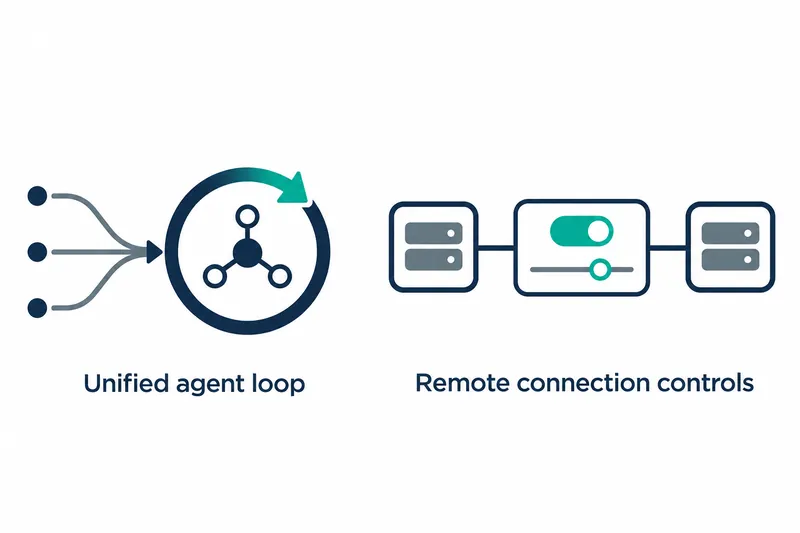
Qwen Code is a development tool that uses agents for project tasks. These changes let developers apply shared execution rules to goals and scheduled tasks, and adjust remote access without restarting the server. In v0.26.7, the shared execution flow requires enabling an experimental setting, while remote access is managed in the server's settings screen.
1. Handle goals and scheduled tasks through the same process
Enabling experimental.unifiedAgentLoop makes goal handling, scheduled execution, and background notifications use a shared agent loop that repeats tasks. Regardless of how a task arrives, the same rules govern iteration, grouped tool handling, and stopping points.
The release notes say ACP, the connection protocol between agents and clients, applies these shared rules to goal handling and scheduled or background notifications. Developers can predict execution using shared rules rather than assessing iteration, tool handling, and stopping rules separately for goals and scheduled or background runs. Nightly integration tests now also run with the unified loop enabled.
2. Adjust remote access without restarting the server
The qwen serve settings screen now includes an option to allow remote connections. Operators can manage remote access, token use, and client disconnections without restarting the server. This reduces the need to restart the server when changing access policies.
Remote access error handling has also changed. Internal error details are now hidden from callers, and the release notes say reviewed reliability and security flaws in this area have also been fixed.
The settings screen path and setting names used in these changes are as follows.
experimental.unifiedAgentLoop
model.catalogRefresh
privacy.usageStatisticsEnabled
Settings → Connections → Allow remote connections
3. Disabling usage statistics also stops automatic catalog refreshes
An operator-scoped model catalog refresh setting has been added. Setting privacy.usageStatisticsEnabled to false stops background catalog refreshes while keeping local metadata, the supplementary information describing models, available.
Operators can stop external refreshes while still using locally stored model information. Background catalog updates stop as well, so choosing a usage statistics setting also involves considering how model information is refreshed.
4. Project-provided code runs only after trust approval
Running repository-provided hooks, grants, and project language servers requires explicit folder trust approval. Hooks are code that runs automatically at specific points, while a project language server is a separate program that assists code editing. This change makes users decide first whether to trust the execution settings included in a project.
In interactive sessions, project hooks configured in .qwen/settings.json also require explicit trust approval for the folder or workspace. Withholding approval triggers a warning. Having project settings and allowing code to run according to those settings are treated as separate steps.
A local Docker workflow has also been added for reviewing untrusted PR code. Code runs in a container while model credentials stay on the host, using a proxy server that relays model requests. Instead of placing credentials directly in the container, this adds steps to prepare the container and the relay path.
5. Reduce execution waits and improve session usability
Performance improvements focus on narrowing the use of shared locks, mechanisms that coordinate concurrent access between tasks and made multiple workspaces wait together. Lock waits were reduced for workspace execution, file rewind, managed-agent session checkout and return, and request intake. The release notes say results and decisions remain unchanged.
Locking was also reduced for everyday session commands such as switching models or canceling tasks.
When the local command-line tool remains unchanged, capability check results are reused to speed up file reads, uploads, and status checks.
Session history displays are also more compact. Large file edit results appear as previews in saved sessions rather than the full contents before and after editing. This reduces the space taken up by long tool outputs in the history view.
Model identification has also been fixed. According to the release notes, OpenRouter's qwen/qwen3-coder:exacto now retains its base model name. The corrected setting is a 262,144-token window, rather than the previously misapplied 200K-token window. This is a configuration correction for the same model identifier, not an improvement in the model's performance.
Table: Context window before and after the model identification fix
Conditions: Comparison of window sizes applied to the same model identifier on OpenRouter
Unit: Tokens
| Model identifier | Before the fix | After the fix |
|---|---|---|
| qwen/qwen3-coder:exacto | 200K | 262,144 |
These token counts reflect model configuration, not speed measurements. The release notes provide no quantitative performance measurements for reduced locking or improved responsiveness.
v0.26.7 organizes agent execution around shared rules and gives operators additional control points for remote access and project code execution.