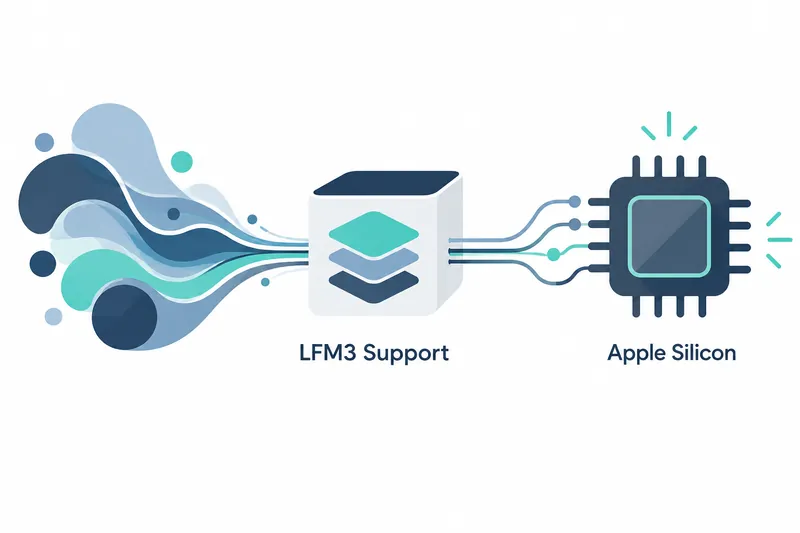
Ollama has released a new version that adds small models for local agents handling multistep tasks and speeds up input processing on Apple silicon. Developers can choose models for text, images, and audio to suit their needs. Some existing models can also process prompts faster, handling the input supplied to the model.
1. Choose text, image, and audio capabilities for the task
The highlight of v0.40.12, released on October 27, 2026, is support for Liquid AI's LFM3. This small model family targets local agents, tool calling, and structured output. It adds options for applications that call tools and receive results in a defined format.
The base text model, lfm3, has 1.7B parameters and a 256K-token context window, the input range it can reference at once. The lfm3-vl model adds image understanding. Developers can choose between focusing on text tasks and interpreting images alongside text.
lfm3-audio handles speech recognition and translation, speech synthesis, and text-to-speech in 18 languages. lfm3-omni handles text, images, and audio in one model. These offer choices for audio-focused tasks and tasks combining multiple input types, respectively.
2. Use decision models for tasks such as classifying billing inquiries
Liquid AI's d1 family now includes a 2B size based on LFM3. It makes decisions about text and images.
The same family's d1-omni also handles audio. As with the models introduced above, which differ by input type, developers can choose a decision model to match the materials they want to process.
The release notes provide an example that supplies a sentence about a duplicate charge and asks whether it is a billing issue. It poses a specific question about the input to obtain a decision, illustrating the model's purpose in a single command.
ollama run d1:2b "I was charged twice for order 4417." --ask "Is this a billing issue?"The example input says an order was charged twice, and the question asks whether this is a billing issue. Developers exploring local inquiry classification can use this question format as a starting point.
3. Existing models also gain faster input processing on Apple silicon
According to the company, prompt processing is faster for Gemma 4 and Flint on Apple silicon. Laguna receives the same improvement. Beyond adding new models, the release refines the stage where existing models receive and process input.
Gemma 4 now preserves more detail in small images. Apart from the new choices for image understanding, this improves how an existing model handles small images.
The MLX inference runtime supports speculative decoding using DFlash2 draft models, auxiliary models that try generation ahead of time. This method helps generation by proposing candidate tokens in advance. Alongside faster prompt processing, model support during inference has also expanded.
4. Weigh broader capabilities against hardware requirements
Developers gain a wider choice of models suited to their tasks, while the hardware needed to run them becomes a cost factor in adoption. Checking the actual deployment environment matters alongside reviewing the feature list.
According to the release notes, lfm3 and d1 2B are supported on Apple hardware in this version, with Linux and Windows support planned for later. The notes provide no figures for prompt-processing gains or measurement conditions.
Consider whether adoption aims to handle new input types or improve input processing in existing models. For the former, review each model's capabilities first; for the latter, check whether the model in use is included in the improvements.
This release's value lies less in the model count itself than in combining task-specific model choices with better input processing for existing models.