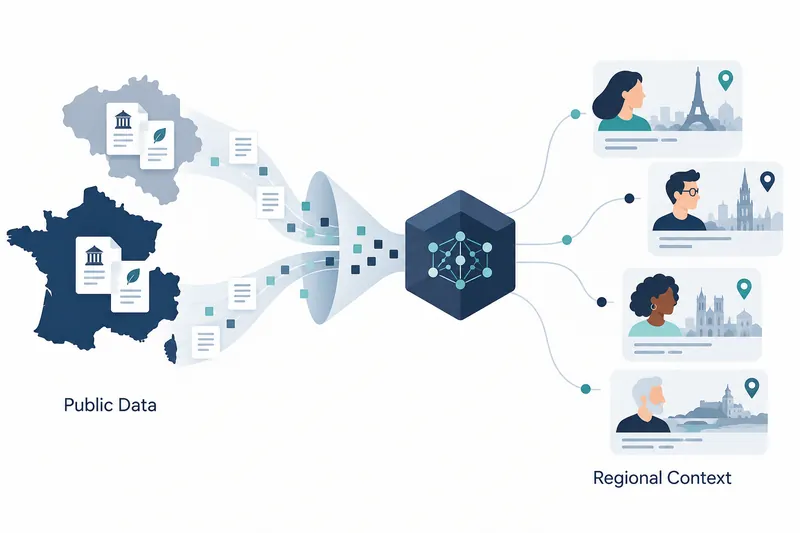
NVIDIA released fictional resident data reflecting French and Belgian demographics and local contexts, plus a workflow for further model training. Local service developers can combine profiles with official procedure documents. The resulting dialogues can tune open models to regional rules and speech styles.
1. Resident personas make regional questions and answers more specific
NVIDIA created Nemotron-Personas-France with French AI startup Pleias and developed the Belgian dataset with Pleias and KU Leuven. It presented both as part of a regional persona data program covering 12 countries.
Personas are fictional residents, not real people. French profiles include demographically aligned ages, municipalities, occupations, and households, along with descriptions of work and daily life. These details can change how users phrase questions and which answers fit their region.
The blog cited passport stamp duty of 43 euros in French Guiana versus 86 euros in mainland France. Linking local population information to dialogue context captures differences in actual procedures, not just language.
Belgian personas span Dutch, French, German, and English. For other regions, the guidance is to reuse the workflow while replacing resident data, behavioral criteria, and reviewers.
2. A workflow from data generation to model comparison
The workflow starts by defining target behavior and evaluation criteria. These cover the audience, tasks, language and tone, official information, safety rules, and answer structure. They serve as a shared contract for generation and review. The tutorial suggests an optional fixed evaluation set of 100~300 human-written questions or de-identified operational patterns. It includes common questions, exceptions, and risky situations.
Next, 2,000 personas are sampled across regions and occupations to generate customer questions and answers. Profiles diversify question wording, while answer facts come from supplied official procedure documents. A separate scoring model checks generated answers, with eight examples reviewed before full generation.
A data audit checks errors and information exposure, filtering out format errors, leftover reasoning text, and possible persona name leaks. The remainder is split 90 to 10, keeping each persona out of either training or validation. This prevents evaluation data from leaking into training.
The example model is Nemotron 3.5 Lightning. LoRA trains only a small set of tuning parameters in an adapter, which is then merged into the original model to serve answers. Finally, identical fixed questions go to the original and tuned models for side-by-side review. NVIDIA recommends direct human evaluation rather than agent-based evaluation.
git clone https://github.com/NVIDIA-NeMo/Nemotron.git
cd Nemotron
git checkout v0.2.0
uv sync --extra data-sdg --extra evaluator
uv run nemotron steps --help
Caveat: the referenced example folder was not in the inspected repository
The blog directs readers to follow the tutorial with the folder `use-case-examples/french-public-service-assistant/`, described as holding example configuration, scripts, sources, and evaluation prompts. When these sources were collected, that folder was not present in the inspected repository tree on main (sha 1c3e781), and it was absent from the `v0.2.0` tag as well.
A fetch of the example's README returned 404: Not Found. The procedure above is therefore the workflow documented in the blog, not a runnable example that was verified here. Anyone reproducing it should first confirm that the folder exists.
3. Changes to examine in example evaluations
According to the company, an example answer to a French passport question from the original model suggested a postal application absent from official documents. The tuned model's example advised requesting a home visit by an official for health-related mobility difficulties and submitting a medical certificate issued less than 3 months earlier. This illustrates a focus on correct application routes rather than fluent wording when evaluating regional adaptation.
The evaluation plan covers six areas: task accuracy, French quality, regional suitability, safety, robustness, and retention of general instruction following. It also checks local phrasing and whether persona information leaks into answers.
Pleias uses persona data, including French and Belgian profiles, for its partner's spinal care assistant Lamina. It turns a small number of real patient cases into training dialogues with varied profiles and tests across patient types.
4. Resource needs and data management trade-offs
The example environment assumes Python 3.11~3.13, a GPU container runtime, and access to the Nemotron repository. Hardware examples use one DGX Station GB300 or one DGX Spark, though other NVIDIA GPU systems can be accommodated. For DGX Spark or hosted APIs, the recommendation is to start with 500~1,000 generated examples.
More consistent regional answers and synthetic dialogues covering rare cases come at a cost: generation and scoring APIs, GPU resources, and human review time. Managing official procedures and behavioral criteria, along with reevaluation, is also part of the workflow. NVIDIA states that persona-based data does not guarantee fairness or adequate representation.
Region-specific post-training uses personas to broaden questions while grounding answers in official procedures and human review.