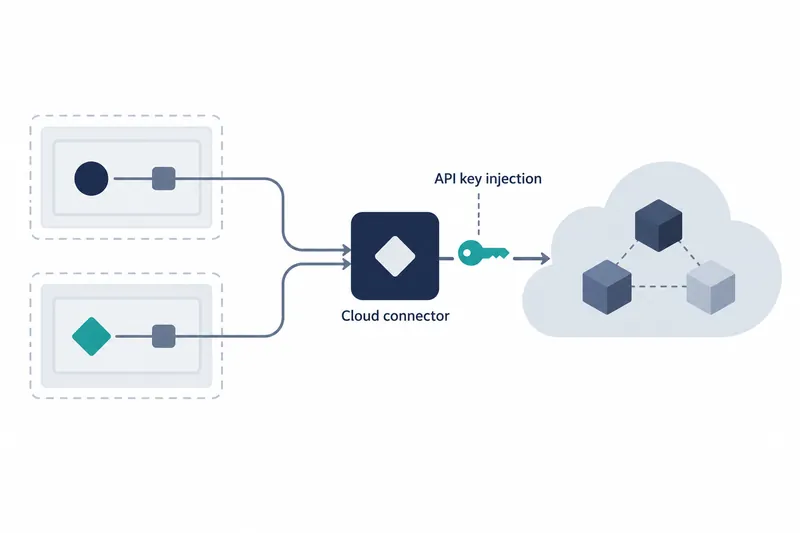
A new connection feature lets agents running in Fly.io's isolated virtual computers use Ollama's cloud models. Developers can grant model access without placing secret keys inside the agents' runtime environments.
1. A connector between the runtime and models
Ollama unveiled a connector for Sprites on October 13, 2026. A Sprite is a Linux virtual machine whose disk persists after a session ends. It is an isolated workspace where agents run commands. The connector links it to cloud models.
Models cited as supported in the announcement include kimi-k3 and glm-5.3. Rather than installing models locally, code inside the virtual machine sends requests to the cloud through a gateway. Ollama's docs also say cloud models need no local GPU.
2. Passing a gateway address instead of a secret key
When a user registers an Ollama API key with a Fly.io organization, the platform encrypts and stores it without returning it via the API. The gateway checks the calling Sprite, then adds the key to its request. The runtime holds only the gateway address and connection ID.
The idea is to let agents use a gateway from an authorized workspace without handing them the key. New connectors deny access to all Sprites by default. Users select targets by label or name prefix, or allow all. Calls work only from inside a Sprite.
Keeping the key out of the runtime reduces paths for leaks through agents, but entrusts key storage and request authentication to Fly.io. Hiding the key does not remove model access. Allowing all opens the connection to every Sprite in the organization.
3. Registering a connection and calling from within
You need an Ollama API key and at least one Sprite. Open Connectors under Sprites in the Fly.io dashboard and add a connector with the key. Select targets in the access settings, save, then run the reachability test beside a target to check the connection.
The connector page shows a command with the connection ID filled in. The following is the exact example from the announcement, to be run inside a Sprite. It has no authentication header because the gateway adds the key.
curl "https://api.sprites.dev/v1/gateway/ollama/<connection_id>/v1/chat/completions" \
  -H "Content-Type: application/json" \
  -d '{"model": "kimi-k3", "messages": [{"role": "user", "content": "Hello!"}]}'
Code using the existing OpenAI SDK can also connect by changing its request destination to the gateway. Ollama's native API paths also support this gateway.
Specifically, set base_url to the gateway address and api_key to any value. This value is not the actual secret key. The gateway handles authentication using the key registered earlier.
A built-in skill for coding agents teaches them to use Ollama. The announcement says authorized Sprites can use models through this skill without further setup. This does not mean connector registration and access authorization can be skipped.
4. Resource costs and operational responsibilities remain
Sprites charges are based on actual CPU time, memory, and storage use. Storage charges may remain even when execution stops and compute charges cease. An idle virtual machine therefore does not mean all costs disappear.
Ollama's announcement links to a pricing page but gives no specific cloud model rates. The connector's benefit is not model call speed or price, but a change in where secret keys reside and how access is controlled.
This connector preserves agents' model access while moving secret key management outside the runtime, while users remain responsible for access scope and resource costs.