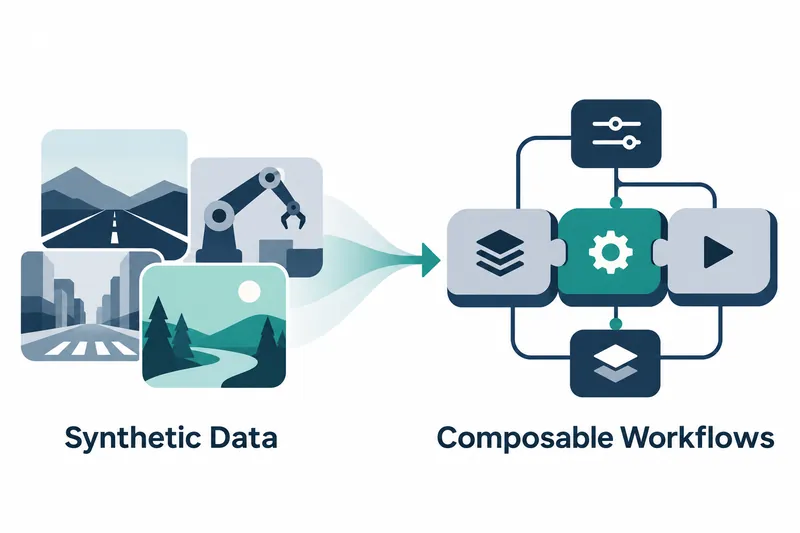
NVIDIA unveiled Cosmos Data Factory, a training data creation tool for autonomous driving, robotics, and inspection AI developers. Coding agents can find scenes in real videos and images, change weather, or synthesize rare accidents and defects.
Data preparation that once linked multiple tools and manual steps can run as predefined workflows or be assembled from individual capabilities. Teams generate hard-to-collect cases on their GPUs in a chosen cloud or in-house environment.
1. Run five data creation workflows directly
The five preconfigured blueprints cover autonomous driving datasets, defect images, event videos, image attribute augmentation, and video data augmentation. Airflow manages execution order and dependencies, deploying services to run on clusters.
The driving workflow finds similar scenes, changes weather or lighting, and checks physical plausibility. Image augmentation changes clothing and colors and adds attributes. Video augmentation preserves scene structure while changing environments. It adds detection, tracking, and descriptions to original and generated videos.
Event video generation creates videos of rare events such as fires or falls from a single image. The defect workflow generates cases from clean inspection images or 3D assets. Outputs may include images, defect-location masks, and generation records.
2. Assemble custom workflows from six capabilities
The six composable capabilities are auto-labeling, defect generation, augmentation, data curation and search, simulation, and orchestration. They handle labeling, defect synthesis, visual changes, retrieval, 3D scene rendering, and service deployment and execution. They can run independently or together.
Cosmos Evaluator checks synthetic videos for requested attributes, object consistency, and physically plausible motion. The event video workflow regenerates failed videos and adds object locations, movement paths, and descriptions to those that pass.
3. Request environment setup, then data tasks
The first request clones the orchestration repository, checks the environment, and sets it up. Preflight checks identify missing requirements without changing the environment. Setup follows a successful check. The repository gives this example request.
Clone the CDF Orchestration repository, then run cdf-orchestration-preflight and cdf-orchestration-setup.The second request describes the data location and desired output in natural language. Ask for nighttime traffic footage to create stopped-vehicle videos, and the agent guides you through search, generation, evaluation, export, and required inputs.
Execution requires a Kubernetes cluster, object storage for inputs and outputs, and a registry for container images containing the runtime environment. An NGC API key and a Hugging Face read token are also needed for model access.
GPU requirements vary by workflow and model placement. The repository lists the following requirements for models deployed inside the cluster.
Generation, language, and vision-language models deployed on your own GPUs, including default Cosmos Evaluator checks
| Workflow | GPU count |
|---|---|
| Autonomous driving dataset generation | 4 |
| Defect image generation | 4 |
| Event video generation | 6 |
| Image attribute augmentation | 2 |
| Video data augmentation | 8 |
Video augmentation requires 5 GPUs in the cluster even when models run on external endpoints. Infrastructure planning must account for model placement as well as the tasks requested of the agent.
4. Company cost claims are compute-only, and the driving figures do not reconcile
NVIDIA measured daily throughput on a cloud server with 8 RTX PRO 6000 Blackwell Series GPUs. It estimated GPU compute costs per output using about $40 per hour, or $960 per day, dividing daily cost by output.
The company reports about 130 autonomous driving clips per day at $2.66 per clip and describes this as about 45x cheaper than the $125 per scenario for direct road collection. Those figures do not reconcile with the source's own stated method of dividing daily cost by output: $960 divided by roughly 130 clips gives about $7.38 per clip, not $2.66. The $2.66 unit cost and the 45x savings comparison are therefore reported here as unreconciled company claims.
The company reports about 42,649 image augmentation pairs daily at $0.023 per pair, about 10x below the $0.25 average for purchased data. Video augmentation produces about 305 roughly 5-minute clips daily at $3.15 each. It describes this as about 7x cheaper than the $22 average it paid for external data. Event video generation produces about 384 clips daily at $2.50 each, based on about 4 minutes per clip.
According to the company, defect image dataset assembly fell from two months to one day, a 60x speedup.
NVIDIA also cited deployments. At offshore oilfields, it said synthetic data raised recall for real anomalies by up to 24%, with an estimated 1,400x return relative to data generation costs. For automated optical inspection of product defects in camera footage, it targets up to 85% less manual inspection-program design work. It also reported a 40% reduction in false defect judgments.
5. Shifting the burden from field collection to compute and review
The benefit is repeatable generation instead of waiting for rare events or recreating dangerous situations. Costs shift from field collection to GPU compute and output review. Quoted prices cover compute only; source preparation, setup, agent use, storage, and human review may cost extra.
Cosmos Data Factory's core value is letting teams run standardized data tasks directly while selecting capabilities to build new workflows.