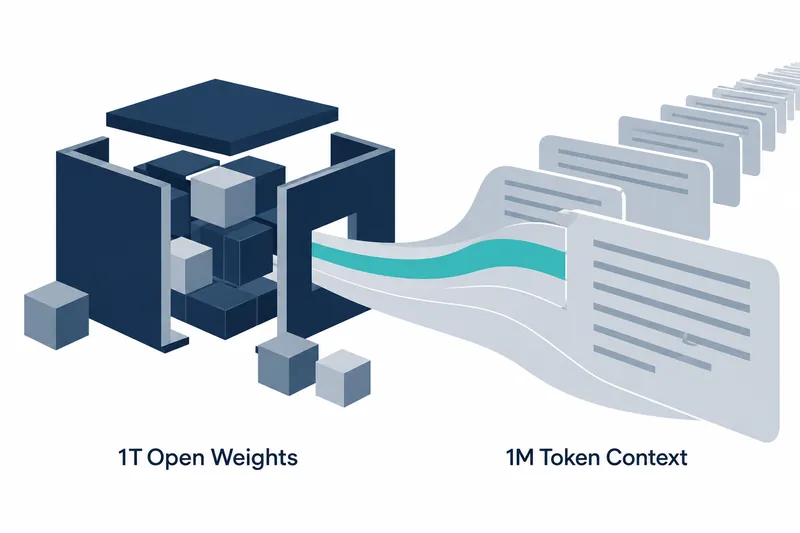
Mistral AI has released improved weights for Mistral Large 4, a large multimodal model that handles multiple input types. Developers can download, customize and self-host it. Hugging Face lists a context of up to 1 million tokens.
1. A model you can own and customize
The model takes text and images as input and generates text. It has about 1 trillion total parameters, with about 49 billion active per token. Official weights come in FP8 and NVFP4, two numerical precision formats.
The language model selects subsets of computational units per token and attends to selected positions among earlier tokens, rather than computing the full model each time. The Pixtral vision encoder converts images into model inputs.
Mistral offers downloads for self-hosting or managed services run by providers. According to Hugging Face, vLLM and llama.cpp support was available on release day, along with further training on an organization's data.
The Mistral Ecosystem Open-Weight license is a modified MIT-style license. General use, modification and commercialization are allowed, but model-as-a-service providers need a separate Mistral license before commercial use.
According to the company announcement, API pricing per 1 million tokens is $0.70 for input, $0.07 for cached input and $2.10 for output.
2. Leading coding scores, according to the company
Mistral says three weeks of reinforcement learning after the public preview improved coding, defensive security and inference efficiency. It scored 19.7% on Cognition's private FrontierCode 2.0 test of repository changes.
Table: FrontierCode 2.0 scores
Conditions: Cognition's private FrontierCode 2.0 benchmark; chart figures from Mistral's announcement
Unit: %
| Model | Score |
|---|---|
| Mistral Large 4 | 19.7 |
| DeepSeek V4.1 Flash | 19.3 |
| GLM-5.3 | 17.8 |
| Kimi K3 | 17.3 |
| GLM-5.3 Flash | 14.2 |
| Beam 1.0 | 2.9 |
The company's scores show narrow gaps among leaders in this private test. On Artificial Analysis's coding agent metric, which tests AI using tools to complete tasks, it reports 48%, effectively tied with GLM-5.3, using 47% fewer average tokens per task. Similar scores with fewer tokens point toward lower coding agent execution demands.
Mistral reports 41% on the terminal-based Terminal-Bench 4.0, up 13 percentage points from preview, with 30% fewer output tokens. Hugging Face separately reports 49.8% on a coding agent metric and 28.3% on a terminal test.
3. Security evaluations and practical uses
Security results also vary by evaluation. Mistral reports 51% on the Artificial Analysis Cyber Index, while Hugging Face reports 82% on vulnerability reproduction and remediation tasks within that index.
The company reports a 96.6% malicious-request refusal rate, averaged across cyber-related requests in JailbreakBench, StrongREJECT and AgentHarm.
Mistral reports an improvement from 93.3% in preview to 97.1% on B3, which tests resistance to attack instructions hidden in requests. Hugging Face reports 93.3% on Lakera's evaluation of the same name.
Hugging Face cites security tools tailored to internal codebases and malware samples, vulnerability reproduction and patching as uses for open weights. Teams can adapt tools to their environment rather than rely solely on external services' response policies.
4. Speed and operating costs depend on hardware
Self-hosting enables control over data and the model, as well as further training, but requires provisioning and maintaining GPUs and an operating environment for a large model.
Hugging Face describes a 2-bit model running on a single Apple Silicon Ultra with 512GB of unified memory. On one M3 Ultra, the low-bit Q2_K format processed about 90 input tokens per second and generated 15 tokens per second.
On four RTX6000 Pro cards tested by Hugging Face, NVFP4 with a 32K context processed 130–590 input tokens per second and generated about 10 tokens per second.
On the same four RTX6000 Pro cards, the roughly 2-bit IQ2_XXS format, configured for an 800K context, processed 500 input tokens per second and generated 30 tokens per second with short inputs. With long inputs, those rates fell to 129 and 3 tokens per second, respectively. Maximum context length and actual response speed are therefore separate operational choices.
The original article provides this llama.cpp server request example:
curl http://localhost:8080/v1/chat/completions \
    -H "Content-Type: application/json" \
    -d '{
        "messages": [
            {"role": "system", "content": "You are a helpful assistant."},
            {"role": "user", "content": "Write a limerick about python exceptions"}
        ]
    }'
The two articles' coding results should be read separately, as matching test settings are unconfirmed. Mistral says it refused real-target attacks in live traffic but is updating safeguards after identifying potential misuse for attacks.
Mistral Large 4 matters not just for its performance claims, but for giving organizations the option to customize and operate a large model themselves.