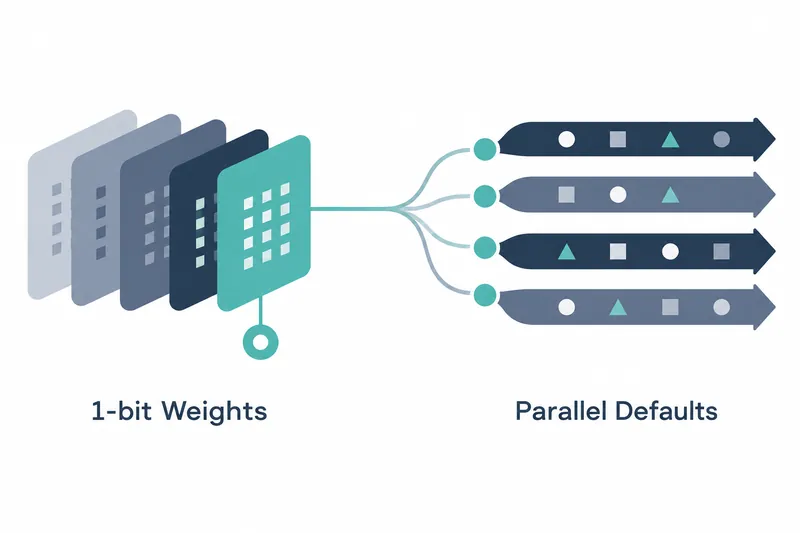
Strata 0.2.9 offers developers running AI models locally two new DeepSeek 1-bit weight options. On some Linux GPUs, settings for faster handling of multiple requests and long prompts, the input text given to a model, now apply by default. This can raise throughput with less manual tuning.
1. 1-bit weights are optional and do not change the default model
Unsloth's UD-IQ1_S and UD-IQ1_M can be selected during installation and in launch commands. Weights are the numerical data used by a model, and their download sizes are 241GB and 258GB, respectively. Having ISTA's Engram files already reduces the download by about 111GB. The existing default model remains unchanged.
According to the developers, each 1-bit set passed 53 of 61 task tests, versus 56 for the existing comparison set. The baseline was ISTA-DAS 2.25, and 35 tasks used documents of 14,000~30,000 tokens. Each set was tested once, with 6 expert modules participating in computation per token. These modules are model components assigned to specific inputs.
By task, the smaller set passed 8 of 8 summarization tests, versus 7 for the existing set. However, it passed 11 of 13 information extraction tests, versus 13 for the existing set. Looking at both the total passes and the intended tasks can therefore help guide the choice.
2. Model speeds must be read alongside GPU configurations
The developers tested the smaller set and the existing comparison set on four Radeon AI PRO R9700 cards. They tested the larger set on two RTX A6000 cards. The hardware used for measurements differed even between the 1-bit options.
According to the developers, UD-IQ1_S generated 48~88 tokens per second on four R9700 cards and processed 4K prompts at 1,204~1,296 tokens per second. UD-IQ1_M generated 41~82 tokens per second on two A6000 cards. These figures came from one run each using the developers' own test documents.
The benefits and costs differ by option. Reusing existing files reduces downloads, but task passes were lower than for the existing comparison set. On two Intel Arc Pro B65 cards, parallel processing raised throughput for 8 concurrent requests from 42.1 to 53.8 tokens per second. However, it slowed single-request generation by 2.7% on the batch server, which processes requests in groups.
3. Linux parallel requests are tuned automatically after users enable them
On Linux with NVIDIA GPUs, setting concurrent requests to 2 or more makes the server automatically apply 9 parallel processing settings. User-specified environment variables and settings take precedence, allowing existing tuning to coexist with the new default behavior.
According to the developers, Qwen3.8 IQ3_S on one RTX PRO 5000 ran 1.45x faster than the previous version with 8 concurrent requests, each using a 1,000-token prompt and 128-token output. The previous version was 0.2.8. Speed ratios across three paired comparisons under matched conditions were 1.451~1.459.
In the same test, single requests were also 5.3% faster. Answers to 12 prompts, checked by selecting the most likely output, matched the previous version. The results thus covered users making one request at a time as well as servers handling multiple requests.
4. Prompt processing is also faster by default on supported cards
On Linux with NVIDIA GPUs, Qwen3.8 handles prompt computation using GPU matrix units that calculate many values at once. The developers report gains of 4.4% for 4K prompts and 5.5~5.7% for long prompts on the RTX PRO 5000. On the RTX A4000, 16K prompts were 2.6% faster and 32K prompts were 3.2% faster.
On Linux configurations where all Radeon cards belong to the gfx12 family, a split-processing kernel is used starting at 64 tokens. A kernel is a program that performs GPU computations. The developers reported the following gains by prompt length, while generation speed was unchanged.
Table: Prompt processing gains on Linux gfx12 Radeon GPUs
Conditions: Linux, all Radeon cards in the gfx12 family, split-processing kernel applied starting at 64 tokens
Unit: %
| Prompt length | Speed improvement |
|---|---|
| 4K | 3.5 |
| 16K | 4.7 |
| 32K | 6.1 |
The same announcement reported gains of 1.7~3.2% for 1K~3K prompts. This change mainly affects the stage that reads input documents rather than answer generation itself.
5. Multi-AMD GPU use changes from the next launch
When running DeepSeek with multiple AMD cards on Linux, the engine uses supported cards unless a specific card is selected. Configurations that saved a single card during installation also use multiple cards from the next launch, without rebuilding. To use just one card, specify it with the following command from the source; the selection is saved.
strata launch --gpu NIn the developers' four-R9700 test, expert modules loaded onto GPUs increased from 2,371 of 15,360 to 12,147. Modules participating per token also changed from 6 to the 5 chosen by the launcher. Sharing memory across cards was thus reflected in the execution configuration as well.
DeepSeek can produce different answers on repeated runs even at temperature 0. In tests that disabled the expert cache, which temporarily stores modules for reuse to reduce this variation, generation slowed by 8~10% on four R9700 cards and 58% on one card.
Strata 0.2.9 expands model and processing options, but adoption should reflect task-specific quality and actual GPU and concurrent-request conditions.