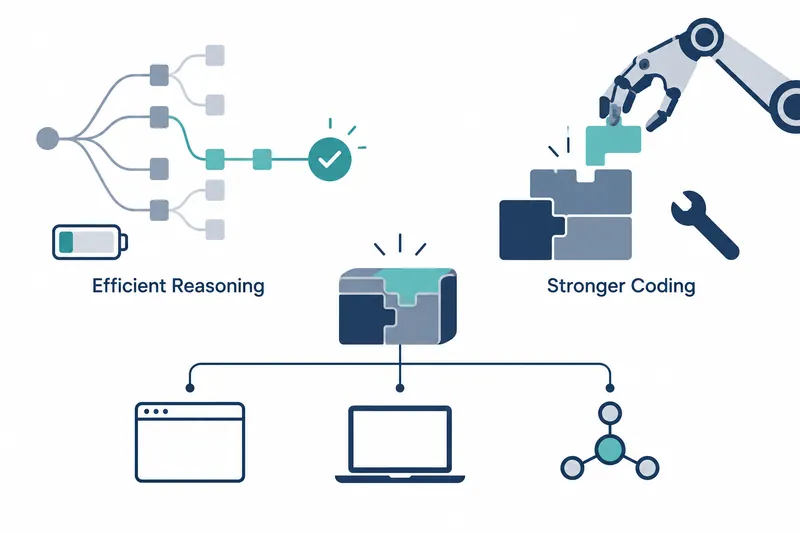
MiniMax unveiled M3.1 Flash on October 19, 2026. The company highlighted agent tasks involving multistep tool use, coding and computer operation. The announcement centers on benchmark results and lower task costs than its predecessor, with measurement conditions differing by score.
1. Workflow automation and coding results
M3.1 Flash scored 76.2 on BankerToolBench. The company described strengths in multistep planning, consistency across documents and files, financial compliance and successive tool calls. Opus 5 also scored 76.2 in the company’s comparison table.
It scored 73.7% on DeepSWE v1.1. This benchmark covers complex software tasks involving code comprehension, feature development, bug fixes and verification through tests. The company’s table lists Opus 5 at 74.0% and GPT-5.6 Sol at 73.0%.
These figures come from comparison tables supplied by MiniMax. Listing evaluation tools and conditions does not mean every comparison result was independently reproduced under identical conditions.
2. Execution tools and context limits
BankerToolBench used OpenCode 1.17.18 and MiniMax-M2.7 as the judge model. OpenCode runs the evaluation, while MiniMax-M2.7 scores the results. This distinction forms part of the score’s measurement conditions.
DeepSWE v1.1 was evaluated using mini-SWE-agent 2.4.5 with a maximum context of 512K tokens. Context covers the input and work history available to the model during processing. Tokens are units used to process text and other data; context size does not indicate processing speed.
The API documentation lists a 1M-token context window for M3.1 Flash. The product’s maximum supported context is distinct from the 512K limit used in the DeepSWE evaluation. The documentation also describes it as a multimodal coding model with adjustable reasoning depth.
3. Different criteria for computer-use evaluations
The company reported 61.7 on OSWorld 2.0, which evaluates computer operation and tasks spanning multiple apps. The table notes specify the officially recommended 0808 Full version. Each model’s score is its highest reported at launch, except DS-V4.1, which uses the company’s internal reproduction.
It scored 29.6 on Agents’ Last Exam (ALE), which evaluates real professional work and complex tasks. The ALE table includes only full evaluation-set results from the official leaderboard under the official Overall setting. This condition avoids direct comparisons with scores from task subsets or other evaluation methods.
Blank ALE entries include models without official evaluations or with only CLI evaluation results; they do not mean zero scores. OSWorld’s highest-reported-score selection rule does not apply to ALE. The company said it ranked first among Chinese models on both benchmarks.
4. Token pricing versus total task costs
The company lists prices per million tokens at USD 0.15 for input, USD 0.60 for output and USD 0.015 for cached input. Cached input pricing applies when stored input is reused. These are rates applied to token usage, not fixed prices per task.
The 70% reduction is the company’s reported difference in total agent task costs versus its predecessor. It is neither independently verified savings nor a uniform reduction across all token rates. Estimating actual costs therefore involves both unit rates and each task’s input, output and cache usage.
According to the launch announcement, M3.1 Flash is available through MiniMax API, M Plan and MiniMax Code, with model weights planned for later release. The reported scores and prices inform adoption decisions but do not guarantee the same savings for a particular workflow.
M3.1 Flash’s adoption value can be assessed by interpreting performance under the disclosed evaluation conditions and comparing both completion quality and total costs in real workflows.